Do Quantum Kernel Methods Really Have an Advantage on Breast Cancer Data? Three Benchmarks Say No

Systematic benchmarks show quantum kernel methods do not outperform classical methods on breast cancer data; comparison choice and selection history matter more.
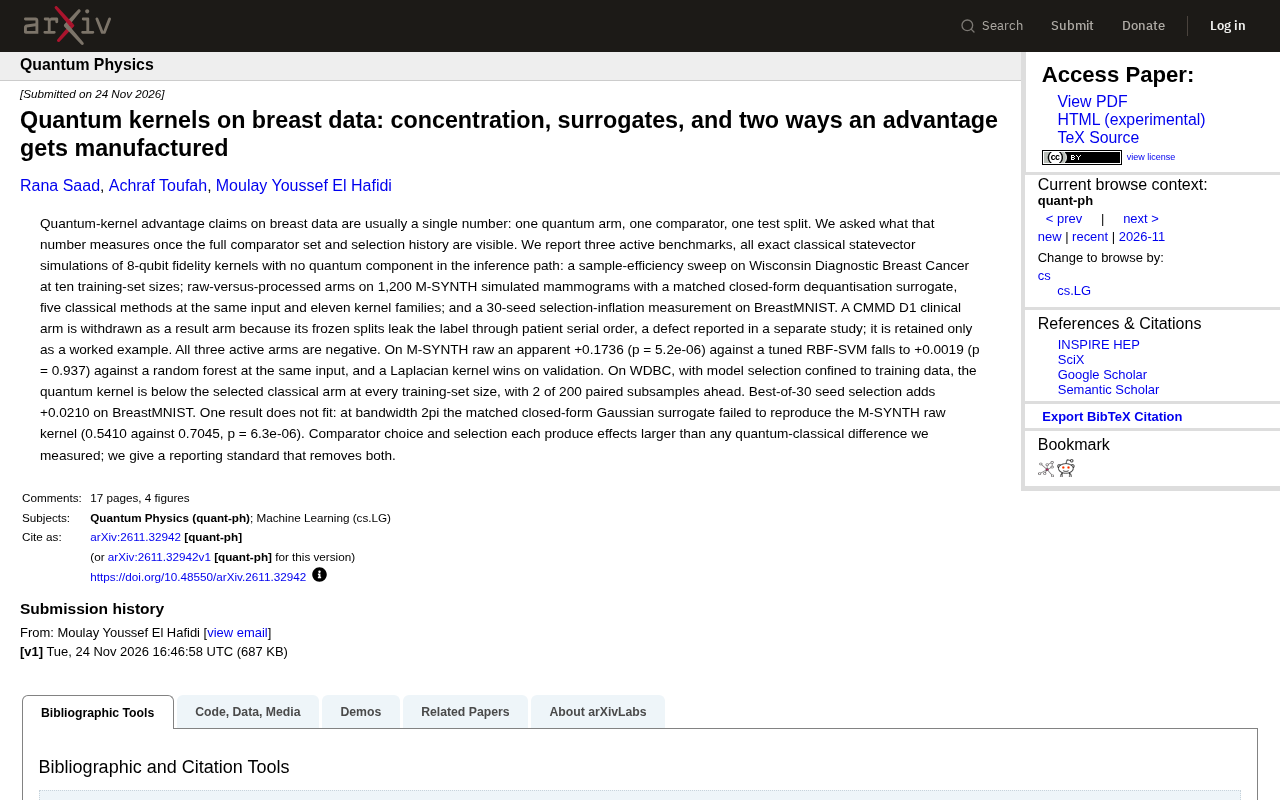
A systematic study evaluated quantum kernel methods on breast cancer data via three active benchmarks (WDBC sample efficiency sweep, M-SYNTH raw vs. processed input comparison, BreastMNIST selection inflation measurement). All used exact classical simulation of 8-qubit fidelity kernels, and results were consistently negative: quantum kernels showed no substantive advantage. On M-SYNTH, the apparent advantage over tuned RBF-SVM (+0.1736) dropped to +0.0019 (non-significant) with a random forest baseline. Best-of-30 seed selection alone yielded +0.0210, exceeding any quantum-classical difference. The CMMD D1 arm was withdrawn due to label leakage. Core conclusion: comparison choice and selection history outweigh quantum-classical differences; authors propose strict reporting standards.
Introduction: The Trap Behind a Single Number
Claims that "quantum kernel methods outperform classical models on breast cancer datasets" appear frequently in the quantum machine learning field. However, such conclusions often rely on a single number: one quantum model, one comparison baseline, one test set split. When the full comparison set and selection history are brought into view, what exactly does that number measure? A systematic study provides a sobering answer.
The study designed three active benchmarks, all using exact classical state-vector simulation of 8-qubit fidelity kernels, with no quantum components in the inference path. The results are consistently negative: under controlled conditions, quantum kernel methods do not demonstrate a substantive advantage over classical methods.
Design and Results of the Three Benchmarks
Sample Efficiency Sweep: WDBC Dataset
The first benchmark performs a sample efficiency sweep on the Wisconsin Diagnostic Breast Cancer (WDBC) dataset, covering ten training set sizes. The key design is that model selection is strictly confined to training data. Results show that at all training set sizes, the quantum kernel method underperforms the selected classical baseline. Among 200 paired subsamples, only 2 favor the quantum kernel method. This result directly challenges the common narrative that "quantum kernels have an advantage in small-sample regimes."
Quantum Kernel Method is a class of machine learning algorithms based on inner products of quantum states. The core idea is to encode classical data into quantum state space, use quantum circuits to compute inner products between data points (i.e., kernel function values), and then embed them into classical kernel methods (such as support vector machines) for classification. Theoretically, quantum kernels can map to high-dimensional Hilbert spaces that are difficult for classical computers to simulate efficiently, potentially offering advantages on certain tasks. However, actual advantage depends on the specific dataset, encoding method, and comparison baseline. The experiments in this article use exact classical state-vector simulation of 8-qubit fidelity kernels without real quantum hardware, so the results reflect the performance of the quantum kernel mathematical model, not the actual performance of quantum hardware.
Raw vs. Processed Input Comparison: M-SYNTH Simulated Mammograms
The second benchmark uses 1,200 M-SYNTH simulated mammograms to compare performance on raw versus processed inputs. The study matched closed-form dequantisation surrogate models and simultaneously compared five classical methods and eleven kernel families.
A seemingly significant result emerged: on raw M-SYNTH data, the quantum kernel showed a +0.1736 advantage over a tuned RBF-SVM (p = 5.2e-06). However, when the comparison baseline was switched to a random forest on the same inputs, this advantage dropped sharply to +0.0019 (p = 0.937), completely losing statistical significance. More interestingly, the Laplacian kernel performed best on the validation set. This shows that the so-called quantum advantage is highly dependent on the choice of comparison baseline.
Dequantisation is a theoretical tool for assessing whether a quantum machine learning algorithm can be efficiently simulated by a classical algorithm. If a quantum algorithm has a polynomial-time classical equivalent (i.e., "dequantises" to a classical algorithm), then its quantum advantage does not hold. In kernel methods, common dequantisation models include approximations based on random features or Gaussian process equivalence. In this article, researchers constructed a closed-form Gaussian surrogate model matched to the quantum kernel and found that it failed to reproduce the quantum kernel's behavior at bandwidth 2π, suggesting that the quantum kernel may have certain properties that classical surrogates cannot capture—but this does not automatically prove quantum advantage and requires further elimination of other explanations.
Selection Inflation Measurement: BreastMNIST
The third benchmark measures selection inflation effects across 30 random seeds on BreastMNIST. Results show that best-of-30 seed selection alone yields a +0.0210 performance improvement. This value itself is larger than any quantum-classical difference measured in the study, revealing a common source of evaluation bias in the literature.
Selection inflation refers to the phenomenon where performance estimates are inflated by trying many options (such as different random seeds, hyperparameters, or feature selections) during model development and reporting the best result. This bias is particularly severe when the test set is used to guide selection. This article quantifies selection inflation through experiments with 30 random seeds: selecting the best seed alone yields a +0.0210 accuracy improvement, which is larger than any measured quantum-classical difference. Therefore, when comparing quantum and classical methods, selection history must be controlled; otherwise, the so-called "advantage" may simply be an artifact of selection bias.
One Result That Could Not Be Fitted
The study had one result that theoretical models could not explain: at bandwidth 2π, the matched closed-form Gaussian surrogate model failed to reproduce the behavior of the M-SYNTH raw kernel (0.5410 vs. 0.7045, p = 6.3e-06). This anomaly suggests that certain behaviors of quantum kernels may not be fully captured by existing classical surrogate models and warrant further investigation. But the authors carefully note that this does not constitute evidence of quantum advantage.
A Cautionary Tale from Clinical Data: Withdrawal of the CMMD D1 Arm
The study originally included a CMMD D1 clinical data arm, but this arm was withdrawn from result reporting. The reason is that its frozen data split leaked label information through patient sequence order—a flaw already reported in another independent study. The arm is retained only as a worked example. This reminds us that data leakage issues in medical imaging benchmarks may be more widespread than previously thought.
Data leakage refers to the accidental use of information that should only be used for testing during model training, leading to overly optimistic evaluation results. In medical imaging data, common forms of leakage include patient-level information mixing (images from the same patient appearing in both training and test sets), preprocessing steps applied globally before data splitting, and data splits that do not account for temporal or sequence order. In this article, the CMMD D1 arm was withdrawn because its frozen data split leaked label information through patient sequence order, highlighting that when constructing medical imaging benchmarks, data must be strictly split by patient and potential leakage channels in data collection and preprocessing pipelines must be audited.
Key Insight: The Impact of Comparison Choice and Selection History Exceeds Quantum-Classical Differences
Perhaps the most important finding of the study is that the impacts of comparison baseline choice and selection history each exceed any measured quantum-classical difference. This means that many "quantum advantages" reported in the literature may simply be artifacts of comparison choice or selection inflation.
Based on this, the authors propose a set of reporting standards aimed at eliminating these two sources of bias. These standards require: explicitly reporting the complete set of comparison baselines, restricting model selection to training data, and disclosing selection history. For the quantum machine learning field, this is undoubtedly a necessary wake-up call.
Conclusion
The negative results from three active benchmarks, the enormous impact of comparison baseline choice, and the quantitative evidence of selection inflation all point to one conclusion: claims of quantum kernel method advantages on breast cancer data require a more rigorous evaluation framework. The reporting standards provided by this study establish a more credible basis for comparison in future quantum machine learning research.
One-line Summary
Systematic benchmarks show that quantum kernel methods do not outperform classical methods on breast cancer data, with comparison choice and selection history having larger impacts.
Paragraph Summary
A systematic study evaluated quantum kernel methods on breast cancer data through three active benchmarks (WDBC sample efficiency sweep, M-SYNTH raw vs. processed input comparison, BreastMNIST selection inflation measurement). All benchmarks used exact classical simulation of 8-qubit fidelity kernels, and results were consistently negative: quantum kernels showed no substantive advantage over classical methods. On M-SYNTH, the apparent advantage of the quantum kernel over a tuned RBF-SVM (+0.1736) dropped to +0.0019 and became non-significant when switching to a random forest baseline. The +0.0210 improvement from best-of-30 seed selection exceeded any quantum-classical difference. The study also found that the CMMD D1 clinical arm was withdrawn due to label leakage. The core conclusion is that the impacts of comparison baseline choice and selection history exceed quantum-classical differences, leading the authors to propose strict reporting standards.
Related articles

Anthropic Denies Claude Was Trained to Sabotage Work: The Controversy Exposes an AI Trust Crisis
Anthropic denies claims that Claude was trained to sabotage work but gives no specifics. This article examines the AI trust issue and the need for vendor transparency.

Gmail 'Send as' to Be Discontinued in 2027: Email Workflows Face Restructuring
Gmail's 'Send as' feature will be discontinued in January 2027, sparking Hacker News discussion. This article explains the feature's role, three affected user scenarios, and a practical preparation checklist for migrating custom sending addresses and reconfiguring domain authentication.

Character.ai Bankruptcy Auction: 21 Million Users' Private Conversations Up for Auction
Character.ai bankruptcy proceedings are auctioning 21 million users' private conversation records, triggering widespread concerns in the Hacker News community about data governance and user privacy in AI companionship products. This article analyzes the legal gray zone of data assets in bankruptcy liquidation, flaws in user agreements, and the AI industry's trust crisis.