Do You Say 'Please' and 'Thank You' to Claude? The Hidden Effects of Polite Language

Does saying 'please' to AI protect your communication habits — or is it just unnecessary etiquette?
A Reddit discussion raises a question worth taking seriously: does issuing constant commands to AI quietly change how we communicate with real people? Drawing on the psychological concept of the spillover effect, the article argues that behavioral patterns reinforced in one context can migrate to others — giving heavy AI users legitimate reason for concern. Users split into an efficiency camp (AI is a tool, no pleasantries needed) and a habit camp (politeness is long-term self-training). Technically, polite language has minimal impact on AI output quality — prompt clarity matters far more. The deeper takeaway: we shape our tools, and our tools shape us back.
A Seemingly Trivial Question Worth Thinking About
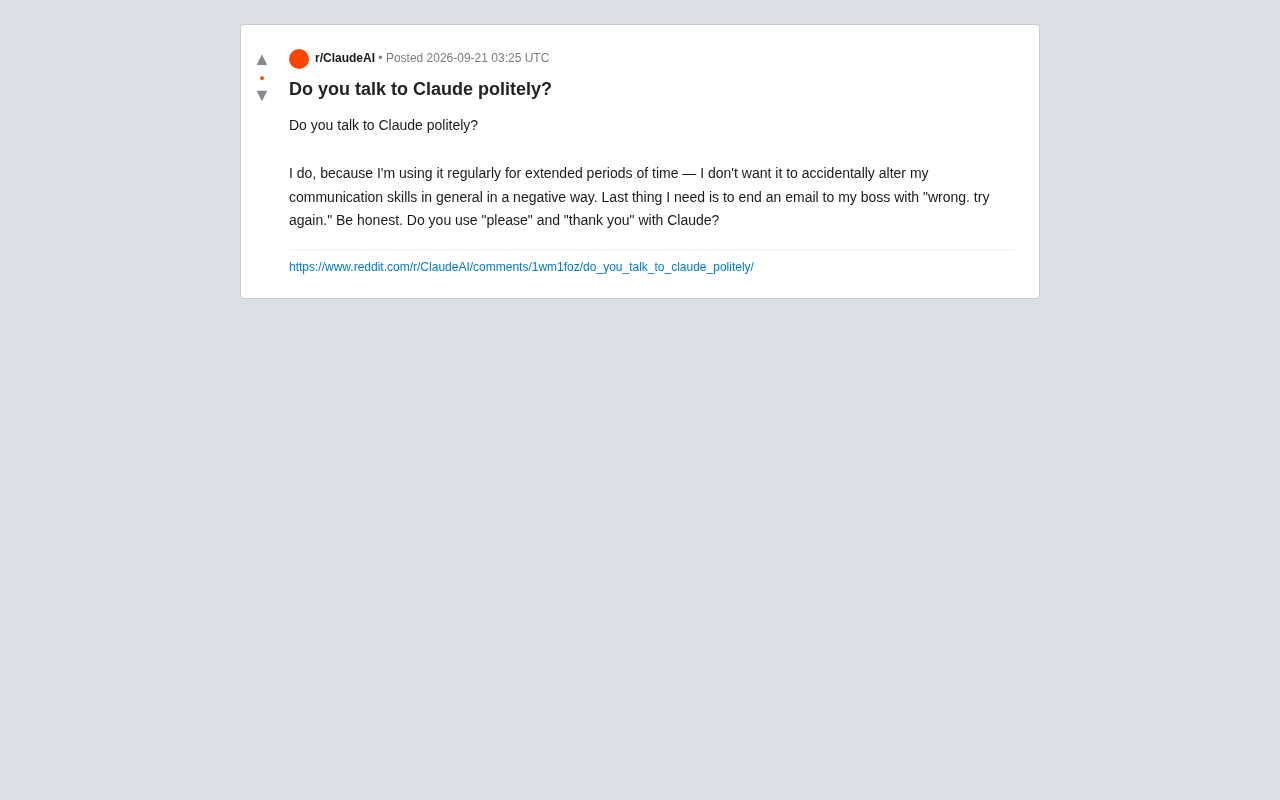
A Reddit user recently sparked a lively discussion with a deceptively simple question: do you use polite language when talking to Claude? The reasoning behind the question was interesting — this person uses AI for extended periods every day and worries that getting used to barking orders at an AI might gradually change how they communicate in real life.
They offered a vivid example of the worst-case scenario: one day, you're wrapping up an email to your boss and suddenly sign off with "wrong. try again." — a command-style phrase imported straight from your AI sessions.
On the surface, this is a question about manners. But it actually touches on something increasingly relevant in human-AI interaction: as our daily habits become intertwined with AI, can these interaction patterns start reshaping how we communicate with actual people?
The Psychology Behind Polite Language
Being polite to an AI isn't really about making the machine feel respected — Claude doesn't feel honored when you say "thank you." The real value lies in maintaining consistency in your own communication habits.
Human language expression relies heavily on muscle memory and ingrained mental patterns. If someone spends hours each day issuing short, directive commands to an AI ("summarize this," "rewrite it," "wrong"), those expression patterns can potentially bleed into other contexts. Psychologists call this the spillover effect — behavioral patterns repeatedly reinforced in one context tend to migrate into adjacent ones.
The Reddit user's concern isn't unfounded. For knowledge workers who use AI tools heavily, human-AI conversations may already account for a significant share of their daily communication. When that share grows large enough, its influence on overall language habits can't be dismissed.
The Efficiency Camp vs. The Habit Camp
Discussions around this topic typically split into two camps.
The efficiency camp sees AI as a tool, and tools don't need pleasantries. Dropping "please" and "thank you" keeps instructions leaner, makes interactions feel faster, and avoids cluttering prompts with meaningless filler. For them, treating AI like a person is actually a cognitive overhead.
The habit camp (like the original poster) prioritizes long-term impact, viewing politeness as a form of self-training — a way to maintain appropriate expression across all communication contexts. This group tends to be heavy users who have deeply integrated AI into their workflows.
The behavioral spillover effect has fairly solid empirical backing in psychology research. Classic studies found that repeatedly practicing a behavioral pattern in one context (such as aggressive language or terse commands) lowers the threshold for that pattern to be triggered in other contexts — closely tied to the neural mechanics of habit formation: the brain strengthens synaptic connections through repetition, making specific stimulus-response loops increasingly automatic. Notably, spillover effects don't require conscious "transfer" of behavior; it's precisely the unconscious transfers that are hardest to notice and correct. This explains why heavy AI users may find their communication style has quietly shifted before they've even registered the change. That said, the strength of the spillover effect is shaped by individual differences, contextual similarity, and behavioral frequency — not everyone will be affected to the same degree.
Does Polite Language Affect the Quality of AI Responses?
Beyond the impact on humans, another commonly debated angle is: does using polite language actually affect the quality of Claude's output?
Technically, large language models are trained on vast amounts of human-generated text. In that text, polite, clear, and well-structured requests tend to be associated with more thoughtful, detailed responses. So in some cases, well-worded prompts may nudge the model toward a slightly different style of answer. But this effect is generally quite weak — far less important than the clarity and completeness of the prompt itself.
In other words, rather than agonizing over whether to say "please," it's better to focus energy on describing your needs clearly. A polite but vague request will consistently underperform a direct but precise one.
A large language model's responsiveness to prompt style stems from the statistical patterns in its training data. In human internet text, polite and formal request contexts (such as academic Q&A or professional forums) tend to be accompanied by more detailed, well-structured answers; terse, command-style expressions appear more often in informal, lower-quality interactions. Models learning these patterns may have internalized an implicit association between "polite request → detailed response." However, this effect has been substantially reduced in modern models trained with alignment techniques like RLHF — models are explicitly optimized to provide high-quality responses to reasonable requests regardless of phrasing, rather than treating users differently based on how politely they ask. So rather than saying polite language directly improves response quality, it's more accurate to say that the information density embedded in your phrasing — whether you've clearly stated the task context, desired output format, target audience, and so on — is the real variable driving output quality.
My Take: This Is About More Than Manners
This seemingly lighthearted Reddit thread actually reflects a deeper question for the AI era: as human-AI interaction becomes increasingly frequent, how do we manage the ways it shapes our own behavior?
Whether you're in the efficiency camp or the habit camp, a few things are worth considering:
- If you're a heavy AI user, pay attention to whether your communication habits have shifted — especially when talking to real people.
- Whether to be polite is a personal choice, but maintaining stylistic flexibility matters — knowing what tone to use in what context.
- Don't feel embarrassed about saying "thank you" to an AI, but don't force yourself to be overly courteous either. The key is being comfortable without letting it affect your real-world social interactions.
The original poster's core insight is genuinely valuable: we shape our tools, and our tools quietly shape us. Now that AI has become a daily companion, occasionally stepping back to examine this two-way influence may matter more than debating whether to say "please."
Closing Thoughts
There's no right answer to whether you should say "please" and "thank you" to Claude. But the question is a useful reminder that human-AI interaction isn't a one-way street of commands and outputs — it's quietly participating in the formation of our everyday habits. Next time you open an AI chat window, it might be worth asking: given how many times a day you repeat this interaction, what kind of communicator is it training you to become?
Related articles

OpenAI Partners with Shield: How the Astra Agent Revolutionizes IT Troubleshooting
OpenAI and Shield launch the Astra agent, which autonomously logs into computers and legacy systems to fix IT issues in real time, 35-40% faster than traditional models, with humans involved only when judgment is needed.

iPhone Duo Battery Life Tested: One Charge a Day Is Unavoidable, and the Large Screen Is the Culprit
iPhone Duo battery test: heavy use needs at least one charge a day, and about 30% remains after 6.5 hours of screen-on time. How often the large screen is unfolded is key; a MagSafe battery pack helps, and long-term degradation is also worth watching.

Kimi K3.1 Pro Open-Sourced: 2.8 Trillion Parameters Close In on Opus
Moonshot releases the open-source MoE model Kimi K3.1 Pro, with 2.8T total parameters and 104B activated, trailing Opus 5.5 by under 1 point on Terminal Bench 4.0.