Documentary 'You Can See Everything': Why Elizabeth Holmes Is Back in the Spotlight

Documentary 'You Can See Everything' scores the second-biggest documentary opening weekend, with the Holmes story still drawing strong interest.
A new documentary about Elizabeth Holmes and Theranos, 'You Can See Everything,' has become the second-highest opening weekend in documentary film history, sparking widespread attention. The article argues the buzz stems from the core tension of the Holmes case: a company claiming to complete hundreds of tests with a small blood sample once enjoyed capital and media backing, only to be proven that its technology didn't hold up—the gap between the ideal narrative and business reality creates lasting appeal. The documentary format offers a perspective on people and environments different from news reporting, linking the individual case to broader tech industry issues. The report provides no specific box office figures, so interpretations should remain cautious.
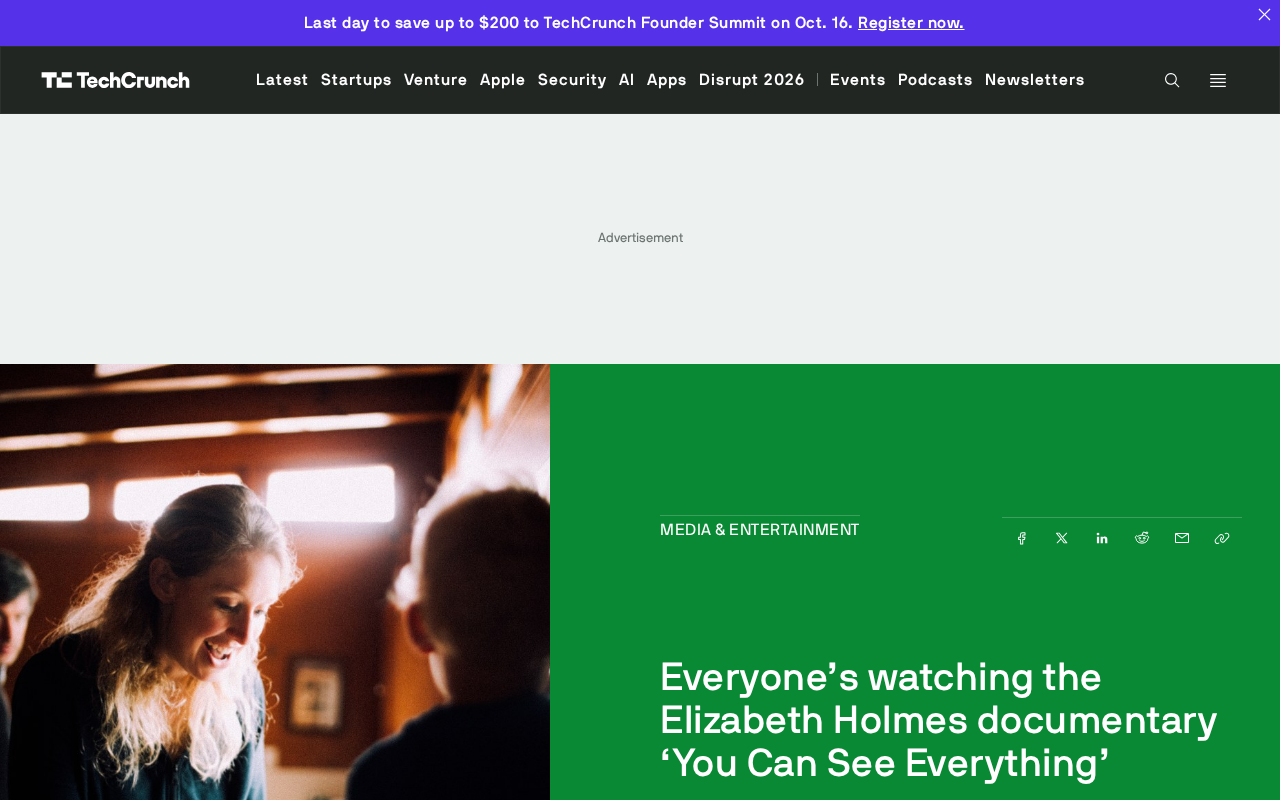
Elizabeth Holmes' name has once again landed at the center of public attention—though this time it's not a courtroom story, but a documentary. According to reports from RSS sources, the documentary You Can See Everything is drawing massive viewership, becoming the second-highest opening weekend in documentary film history.
Where Does the Buzz for a Documentary Come From
What makes the opening performance of You Can See Everything noteworthy is that it tackles a story that has already been told many times over. The collapse of Theranos, Holmes' trial, and the reckoning with Silicon Valley startup culture have all appeared in news coverage, podcasts, and film and television productions. The fact that a new documentary can still draw large audiences into theaters shows that public interest in this story has not faded.
The report's assessment is direct: this is the second-biggest opening weekend for a documentary film. Such results are uncommon for the documentary genre. Documentaries typically rely on word of mouth and long-run screenings to build an audience, and generating buzz right at opening usually means the subject matter carries its own draw—or that the distributor did effective work on the promotional side.
Why This Story Still Has Appeal
The core tension in the Holmes case lies in the gap between the ideal narrative and business reality. A company that claimed to complete hundreds of tests with a small amount of blood once enjoyed the dual backing of capital and media, only to be proven that its technology didn't hold up. This contrast itself constitutes narrative material.
The documentary format also offers a perspective different from news reporting. News focuses on facts and accountability, while documentaries are better suited to portraying a person's state, the atmosphere of the environment, and the decision-making process. For viewers, this means that even if they already know the broad strokes of the events, they may still gain new angles of understanding from the footage.
From a communication standpoint, this subject has another characteristic: it connects to widespread issues in the tech industry. Exaggerated claims by startups, investors' failure to conduct due diligence, and the media's hype of celebrity founders—these problems are not limited to a single company. The documentary magnifies an individual case, and what the audience sees is a whole system.
To understand why the Holmes case continues to carry narrative tension, one must return to the technological claims of Theranos itself. The company's purported "Edison" device could complete hundreds of tests—from routine biochemistry to complex immunoassays—using a tiny finger-prick blood sample, whereas traditional lab testing typically requires a full vial of venous blood and relies on multiple large instruments. The smaller the blood sample, the higher the demands on sensor sensitivity and interference resistance; at the same time, different tests vary greatly in their requirements for sample handling, reagents, and reaction conditions, making it extremely difficult in engineering terms to compress hundreds of tests into a single small device. It is precisely this enormous gulf between the technological promise and actual feasibility that formed the factual basis for subsequent investigative reporting, regulatory intervention, and criminal trials—and explains why the story is still retold years later.
Signals from the Documentary Market
The opening performance of You Can See Everything can also be viewed within the documentary distribution landscape. Streaming platforms have increased their investment in documentaries in recent years, while theatrical documentaries rely more on topicality to attract audiences. When a subject can generate opening buzz, it usually indicates an ability to reach beyond the core documentary audience.
The report does not provide specific box office figures or the scale of the release, so interpretations of the results should remain cautious. What can be confirmed is that the documentary has already sparked discussion among viewers, and that discussion itself will further drive viewership.
"Opening weekend" is a core metric for measuring a film's market performance during its premiere phase, typically referring to box office revenue or admissions during the first weekend of official release (usually Friday through Sunday). For documentaries, the meaning of this metric differs from that of commercial blockbusters: documentary audiences are more dispersed, and box office often depends on word-of-mouth spread and long-run screenings. Therefore, a standout opening usually means the subject matter has news value or cultural topicality and can gather non-core documentary viewers in the short term. For this reason, when comparing the opening results of different documentaries, one must consider the number of theaters, distribution strategy, and statistical methodology—looking at rankings alone can easily overestimate or underestimate actual impact.
Conclusion
The Holmes story's renewed attention in the documentary space shows that public reflection on the myth of tech startups is still ongoing. The opening performance of You Can See Everything is a market signal worth noting, but what new content it offers narratively still needs to be tested by audiences and critics.
One-line Summary
The documentary You Can See Everything achieves the second-biggest documentary opening weekend, showing Holmes story's enduring appeal.
Paragraph Summary
A new documentary about Elizabeth Holmes and Theranos, You Can See Everything, has become the second-highest opening weekend in documentary film history, drawing widespread attention. The article argues that this buzz stems from the core tension of the Holmes case: a company claiming to complete hundreds of tests with a small amount of blood once enjoyed capital and media backing, only to be proven that its technology didn't hold up—and the gap between the ideal narrative and business reality creates lasting appeal. The documentary format also offers a perspective on a person's state and environment different from news reporting, and connects the individual case to widespread tech industry issues such as startup exaggeration, absent due diligence, and media hype of celebrity founders. The report does not provide specific box office figures, so interpretations of the results should remain cautious.
Related articles

Gemini 4 Argon Hands-On: AI Builds Board Games, Constructs Temples, and Trains Robots Autonomously
Gemini 4 Argon hands-on roundup: AI autonomously builds a desk racetrack and temple in Blender, writes a ray tracing engine, trains a humanoid robot to sink 7 shots, plus API pricing and developer access.

The Magic Octagonal Coin: Why Only 9% of People Can Predict Its Flip?
Only 9% of people can correctly predict the Magic Octagon coin flip. This article explains its spatial rotation mechanism, common cognitive pitfalls, and a new hypothesis based on Relevance Theory, exploring the limits of human spatial reasoning.

Sam Altman: AI Is Entering the Era of Scientific Discovery — Math Breakthroughs Will Replicate in Biology and Energy
Sam Altman says AI is entering the era of scientific discovery — math breakthroughs will replicate in biology, materials science, and energy to help develop new drugs and energy sources.