Does Having Employees Advocate for AI Products Work? Google Gemini's Trust Crisis

Reddit debates whether Google employees advocating for Gemini helps or hurts trust in the AI product.
A Google employee's frequent social media advocacy for Gemini sparked heated Reddit debate about the credibility of employee endorsements in AI. While users acknowledged Google's structural advantages in chips, data, and infrastructure, they emphasized that trust ultimately comes from product quality, not marketing — citing Google's history of AI missteps as proof that advantages don't guarantee success.
A Debate About "Employee Endorsements"
In Reddit's Gemini community, a recurring phenomenon has sparked heated discussion: a Google employee frequently "advocates" for Gemini models on social media, and each time their posts get screenshotted and shared to the forum, triggering round after round of debate.
One user joked: "I didn't know Google's job description included posting bait." Another quipped: "Honestly, the consistency is kind of impressive. At this rate, Gemini itself might have to come out and prove you wrong."
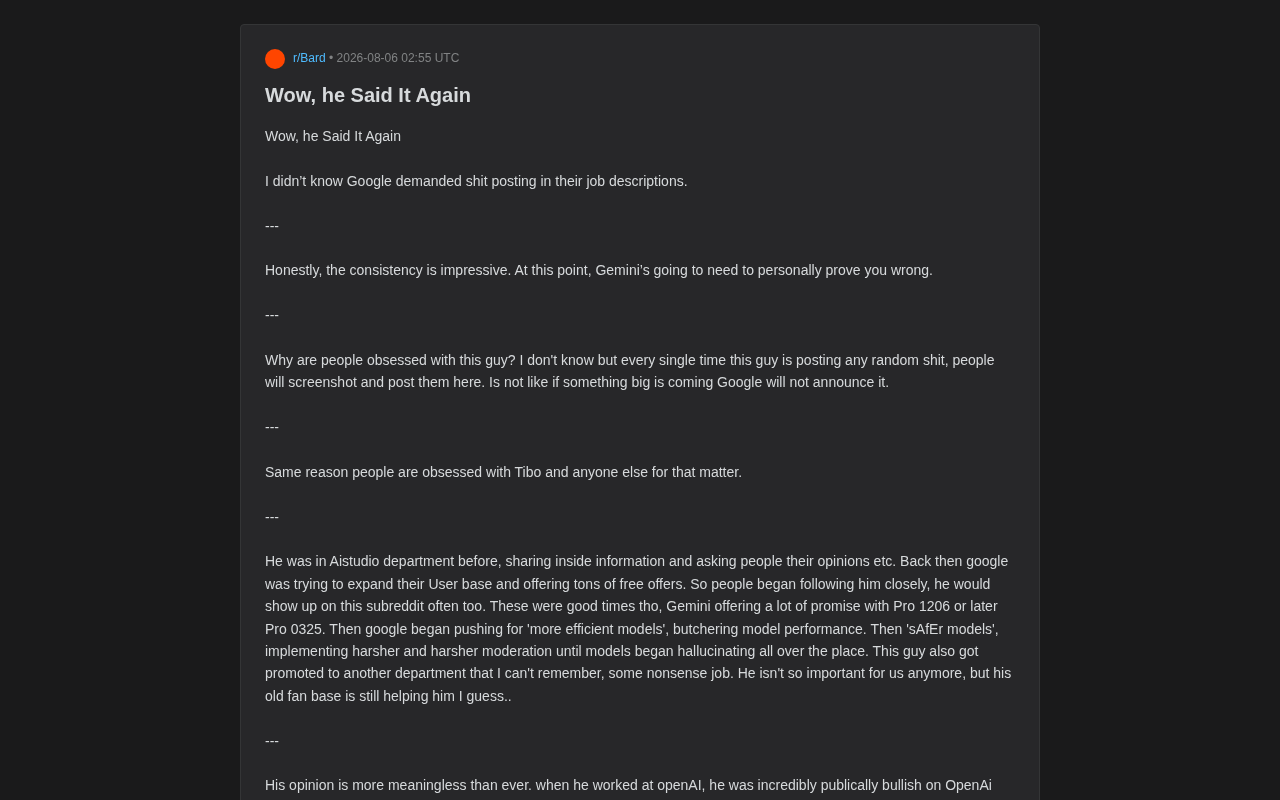
This seemingly playful discussion actually touches on a thought-provoking issue in the AI industry: When tech company employees become public "cheerleaders," how much credibility do their statements actually carry?
The Credibility Paradox of Employee Endorsements
The sharpest take in the discussion came from a user who cut straight to the fundamental contradiction of "employee advocacy":
"His take means less than ever before. When he was at OpenAI, he was extremely publicly bullish on OpenAI's models and very outspoken about it. Then when he got recruited to Google, suddenly he's publicly bullish on Gemini models without exception. See the problem? He's just saying 'reminder, I still work at Google,' which means absolutely nothing. He's paid to promote his employer's interests."
This point, while seemingly obvious, gets at the essence of industry marketing. When someone's position does a 180-degree turn with each employer change, the independence of their technical judgment naturally evaporates. This isn't a personal attack but rather a questioning of the entire "employee KOL" marketing model.
Employee KOL (Key Opinion Leader) marketing is a strategy widely adopted by tech companies in recent years, encouraging internal employees to advocate for company products on social media in a personal capacity, leveraging their "insider" status to enhance credibility. This practice occupies a gray area between official PR and independent reviews — employees are neither official spokespeople nor truly independent from their employer's interests. In the AI industry, because the technical barrier is high and ordinary users struggle to verify model capabilities themselves, employees' "professional endorsements" often carry more influence than traditional advertising, but are also more easily questioned for their motives.
From Insider to Marketing Symbol
A veteran community member recounted this employee's "evolution":
"He was previously in the AI Studio division, sharing internal news, soliciting everyone's opinions, etc. At that time Google was working hard to expand its user base, offering tons of free perks. So people started following him closely, and he appeared frequently on this forum. Those were good times — Gemini showed a lot of potential with Pro 1206 or later Pro 0325."
But the subsequent shift disappointed longtime users: "Then Google started pushing 'more efficient models,' which hurt model performance. Then 'safer models,' implementing increasingly strict content moderation, until the model started hallucinating everywhere."
Hallucination is one of the core challenges of large language models, referring to models generating content that appears plausible but is entirely fabricated. This stems from the fundamental working principle of LLMs — they are essentially probabilistic next-token predictors, not knowledge retrieval systems. Models learn language patterns and statistical correlations during training but don't truly "understand" factual truth. When model confidence is insufficient, they still tend to generate fluent text rather than express uncertainty. Current industry approaches to hallucination include RAG (Retrieval-Augmented Generation), RLHF (Reinforcement Learning from Human Feedback), and chain-of-thought reasoning, but no perfect solution exists yet. Hallucination rate has become a key metric by which users judge model reliability.
This narrative reveals a real user experience gap — the chasm between technical promises and actual delivery often determines product reputation far more than any marketing rhetoric.
Google's AI Advantages and Execution Risks
Despite skepticism about individual employees' statements, the community contains plenty of rational analysis of Google's overall strengths. One user listed Google's structural advantages in the AI race:
"Google has so many advantages — they just need to leverage the latest and strongest architectures, combined with massive training datasets, an enormously large pre-installed user base, large-scale data center footprint, custom chip production capabilities, and revenue outside of AI to sustain a long game — while pure AI companies must monetize as quickly as possible. Looking at these advantages, betting against Google in AI is insane."
This analysis is quite fair. The "custom chips" mentioned here refer to Google's self-developed TPU (Tensor Processing Unit), which has iterated to its sixth generation, Trillium, since its 2015 debut. Unlike general-purpose GPUs, TPUs are specifically optimized for machine learning workloads, offering significant efficiency advantages in matrix operations and large-scale parallel computing. Google not only uses TPUs to train its own models but also provides TPU compute to external customers through Google Cloud. Combined with its data center network spanning over 30 regions globally and the massive data accumulated from processing billions of search queries daily, Google's level of vertical integration in AI infrastructure is virtually unmatched in the industry.
Compared to pure AI companies like OpenAI and Anthropic that need rapid fundraising and monetization, Google, backed by mature businesses like search advertising, has the capital to fight a "war of attrition." These pure AI companies face fundamentally different survival logic — while OpenAI's valuation exceeds $300 billion, its 2024 revenue of approximately $3.6 billion came alongside losses as high as $5 billion, with operations highly dependent on continuous fundraising. Anthropic similarly needs ongoing support from strategic investors like Amazon. They must rapidly launch paid products and prove commercial value, or face the risk of running out of funding. By contrast, Google's 2024 advertising revenue exceeded $300 billion — even short-term losses in its AI division won't shake the company's foundation. This "war of attrition" capability is a structural advantage that pure AI startups simply cannot match.
"You're Only as Good as Your Latest Model"
But the same user also added a crucial caveat: "You're only as good as your latest model... and only as bad as your latest model."
This statement brilliantly captures the brutal reality of AI competition — no amount of historical accumulation and resource advantages can overcome a single botched product release.
Another user immediately countered the "advantages guarantee victory" thesis with historical examples: "Remember the Bard era? The Gemini 1.x era? You can have all the advantages and still botch it completely."
Google's early AI product failures indeed prove this point. Google Bard launched in February 2023 as Google's first direct response to ChatGPT, yet during its first public demo, Bard's answer about the James Webb Space Telescope contained factual errors, directly causing Alphabet's stock to drop by over $100 billion in market value in a single day. Subsequent Gemini 1.0 and 1.5 versions, while improving on technical benchmarks, still frequently exhibited over-moderation and hallucination issues in actual user experience. In 2024, Gemini's image generation feature triggered another PR crisis over racial diversity controversies in historical figures. Technical resources don't equal product success — execution and user experience are the ultimate judges.
Community Mindset: The Cycle of Expectation and Disappointment
Behind this discussion lies a complex collective psychology within the AI community. Users maintain vigilance against official marketing while simultaneously holding genuine hopes for technological breakthroughs.
Interestingly, even amid criticism, some users maintained an open attitude: "Respect the persistence. Now I'm genuinely curious — which Gemini feature has you so convinced?" This willingness to "be persuaded" shows that the community isn't purely negative but is searching for real technical value.
The Battle Between Marketing Volume and Product Strength
This seemingly trivial forum debate actually serves as a reminder to the entire AI industry: in an era of information overload, users are increasingly immune to "official messaging." As one user put it: "If there's really something big coming, Google wouldn't not announce it officially."
An employee's personal social media hype might create short-term buzz, but it cannot substitute for solid product iteration. When model performance, content moderation calibration, hallucination rates, and other practical metrics are what users truly care about, any marketing divorced from the product itself rings hollow.
Trust Must Be Delivered Through Product
From this Reddit discussion, we see not just complaints about a particular employee, but the increasingly mature judgment of the AI user community. They can distinguish marketing rhetoric from technical substance, and maintain rational expectations within their criticism.
For Google, its AI advantages are undeniable — chips, data, infrastructure, and capital leave no weak spots. But as the community repeatedly emphasizes, advantages can be squandered, and trust must be delivered through product. Rather than relying on employees' social media endorsements, it would be better to let the next generation of Gemini speak through its capabilities.
After all, in this field, "you're only as good as your latest model."
Related articles

Gemini 4 Argon Hands-On: AI Builds Board Games, Constructs Temples, and Trains Robots Autonomously
Gemini 4 Argon hands-on roundup: AI autonomously builds a desk racetrack and temple in Blender, writes a ray tracing engine, trains a humanoid robot to sink 7 shots, plus API pricing and developer access.

The Magic Octagonal Coin: Why Only 9% of People Can Predict Its Flip?
Only 9% of people can correctly predict the Magic Octagon coin flip. This article explains its spatial rotation mechanism, common cognitive pitfalls, and a new hypothesis based on Relevance Theory, exploring the limits of human spatial reasoning.

Sam Altman: AI Is Entering the Era of Scientific Discovery — Math Breakthroughs Will Replicate in Biology and Energy
Sam Altman says AI is entering the era of scientific discovery — math breakthroughs will replicate in biology, materials science, and energy to help develop new drugs and energy sources.