Does "Silent Degradation" of Model Capabilities Constitute Sabotage?

Tim Sweeney accuses providers of silently reducing model capabilities, sparking a debate over transparency and trust in AI services.
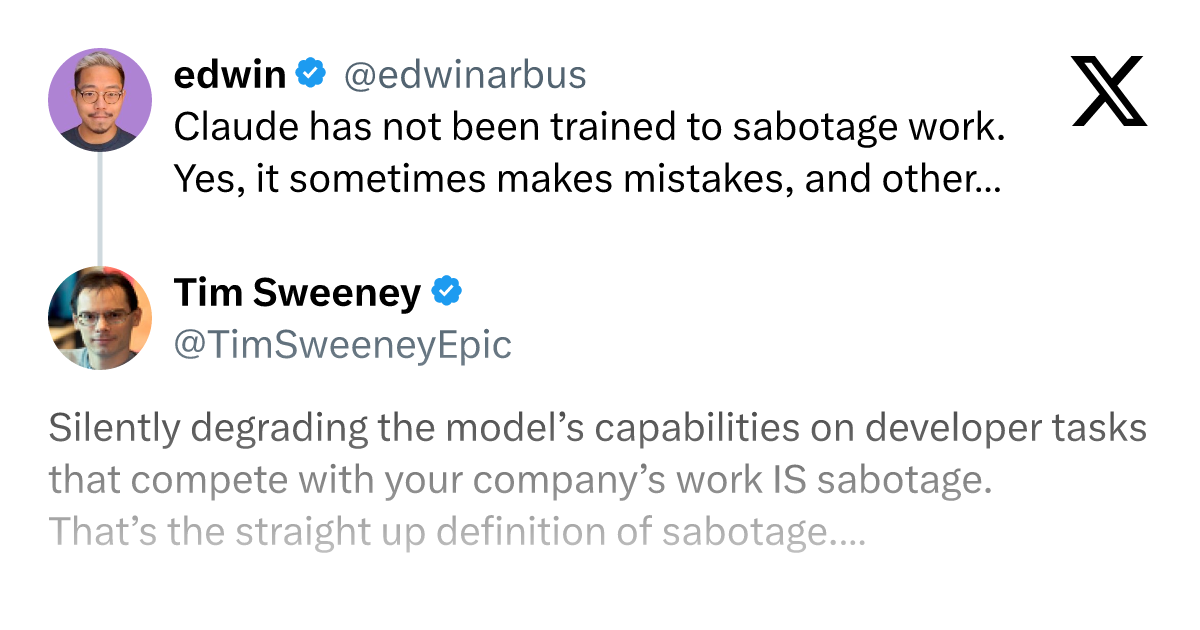
Epic Games CEO Tim Sweeney publicly criticized model providers on X for silently reducing model capabilities without users' knowledge, calling it "sabotage"; the view gained 228 points and 77 comments on Hacker News. The article notes that the core issue is information asymmetry between user expectations and actual capabilities: behind the same model name and API endpoint, inference configurations and routing strategies may have been quietly adjusted. The community is divided, and the article discusses the legal effect of "the model may be updated at any time" in terms of service while offering developers practical safeguards such as pinning versions, regression testing, retaining call records, and following announcement channels.
Background: The Epic CEO's Accusation
Epic Games CEO Tim Sweeney publicly stated on X that reducing a model's capabilities without users' knowledge is essentially an act of sabotage. The tweet gained 228 points and 77 comments on Hacker News, quickly sparking discussion in the tech community about transparency issues among model providers.
Sweeney's argument is not complicated: when users pay to use a model but are quietly switched to a weaker version without any notice, this goes beyond "product iteration" and comes closer to a breach of the user contract. The reason this statement resonated is that it touches on the most sensitive aspect of AI product delivery today—managing users' expectations of model capabilities.
Why "Silent Degradation" Deserves Scrutiny
The Gap Between User Expectations and Actual Capabilities
It is common practice for model providers to adjust inference configurations or routing strategies for reasons such as cost, safety compliance, or load balancing. The problem is that these adjustments often do not appear in the product interface or changelog. Users see the same model name and the same API endpoint, but the actual quality of results may already be different.
For developers who rely on model outputs, this uncertainty is costly. An application's behavior may change overnight, while the clues for troubleshooting are virtually nonexistent. What Sweeney calls "sabotage" points precisely to this capability reduction under information asymmetry.
The Cost of Trust Exceeds the Technical Cost
For model providers, degradation itself is not necessarily a wrong decision. Inference costs, compliance requirements, and system stability are all real constraints. But hiding these decisions may avoid user churn in the short term while overdrawing trust in the long term. In the HN comment thread, multiple developers mentioned that once they discover a product is changing behind the scenes, they will reassess whether to use that model on critical paths.
Model aliases and version snapshot mechanisms are the key technical background for understanding this controversy. Most commercial model APIs offer two types of endpoints: one is a fixed version number (such as gpt-4-0613) or snapshot identifier, pointing to weights and inference configurations frozen at a certain moment; the other is a floating alias (such as gpt-4, latest), which the provider points to the currently recommended version in the background. The convenience of floating aliases is that improvements can be obtained without changing code, but the cost is that capabilities may drift in both directions—they may become stronger, or they may become weaker due to quantization, distillation, routing switches, or context truncation. Some providers also perform A/B splitting behind aliases, causing the same endpoint to return results from different backends within a short period. This is precisely the mechanism by which "silent degradation" can occur in engineering terms: what users observe is not the same fixed artifact, but a logical name continuously redirected by the provider.
Capability drift is an existing concept in machine learning operations, referring to shifts in output quality relative to a baseline under changes in input distribution, serving configuration, or dependent components. In traditional software, version upgrades are usually accompanied by semantic version numbers and changelogs; but the "versions" of large model services often do not follow this contract. Weight fine-tuning, reduced inference precision from FP16 to INT8, shrinking context windows, and system prompt adjustments can all change behavior without any declaration of a version number. For downstream applications, such drift is difficult to catch through unit tests because outputs are probabilistic: the same input may yield differently worded but semantically equivalent results, or may systematically fail on edge cases. As a result, the industry has gradually introduced the practice of "model evaluation regression," using fixed benchmark sets and statistical metrics to monitor drift rather than relying on exact item-by-item comparison.
Points of Divergence in Community Discussion
According to the Hacker News discussion, the community is clearly divided on this issue. One side believes that any unannounced capability change should be explicitly labeled, or at least version records should be retained in product documentation; the other side points out that it is industry practice for cloud providers to make adjustments in underlying resource scheduling, and demanding full transparency is unrealistic.
Some comments also approach the issue from a legal and contractual angle: if the terms of service already state that "the model may be updated at any time," does that give providers permission to make silent changes? There is no conclusion on such discussions yet, but it reveals a fact—existing AI service agreements have not established clear disclosure standards for "capability versions."
A commonly mentioned analogy in the discussion is the opacity of underlying scheduling in cloud services. Providers such as AWS and GCP similarly do not inform users item by item when performing live migration of virtual machines, replacing CPU models, or adjusting network paths. The industry generally accepts this practice on the grounds that underlying resources are regarded as replaceable implementation details. But there is an essential difference between model capabilities and underlying hardware: the former directly constitutes the core value users purchase, rather than being a means of implementation. When users pay for "a certain level of capability," capability itself is the deliverable, not a freely replaceable underlying implementation. This distinction explains why the same "industry practice" argument is unconvincing in the model context, and also shows that establishing disclosure standards requires first defining which changes are implementation details and which are changes in product semantics.
Practical Advice for Developers and Users
Before there is a unified industry standard, teams that rely on model capabilities can take some self-protection measures:
- Pin versions or snapshots: Prefer services that provide explicit version numbers or snapshot mechanisms, and avoid alias endpoints that "always point to the latest."
- Build regression tests: Maintain a set of benchmark cases for critical tasks, regularly compare output quality, and detect capability drift as early as possible.
- Keep change records: Record version information for each model call in your own system to facilitate troubleshooting.
- Follow provider announcement channels: Include model update logs in daily monitoring rather than relying on product interface notices.
These practices cannot fundamentally solve the transparency problem, but they can significantly reduce the business risks brought by silent degradation.
Conclusion: Transparency Is the Bottom Line of AI Productization
The reason Sweeney's statement attracted attention is not how intense the word "sabotage" is, but that it points out a widely overlooked issue: the visibility of model capabilities is itself part of the product. Providers certainly have the right to adjust technical strategies, but when such adjustments affect capabilities users already rely on, notification is not optional—it is a basic service responsibility.
Discussion around this topic is still ongoing, and it may prompt more teams to re-examine the boundaries of rights and responsibilities between themselves and model service providers.
One-line Summary
Tim Sweeney accused providers of silently reducing model capabilities, sparking a debate over transparency and trust in AI services.
Paragraph Summary
Epic Games CEO Tim Sweeney publicly criticized model providers on X for reducing model capabilities without users' knowledge, calling it "sabotage." The view gained 228 points and 77 comments on Hacker News. The article points out that the core problem of silent degradation lies in the information asymmetry between user expectations and actual capabilities: behind the same model name and API endpoint, inference configurations and routing strategies may have already been quietly adjusted, while developers have almost no way to investigate. The community is divided: one side argues that any capability change should be clearly disclosed, while the other believes that underlying scheduling adjustments are industry practice. The article also discusses from a legal and contractual perspective the effect of "the model may be updated at any time" in terms of service, and offers developers self-protection suggestions such as pinning versions, regression testing, retaining call records, and following announcement channels, ultimately emphasizing that the visibility of model capabilities is itself part of the product.
Related articles

Samsung Tests Recompose Feature: Change the Viewing Angle After Taking a Photo
Samsung One UI 9.5 beta code reveals a Recompose feature based on the existing Move tool that may let users adjust a photo's viewpoint after capture. We analyze its technical logic, user value, and launch prospects.

Nimble's Detachable Power Bank Drops $20 — Is It Worth Buying?
Nimble SharePower 10,000mAh detachable power bank drops to $59.96, a $20 discount and all-time low. We analyze its detachable design, pricing, and buying advice across all four colors.

An Author Under a Gag Order: Sarah Wynn-Williams on 'Careless People'
Sarah Wynn-Williams, author of Careless People, discusses living under a gag order in a Guardian interview, exploring its impact on writers and platform power.