Don't Be Fooled by 'Health Age': The Pseudoscience Trap in Wearable Devices
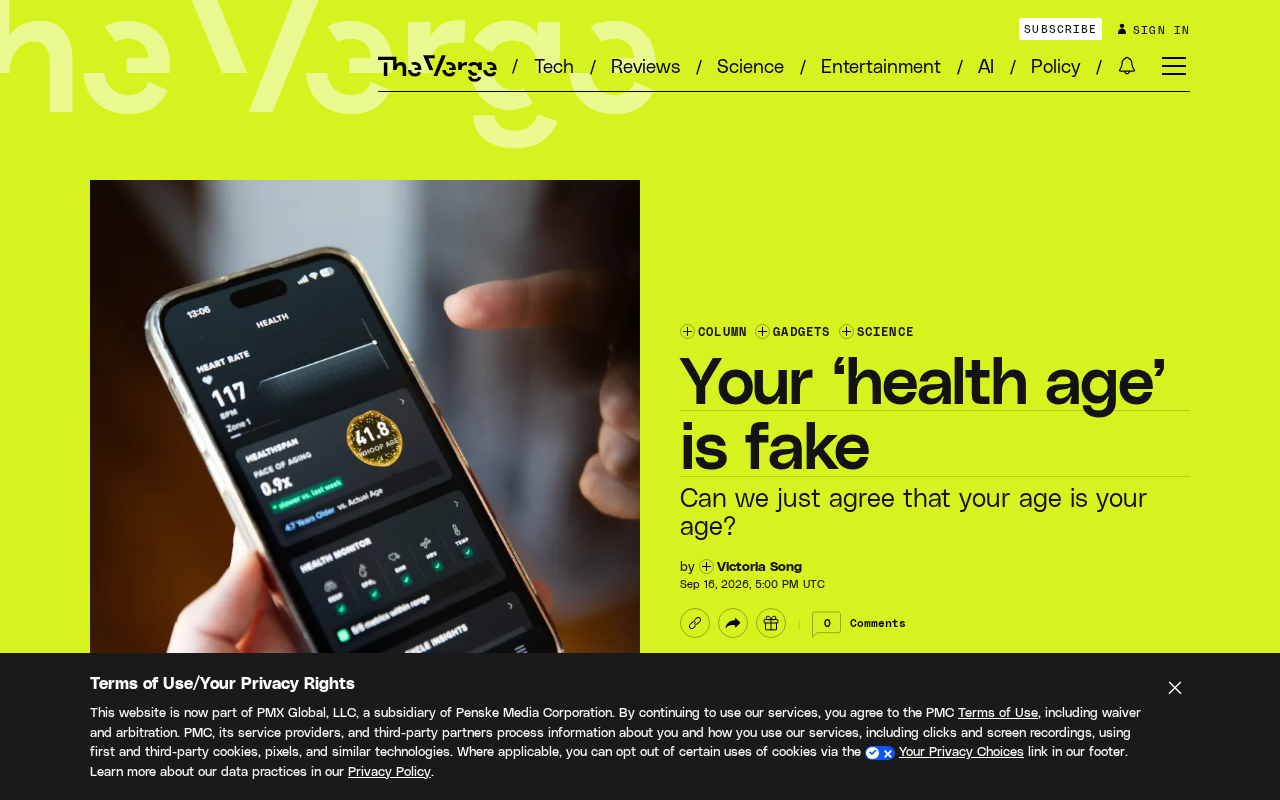
Is 'health age' a legitimate health metric — or just anxiety-inducing marketing dressed up as science?
This article critically examines the "health age" concept highlighted at the Apple Watch launch. Manufacturers feed heart rate, sleep, HRV, and other data into proprietary algorithms to produce a single number — but without unified scientific standards, it's a marketing composite, not a medical assessment. Consumer sensor accuracy is limited, and layering an unvalidated age conversion on top of imperfect data compounds the uncertainty. Worse, gamification-style packaging can trigger unnecessary health anxiety and distort decision-making. The takeaway: wearable data is best used for spotting long-term trends, real health evaluation still requires professional medical care, and users should maintain critical awareness of these "science-wrapped" metrics.
When Tech Companies Tell You Your 'Health Age'
At last week's Apple Watch launch event, The Verge senior reviewer Victoria Song let out an audible "Noooo!" from inside Steve Jobs Theater. What triggered her reaction was a concept that has grown increasingly popular in wearable devices and health apps in recent years — "health age."
This deceptively scientific-sounding metric typically uses an algorithm to combine data points like heart rate, activity levels, and sleep patterns to produce a single "biological age." If your health age is lower than your actual age, the app rewards you with positive feedback; if it's higher, it nudges you to exercise harder, sleep better, or clean up your lifestyle. It sounds motivating — but that's precisely the problem. It isn't nearly as reliable as it sounds.
What "Health Age" Actually Is
At its core, "health age" is a marketing-driven composite metric. Manufacturers feed multiple health data points into a proprietary algorithm and spit out a single number. The appeal is obvious: ordinary users don't need to understand the clinical significance of resting heart rate, heart rate variability (HRV), or VO2 max — they just see a number tied to their age and can intuitively judge whether they're "healthy."
But that simplification is exactly the problem. Different manufacturers use different, opaque algorithms, and the same person can receive wildly different "health ages" from different devices. Without a unified scientific standard, this number is more of a product experience design choice than a rigorous medical assessment.
HRV and VO2 max are the two metrics most commonly cited in health age algorithms, and each deserves its own explanation. HRV refers to the tiny variations in time between successive heartbeats; higher HRV is generally associated with good autonomic nervous system regulation and is considered a signal of cardiovascular health and stress resilience — but individual baselines vary enormously based on age, genetics, and day-to-day state. VO2 max is the maximum amount of oxygen the body can consume per kilogram of body weight per minute during peak exertion — a classic medical measure of aerobic endurance that traditionally requires laboratory testing on a treadmill or exercise bike. Consumer-grade watches estimate VO2 max through mathematical modeling of heart rate versus exercise intensity rather than direct measurement, with error margins that can reach ±10–15%. Taking two metrics that already have significant measurement limitations and converting them again into an "age" number means uncertainty compounds at every step of the way.
Why It's "Fake"
Song's core criticism is this: "health age" creates the illusion of scientific authority. It compresses complex, highly individual physiological states into a single number that's easy to compare and easy to worry about — while obscuring the uncertainty baked into the underlying algorithm and the inherent limitations of the data it's built on.
Consumer wearable sensors have limited accuracy, and metrics like sleep staging and HRV already carry measurement error. Stacking an inadequately validated "age" conversion on top of imperfect raw data makes the credibility of the final result easy to question. Even more concerning is that these metrics are often packaged as gamification elements designed to motivate users — which can instead trigger unnecessary anxiety about their bodies and lead to misguided health decisions.
This practice of compressing complex health states into a single number is known in behavioral psychology as "metric substitution" — replacing a real goal that's difficult to measure directly with a proxy that's easy to quantify. Research shows that when people focus too intensely on a quantifiable metric, they tend to confuse optimizing the metric with actually improving their health. In health tech, this is a textbook illustration of Goodhart's Law: once a measure becomes a target, it ceases to be a good measure. More concretely, the instant feedback loop of "health age" reinforces short-term behaviors (like over-exercising or obsessing over sleep quality to "lower your age") rather than cultivating sustainable, long-term healthy habits.
How to Actually Think About Health Data
None of this means wearable devices are worthless. Basic data like heart rate, activity levels, and sleep duration can still be meaningful for observing long-term trends and building healthier habits. The key is to treat them as directional signals — not precise diagnoses.
Genuine health assessment belongs in the hands of professional medical evaluation, not a number generated by a watch with a marketing pitch behind it. When tech companies use concepts like "health age" to make you anxious about an abstract metric — or to justify your purchase — a healthy dose of skepticism may be the most rational response of all.
Final Thoughts
Victoria Song's "Noooo!" speaks for a segment of tech reviewers who are increasingly wary of health tech's drift toward over-marketing. As health monitoring features become the flagship selling point of smartwatches, users need to understand the real limitations hiding behind flashy metrics. Numbers can be useful tools — but they should never become a veneer for pseudoscience.
Related articles

The Siberian Ice Maiden and the Archaeological Mysteries of the Scythian World
The Siberian Ice Maiden is a Scythian female mummy from the Ukok Plateau. Her tattoos, silk garments, and grave goods reveal ancient nomadic art, social hierarchy, and cross-regional trade — alongside ongoing repatriation controversies.
SQL Row Pattern Matching: Implementing "Row-Level Regex" with MATCH_RECOGNIZE
MATCH_RECOGNIZE gives SQL regex-like power over row sequences. Detect brute-force attacks, fraud patterns, and user behavior flows with clean, declarative syntax — no more messy self-joins.

Hackers Break Into Flock Surveillance Cameras, Exposing the Inner Workings of License Plate Recognition Systems
Hackers breached Flock Safety's ALPR cameras, exposing how license plate recognition systems collect data and the privacy and security risks they pose.