Doneas: 15-Minute Daily Accountability Calls That Keep Indie Developers From Procrastinating

Doneas uses daily 15-minute five-person accountability calls and a public progress page to help indie developers beat procrastination and ship more.
Doneas, the second-ranked new product on Product Hunt, tackles indie developers' unsupervised procrastination. Its core mechanics: plan tasks on Monday, hold a 15-minute accountability call with four other developers daily, and log deliverables on a public progress page. The tagline "Plan less. Focus better. Ship more." targets solo builders' pain points of ballooning plans and slack execution. Accountability works via peer pressure, progress visualization, and member similarity—essentially productizing the Mastermind group model. But the product faces challenges around match quality, retention, confidentiality of the public progress page, and pricing. It suits indie developers, freelancers, and early-stage founders whose self-discipline is inconsistent and who repeatedly get stuck on "thinking more than doing."
Indie developers' biggest fear isn't technical challenges—it's procrastination without oversight. Doneas, the second-ranked new product on Product Hunt, aims to solve this with "daily accountability calls + a public progress page."
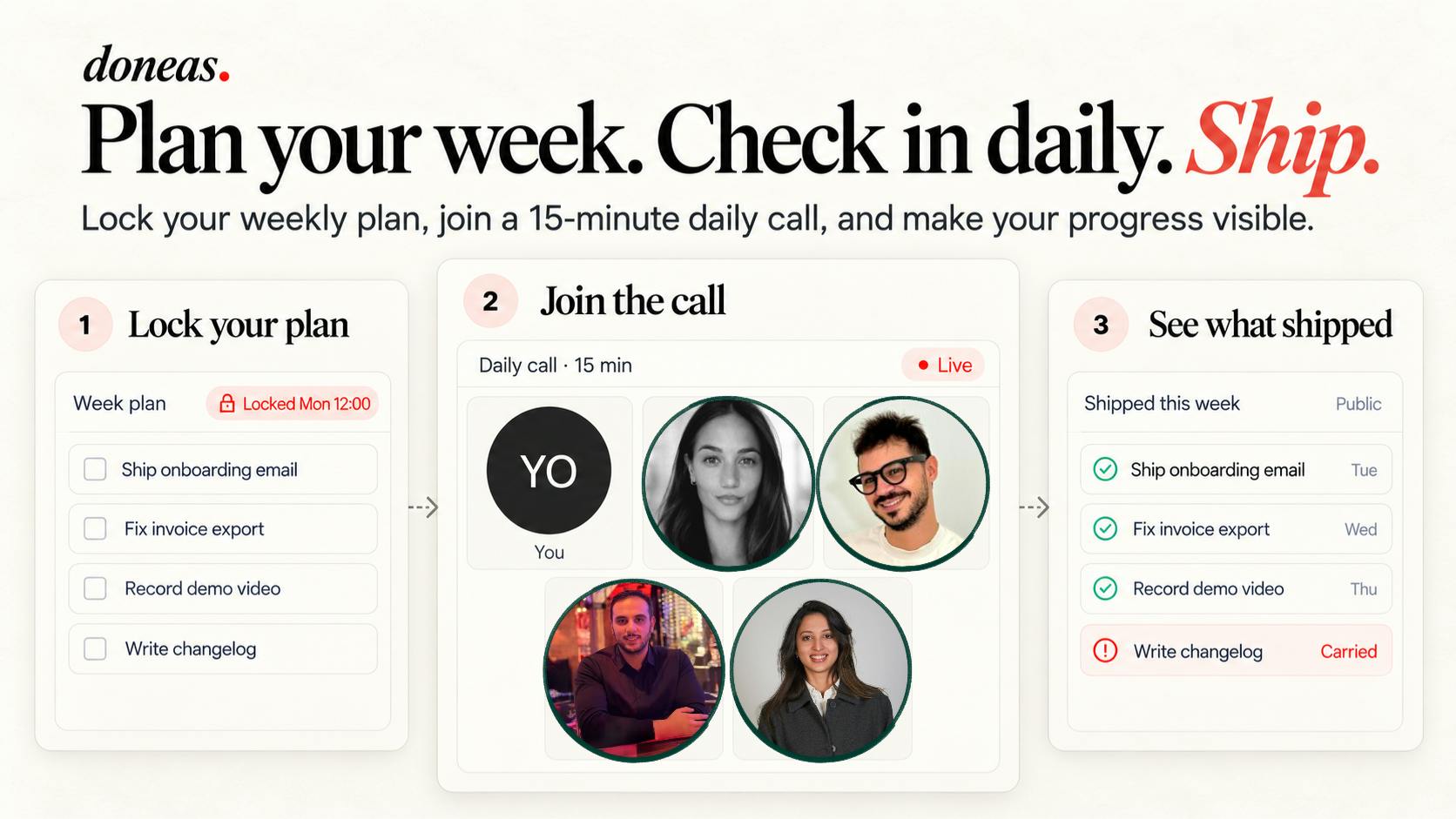
Core Mechanics: 15-Minute Calls + a Public Progress Page
Using Doneas is straightforward: plan the week's tasks on Monday, then join a group of five other developers for a 15-minute accountability call every day, and finally log every delivered result on a public progress page.
Its tagline is "Plan less. Focus better. Ship more." This positioning hits the pain points of solo builders precisely: when working alone, plans tend to balloon and execution tends to slacken—external accountability effectively closes the gap between the two.
From a product design standpoint, Doneas keeps the cost of accountability very low: a 15-minute call isn't a burden, a five-person group ensures everyone gets speaking time, and the public progress page turns "what I did today" into a commitment others can see.
A public progress page is a lightweight tool that makes individual work progress visible to others, commonly found in indie developer communities and build-in-public practices. It typically displays daily deliverables in a timeline or log format, and visitors can be group members, potential users, or anyone interested. Its psychological mechanism lies in commitment and consistency: when work results are publicly recorded, individuals are more inclined to honor their commitments and avoid "self-deception." At the same time, a public progress page also serves as a portfolio, helping developers build credibility. But note that public content may expose project direction, feature details, or launch plans—for unreleased products, a balance must be struck between transparency and confidentiality.
Why Accountability Works for Indie Developers
Indie developers lack colleagues, lack standups, and lack the pressure of "someone waiting on my output." Doneas essentially fills all three gaps.
- Peer pressure: A call at a fixed time with fixed people every day creates a social commitment that's harder to dodge than any to-do list.
- Progress visualization: The public progress page turns a vague "staying busy" into a concrete "what was delivered," preventing self-deception.
- Similarity among group members: Five builders in similar situations understand each other's blockers, so feedback is more targeted than generic encouragement.
This model isn't new—Mastermind groups and co-working communities have long validated the value of peer accountability. Doneas's difference lies in productizing it, making it a daily routine, and lowering the barrier to a near-zero 15 minutes.
A Mastermind group is a long-term mutual-aid group made up of peers in similar situations. Members meet regularly to share goals, progress, and struggles, and to offer each other feedback and accountability. This model traces back to the "master mind" concept proposed by Napoleon Hill in Think and Grow Rich, and was later widely adopted by entrepreneur communities. Its effectiveness comes from three mechanisms: first, social commitment—public declarations strengthen the motivation to follow through; second, peer learning—members gain inspiration from others' experiences and blockers; third, regular rhythm—communication at a fixed frequency creates external structure that compensates for fluctuations in personal discipline. Doneas compresses the Mastermind from a weekly or monthly in-person gathering into a daily 15-minute online call, retaining the core of peer accountability while greatly lowering the barrier to participation.
A Few Concerns Worth Noting
150 upvotes and 83 comments on Product Hunt show considerable interest, but the relatively high comment-to-upvote ratio also suggests plenty of questions in the discussion.
The most practical issue is match quality: can five stranger builders maintain the call rhythm over the long term? How are vacancies filled when members drop out? If the group atmosphere is lax, accountability becomes a mere formality. In addition, the public progress page involves disclosing project information, which may raise confidentiality concerns for unreleased products.
Pricing and retention are also key. The value of accountability products depends heavily on network effects and usage inertia—once a day passes without a call, the habit chain easily breaks. Doneas needs to prove it can keep people engaged, not just for a few novel weeks.
Network effects in accountability products manifest as follows: as group members become more familiar with one another, the social value of calls and the intensity of accountability increase, and the cost of churn rises accordingly. But this effect is a double-edged sword—if group matching quality is poor or members churn frequently, network effects can quickly turn negative, causing remaining members to lose motivation to participate. Usage inertia refers to the product's value depending heavily on the habit chain formed by daily repeated behavior; once interrupted (e.g., missing a call one day), the continuity of the habit is broken, and users easily abandon it entirely. Therefore, retention curves for such products are usually extremely sensitive to early experience, requiring fill-in mechanisms, reminder strategies, and group restructuring rules to sustain inertia.
Who Should Try It
Doneas suits indie developers, freelancers, and early-stage founders who work alone, have clear delivery goals, but easily fall into a disconnect between planning and execution. If you already have a stable self-discipline rhythm, its marginal value will be limited; but if you repeatedly get stuck on "thinking more than doing," daily accountability calls are worth a try.
The product is now live on Product Hunt; group matching and pricing details are available on its official website.
One-line Summary
Doneas uses daily 15-minute five-person accountability calls and a public progress page to help indie developers overcome procrastination and ship more.
Paragraph Summary
Doneas is the second-ranked new product on Product Hunt, designed to solve the problem of procrastination among indie developers without oversight. Its core mechanics are planning tasks on Monday, holding a 15-minute accountability call with four other developers every day, and logging deliverables on a public progress page. The tagline "Plan less. Focus better. Ship more." precisely targets solo builders' pain points of ballooning plans and slack execution. Accountability works through peer pressure, progress visualization, and member similarity—essentially productizing and routinizing the Mastermind group model. However, the product faces challenges around match quality, member retention, confidentiality concerns with the public progress page, and pricing and retention. It suits indie developers, freelancers, and early-stage founders whose self-discipline rhythm is unstable and who repeatedly get stuck on "thinking more than doing."
Related articles

Why Does the Tesla Roadster Need to Fly? A Deep Dive into Musk's Wild Demo
Tesla's Roadster launch showed wall-climbing, upside-down driving, and flying stunts—but The Vergecast notes the demo car may lack a battery, the Rocket version is invite-only and not street-legal, and the website terms don't guarantee delivery. After nine years of delays, why does this car still need to exist?

AI Is Not a Replacement: Human-AI Collaboration Through the Lens of Factory Root Cause Analysis
Starting from factory root cause analysis, this article explains how AI accelerates evidence chain construction rather than replacing human experts, exploring the pragmatic implementation logic and business value of 'AI supporting people rather than replacing them.'

AI Agent Decision Auditing: Building an Evidence Chain in Regulated Workflows
Starting from a Reddit discussion, this article analyzes three core issues in AI agent decision auditing within regulated workflows: what fields audit records should contain, how to handle feedback latency for erroneous decisions, and how to continuously calibrate LLM judge consistency with human judgment.