Doom AI Doubles Its Score with an LLM Coach: A New Approach to Hierarchical Agent Design
Give a shoot-only Doom AI an LLM coach, double its score, and validate the hierarchical agent design paradigm.
The article introduces a Doom game AI experiment in which the creator combines a lightweight GLiNER model with an LLM coach to build a hierarchical agent architecture. GLiNER alone only shoots when it sees enemies and occasionally spins in place, lacking high-level cognition such as health management. The LLM coach, however, issues tactical instructions in natural language based on the game state, such as entering the side room to get the plasma gun or grabbing a medkit when health is low. The results show that the combined system scores more than double GLiNER alone. The article points out that the experiment validates a general design pattern of "LLM as high-level planner, lightweight model as executor," whose advantages include cost-efficiency balance, a highly generalizable natural language interface, and improved decision interpretability, while limitations include the executor's capability ceiling and LLM response latency. It offers reference value for scenarios such as game AI, robot control, and automated workflows.
In AI agent research, getting a model that excels at low-level operations to also possess high-level strategic awareness has always been a challenge. Recently, a YouTube creator (#JevAI) demonstrated an experiment that offers a simple yet effective answer: give a Doom AI that only knows how to "shoot" an LLM coach, and its game score more than doubled.
Experiment Design: Low-Level Player and High-Level Coach
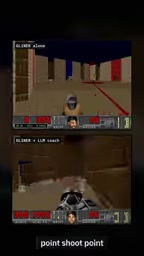
In the video, the creator built two Doom AI agents running side by side. On the left is a GLiNER model acting alone, whose behavior pattern is very one-dimensional—it shoots whenever it sees an enemy and does almost nothing else. In the creator's words, "it's like it's saying shoot, burst fire, shoot, and does nothing else."
On the right is a combination of GLiNER and an LLM coach. This LLM does not directly control the character; instead, it plays the role of a "tactical advisor," issuing instructions to GLiNER based on the game state.
The key to this hierarchical architecture lies in the separation of responsibilities: GLiNER handles real-time, low-latency action execution, while the LLM understands the game situation and plans short-term goals. The two communicate through natural language instructions.
GLiNER is a lightweight information extraction model based on a bidirectional Transformer, with the full name Generalized Language Interface for Named Entity Recognition. Unlike traditional NER models, GLiNER supports describing arbitrary entity types in natural language, enabling zero-shot recognition without retraining for new categories. In this experiment, GLiNER is used as a vision-to-action mapper: it receives game frames, identifies entities such as enemies, weapons, and items, and outputs the corresponding immediate actions. Because of its small model size and low inference latency, it is well suited to high-frequency, real-time low-level control tasks, but it lacks the ability to abstractly reason about the global state.
Hierarchical Agent Architecture is a classic paradigm in reinforcement learning and robot control. Its core idea is to split the decision-making process across multiple time scales: a high-level policy plans subgoals over longer time spans, while a low-level policy completes specific actions at the millisecond level. In this experiment, the LLM coach is equivalent to the high-level policy, taking the game state as input and generating natural language subgoals; GLiNER is equivalent to the low-level policy, translating subgoals into concrete operations. This separation allows high-level planning to leverage the commonsense and reasoning capabilities of large models, while low-level execution remains lightweight and real-time, avoiding the high cost and latency of having a large model participate directly in every frame's decision.
How the Coach Changes Behavior: From "Mindless Shooting" to "Purposeful Action"
The intervention of the LLM coach noticeably changed GLiNER's behavior. When running alone, GLiNER occasionally performed meaningless actions such as spinning in place.

But with a coach, the LLM continuously gives specific tactical instructions. For example: "Enter the side room, get the plasma gun, then fight the enemies." After receiving such instructions, GLiNER attempts to carry out a series of purposeful actions rather than just staying in place and shooting.
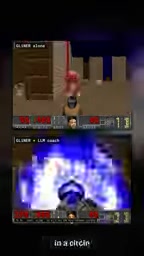
More importantly, the coach can dynamically adjust strategy based on state changes. When the player's health drops, the LLM promptly reminds: "Go get a medkit." GLiNER complies, then continues attacking enemies.
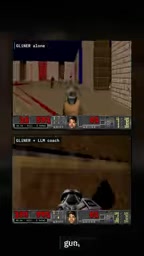
This dynamic adjustment capability is exactly what standalone GLiNER lacks. It has no concept of "health management" and will simply keep shooting until it dies. The LLM coach fills in this layer of cognition.
The Insight Behind the Doubled Score
In the video, the creator concludes that the system with GLiNER plus the LLM coach scores "far better" than GLiNER alone. Although no precise numbers were given, the description "more than doubled" is enough to make the point.
The value of this experiment is not in the Doom game itself, but in how it validates a general agent design pattern: use a large language model as a high-level planner, paired with a lightweight specialized executor. Several aspects of this architecture are worth noting:
First, the balance between cost and efficiency. The LLM does not need to participate in every frame's decision—it only issues instructions at key moments, greatly reducing inference costs. GLiNER, as the executor, can maintain low-latency responses.
Second, natural language as the interface. The LLM and GLiNER communicate through natural language instructions, which means the executor does not need to be retrained for each task—it only needs to understand language. This interface is highly generalizable.
Third, improved interpretability. Compared with end-to-end black-box models, the coach's instructions are human-readable, allowing developers to clearly know what the AI is "thinking," which facilitates debugging and optimization.
Of course, this experiment also has limitations. GLiNER's own capability boundary determines the upper limit of execution. No matter how reasonable the LLM coach's instructions are, if the executor cannot perform fine-grained operations, the results will be compromised. In addition, the LLM's response latency may become a bottleneck in certain fast-paced scenarios.
Language as Interface refers to using natural language text as the communication protocol between different modules. Compared with traditional fixed-dimensional vectors or predefined action commands, natural language interfaces offer greater generality and composability: the high-level planner does not need to know the executor's internal structure—it only needs to describe the goal in language; the executor does not need to be retrained for each new task—it only needs the ability to understand language instructions. This idea is in line with work such as SayCan and Inner Monologue. Its advantages are that modules can be replaced independently and instructions are human-readable, but the premise is that the executor has sufficient language grounding capability; otherwise, instructions may not be executed correctly.
Implications for AI Application Development
For developers building AI agents, this experiment offers a pragmatic approach: do not insist on using a single model to solve all problems. Splitting tasks into two layers—"planning" and "execution"—using an LLM as the brain and a lightweight model as the hands and feet often yields better results at lower cost.
Especially in scenarios such as game AI, robot control, and automated workflows, this hierarchical design is becoming a mainstream paradigm. The value of the LLM coach may only just be beginning to be explored.
Related articles

14 Core Concepts of Reasoning Models: From Chain of Thought to GRPO Explained
A systematic breakdown of 14 core concepts of reasoning models: chain of thought, test-time compute, verifiers, RLVR and GRPO, distillation, and reward hacking, plus rules for controlling thinking-token costs to help you decide when reasoning is worth paying for.

OpenAI's Claimed Refutation of ETH Sparks Debate, Meta Bets Big on AI Infrastructure
OpenAI claims an AI-assisted discovery that challenges the Exponential Time Hypothesis (ETH) and launches the mid-tier GPT-6.1 Tera. Cloudflare discloses a cross-customer data leak postmortem, and Meta plans $95B in AI infrastructure financing.

Data Scraping, AI Proofs, and Open Source Contracts: This Week's Deep Dive into the Tech World
From the 3D model crawler controversy and OpenAI's Lean formal proofs to AI agents challenging Brooks' Law and Debian rejecting LLM review, this week's tech discussions center on openness and verifiability.