Dotverse: Building a Character Team for ChatGPT's Dots on Mac

Dotverse is a Mac app that combines multiple ChatGPT Dots into an invokable multi-role team.
Dotverse is a Mac app that debuted on Product Hunt, aimed at solving the limitation that ChatGPT's Dot feature can only activate one role at a time. It lets users build a team of different characters and personalities from existing Dots for multi-role collaboration. Positioned as a supplementary layer to ChatGPT, its Mac-first strategy targets heavy desktop users but excludes non-Mac users. With 83 upvotes and 3 comments on Product Hunt, it remains in early exposure, and its actual value is yet to be verified.
From a Single Dot to a Whole Crew
ChatGPT's Dot feature lets users assign specific behavior patterns or roles to the AI, but typically only one can be active at a time. Dotverse, which debuted on Product Hunt, aims to break past that single-point limitation: it's a Mac app that lets you build a "crew" of different characters and personalities based on your existing Dots.
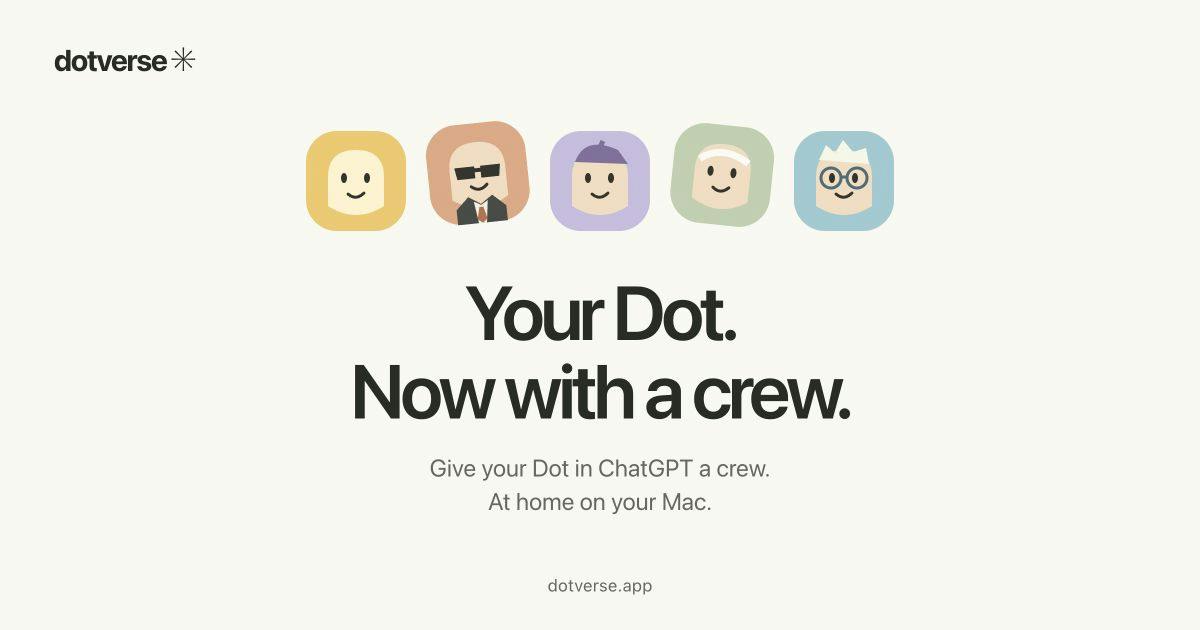
On its Product Hunt launch page, Dotverse's tagline is "Your Dot now with a crew." It received 83 upvotes and 3 comments that day, ranking 15th. The developer is listed as Rahul, and the product is categorized under Artificial Intelligence and Tech.
Background on ChatGPT Dots: Dot is a feature ChatGPT launched in 2024 that allows users to create custom versions of ChatGPT. Each Dot can have preset specific instructions, knowledge bases, and interaction styles, thereby playing a fixed role (such as "writing coach" or "code reviewer"). Users typically switch between Dots via the sidebar, but only one can be active at a time. Dotverse builds on this mechanism by combining multiple Dots into a collaborative "team," so understanding the independence of Dots and their switching limitations is a prerequisite for understanding the product's value.
What Problem Does It Solve
The pain point of custom AI roles often isn't "creation" but "switching." Once users have prepared multiple Dots for different scenarios like writing, coding, and analysis, they can only invoke one at a time, which breaks the multi-role collaboration experience. Dotverse's angle is to reorganize these isolated roles into an invokable collection.
From its product positioning, it doesn't try to replace ChatGPT but exists as a supplementary layer on Mac—relying on your existing Dot configurations and layering team orchestration capabilities on top. The benefit of this approach is lower migration cost, as users don't have to build a prompt system from scratch.
Common patterns of multi-role collaboration: In the AI application space, multi-role collaboration typically refers to multiple AI agents each taking on different responsibilities and working together through message passing or an orchestration layer. For example, one agent generates content while another fact-checks it. Dotverse's claimed "team" capability may involve similar orchestration logic, but the specific implementation (such as serial vs. parallel, or whether context is shared) has not been disclosed. This pattern is fundamentally different from simple role switching: switching is the user manually selecting a single Dot, while collaboration requires the system to automatically schedule multiple Dots and integrate their outputs.
What a Mac-First Positioning Means
Choosing a Mac app over web or mobile reveals the product's early user assumptions: the target audience is professional users who heavily use ChatGPT in desktop work scenarios. These users are more willing to pay for productivity tools and more accepting of installing third-party apps at the system level.
However, this also brings a real constraint—non-Mac users are excluded. For a tool that depends on the ChatGPT ecosystem, coverage directly affects how quickly word of mouth spreads. Whether it can expand to other platforms may be a key thing to watch going forward.
The Mac app ecosystem and AI tools: The Mac platform has a relatively mature desktop app ecosystem, especially for productivity and developer tools. Many AI startups choose Mac-first because macOS offers more open accessibility APIs and system-level integration capabilities (such as menu bar presence, keyboard shortcuts, and clipboard access), making lightweight, low-interference interactions easier to implement. In addition, Mac users include a higher proportion of creative professionals and developers, who tend to be more receptive to subscription-based tools—fitting Dotverse's positioning toward heavy ChatGPT users.
Uncertainties Worth Watching
The 3 comments and 83 upvotes on Product Hunt indicate the product is still in an early exposure stage, with limited community discussion—not yet enough to judge the actual experience. The materials do not disclose specific feature details of Dotverse, such as how team roles collaborate, whether parallel invocation is supported, or how deeply it integrates with ChatGPT's official interfaces—all of which would significantly affect the product's value.
For existing Dot users, Dotverse offers a new way of thinking: pushing AI customization from a "single assistant" toward "division of roles." But until more hands-on information emerges, it's more a direction worth noting than a proven productivity answer.
One-line Summary
Dotverse is a Mac app that combines multiple ChatGPT Dots into an invokable multi-role team.
Paragraph Summary
Dotverse is a Mac app that debuted on Product Hunt, aimed at solving the limitation that ChatGPT's Dot feature can only activate one role at a time. It allows users to build a team of different characters and personalities based on their existing Dots, enabling multi-role collaboration. Positioned as a supplementary layer to ChatGPT, it relies on users' existing Dot configurations to lower migration costs. Its Mac-first strategy targets heavy desktop users but excludes non-Mac users. Currently, the product has 83 upvotes and 3 comments on Product Hunt, ranking 15th. It is still in an early exposure stage, with specific collaboration mechanisms and integration depth not yet disclosed, and its actual value remains to be verified.
Related articles

Will GitHub Die? Open Source Maintainer Burnout and the Collaboration Crisis in the AI Era
Lex Fridman podcast discussion on open source maintainer burnout and GitHub's predicament: massive pull requests overwhelm core maintainers, and AI worsens code bloat. Using math journal peer review and Poincaré conjecture verification as analogies, the article analyzes why verification in knowledge production must be deliberately slow, and how open source communities can avoid the failure mode of maintainers exiting.

Stop Building Cookie-Cutter AI Websites: 3 Tools That Transform Your Coding Agent
Three tools that boost AI coding agents: FFmpeg skill for local video editing in Claude Code and Cursor, Hallmark's 50 design themes to fix cookie-cutter AI sites, and Jailbreaks' 25+ model prompts.

How America's Gerontocracy Squeezes the Younger Generation
Americans over 55 hold nearly three-quarters of national wealth, alongside an 80-year-old president and elderly congressional leaders. The Atlantic's Idrees Kahloon explains how gerontocracy drives up housing costs, squeezes opportunities for the young, and explores zoning reform and child poverty reduction as practical fixes.