Doubao AI Comic Series Mass Production Tutorial: A Complete Workflow from Source Material to Storyboard

A full Doubao-powered workflow for mass-producing AI comic series, from licensed source material to storyboard.
Based on a Bilibili creator's hands-on experience, this article breaks down the two core barriers to AI comic production and how to overcome them. On the copyright side, it recommends sourcing officially licensed material through the Fanqie Creator Center. On the adaptation side, it emphasizes that web novel source text must be carefully restructured for short video pacing using Doubao's Expert Mode with a "senior comic screenwriter" persona prompt — focusing on strong hooks, episode-ending cliffhangers, and cutting redundant content. After scripting, storyboard design is identified as the key to final output quality, governed by three hard rules: 15-second segment splits, at least three shot angles per segment, and a locked visual style. Beginners are advised to use Seedance 2.0 to manage credit costs. The article concludes that long-term success in AI comic production depends on process standardization and reusability, not per-frame visual polish.
AI comic series are becoming a traffic goldmine on platforms like Hongguo and Fanqie. A single 7-second short video can generate meaningful revenue sharing — yet very few creators manage to upload work consistently. Most newcomers get stuck at two bottlenecks: finding copyright-safe source material, and not knowing how to adapt original novels. This tutorial is based on a workflow shared by a Bilibili creator, breaking down how to mass-produce AI comic series using just a computer and Doubao.
The Two Core Barriers to AI Comic Production
Many people see others' comic short series and want to try it themselves, only to stumble at the very first step. The core difficulties fall into two areas.
The first is the copyright barrier. Searching the entire internet for commercially safe, infringement-free licensed content is exhausting. Videos that take days to produce get taken down for copyright violations, wiping out all that effort. The creator's recommended solution is the Fanqie Creator Center, which covers male and female audience genres across all categories. All content carries official licensed authorization, making it legally compliant for comic series promotion and eliminating copyright disputes at the source. Don't blindly pick content — prioritize novels that match your account's niche, then copy the text from the first chapter and you're ready to start.
The second is the adaptation barrier. Without understanding short video traffic mechanics, directly adapting original source material produces comic series with loose pacing and bland storytelling that can't hold viewers. A critical reminder here: raw novel text should never be fed directly into a video generation tool. Web novels are written for readers — the pacing is slower, the descriptions more detailed, and the format is completely misaligned with short video traffic logic. The content must go through careful adaptation to be reshaped into a fast-paced comic script.
Rewriting a Hit Script Using Expert Mode
Paste the copied novel text into the Doubao chat window — but here's the biggest trap beginners fall into: always switch to Expert Mode, never take the shortcut of using Quick Mode. Quick Mode produces rough output that falls short on plot detail and pacing, and the resulting comic series simply won't retain viewers.
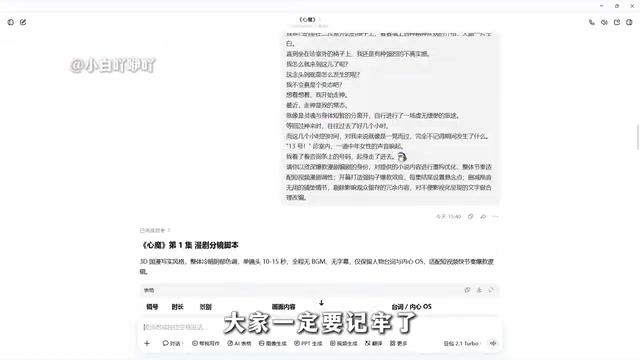
After pasting the source text, attach a professional prompt and send them together. The core rewriting instruction shared by the creator is: take on the identity of a "senior viral comic series screenwriter" and reconstruct the novel content. The overall pacing should match short video comic series tone — open with a strong hook, plant a cliffhanger at the end of each episode, cut slow and unnecessary setup, eliminate redundant content that hurts retention, and reasonably adapt any text that doesn't translate well to visual storytelling.
Why write the rewriting prompt in such detail? The key is giving the AI a specific, vertical professional identity. Without a defined role, the AI tends to produce bland, generic content that misses both the satisfying moments of the comic genre and the traffic-driving mechanics. By assigning the "senior comic screenwriter" persona, the AI approaches the material from a practitioner's perspective — refining plot, controlling pacing, and producing output that better fits traffic logic.
The Three Core Logic Points Behind the Rewrite
Hook viewers immediately. The outcome of a short video is often decided in the first three seconds. If the opening doesn't grab attention, the rest of the story doesn't matter. The right approach is to front-load the most conflict-heavy, compelling moments and throw the hook right at the start.
Plant cliffhangers at the end. A flat ending means viewers swipe away and never come back. Cut each episode at the peak of a conflict — the most suspenseful moment — to spark curiosity and drive viewers to keep watching, boosting completion rates and follow-through.
Trim redundant plot. Web novels are long and packed with setup, description, and transitional scenes. Copying them wholesale drags the pacing down. Cut unnecessary content decisively, tighten the narrative, and keep viewers immersed throughout.
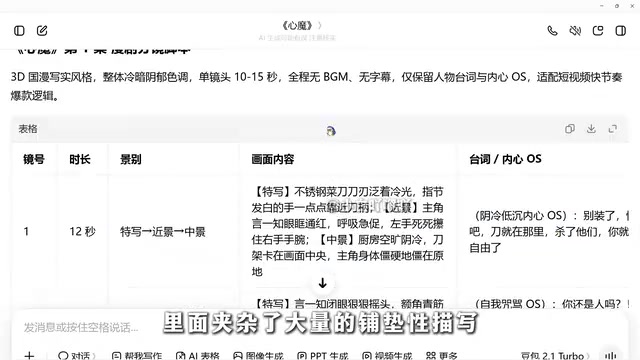
Submit the original text along with the custom prompt, and you'll quickly receive the rewritten script. Compared to the source material, the adapted version has noticeably faster opening pacing, more concentrated conflict, and a significantly improved viewing experience.
The core difference between Doubao's "Expert Mode" and "Quick Mode" lies in the trade-off between reasoning depth and output quality. Quick Mode prioritizes response speed and simplifies complex tasks, often producing content that lacks detail and nuance. Expert Mode invokes a more complete reasoning chain and performs more consistently on tasks requiring multi-step logical thinking — such as creative writing and script adaptation — delivering narrative structure, character motivation, and pacing control that are closer to professional standards. For AI comic production, where content quality directly affects viewer retention, the choice of mode has a real downstream impact on the final product.
Storyboarding: The Core of Final Output Quality
Finishing the script doesn't mean you can jump straight into video generation. The step that truly determines visual consistency and overall production quality is storyboard design. Before generating any footage, you need to understand the underlying logic of model compatibility and storyboard prompts.
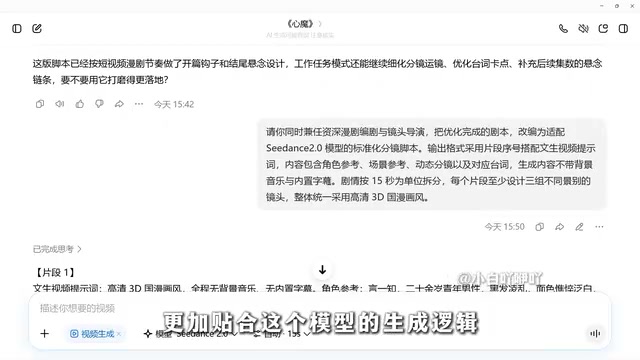
The creator's general storyboard prompt framework asks the AI to take on the dual role of "senior comic series screenwriter" and "shot director," adapting the script into a standardized storyboard for the Seedance 2.0 model. The output format uses "segment number + text-to-video prompt," covering character references, scene references, dynamic shot descriptions, and corresponding dialogue. Generated content should include no background music and no built-in subtitles, with the story broken into 15-second segments, at least three different shot angles designed per segment, and a unified high-definition 3D Chinese animation style throughout.
Model Selection: Beginners Should Start with 2.0
Model compatibility directly affects the final output. The creator recommends that beginners start with Seedance 2.0: while 2.5 supports longer clips, 2.0 is more credit-efficient and delivers results comparable to 2.5, making it a better overall value. Its stability and performance are on par with other models, and it effectively reduces common issues like visual artifacts and character distortion — very beginner-friendly. This is why the prompt should explicitly name the model, so the AI generates storyboards and prompts better aligned with that model's generation logic.
Seedance is ByteDance's video generation model series, optimized specifically for short video content creation. Version 2.0 delivers significant improvements over earlier versions in visual coherence and character consistency, and is particularly well-suited for batch generation in fixed styles like 3D Chinese animation. Version 2.5 extends single-generation length from 15 seconds to 30 seconds, which theoretically reduces the number of clips that need to be spliced — but at the cost of dramatically higher credit consumption. For beginners still figuring out the workflow, credit costs are a real barrier to experimentation. The smarter path is to run the full workflow with 2.0 first, then consider upgrading to 2.5 once you've got the process dialed in.
Three Hard Rules for Storyboarding
A storyboard is essentially about breaking down the complete story into detailed execution plans — pre-mapping camera movements, character actions, visual details, and voiceover cues. Think of it as the operational blueprint for your comic series. Skipping this step and jumping straight to batch generation typically results in chaotic visuals and severe narrative gaps. The creator lays out three hard rules:
Break the story into 15-second segments. This matches the tool's single-generation time limit (2.5 can go up to 30 seconds). Working within the tool's constraints ensures consistent output — adjust as needed if using a model that supports longer clips.
Design at least three shot angles per segment. Without this constraint, the AI tends to generate a single static shot — 15 seconds of one fixed frame looks like a slideshow, with no narrative rhythm or dynamic feel, closer to a motion comic than actual video.
Lock in a consistent visual style throughout. Without this, the AI will randomly mix 3D, 2D, and live-action aesthetics, causing jarring visual inconsistency. This example uses 3D style throughout — locking it in from the start is the only way to ensure visual coherence.
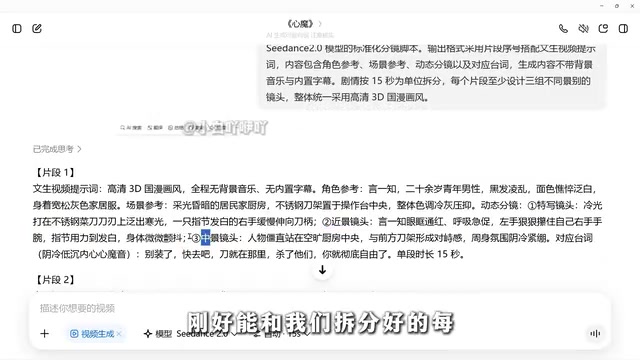
On formatting: segment numbers are used instead of conventional shot numbers because a single 15-second segment typically contains multiple shots. Grouping by segment number maps cleanly to each generated video clip, keeping batch generation and editing organized and reducing the chance of mismatches or missed cuts. Each text-to-video prompt follows a fixed structure: "character reference + scene reference + dynamic shot description + dialogue + no music, no subtitles." Disabling built-in music and subtitles preserves space for consistent post-production packaging.
The "storyboard script" concept originates from traditional film and TV production — it's the pre-production step that translates a screenplay into a frame-by-frame visual plan, covering shot type, camera movement, character positioning, and dialogue timing. In AI video generation, the storyboard script serves as a structured container for prompt engineering: it breaks down vague narrative intent into precise instructions the model can act on. Skipping this step and feeding raw plot text to the model leaves it to fill in visual details on its own — but those details often diverge significantly from what the creator intended, and results are highly random, making it difficult to maintain character appearance and scene tone consistency across multiple segments.
Process Standardization Matters More Than Per-Frame Polish
Once you have the storyboard script, go through it line by line. Focus on whether camera movements, character actions and expressions, and dialogue text all meet the standard — and have the AI adjust anything that doesn't until it fully meets production requirements. Only when the storyboard is finalized has the foundation of an AI comic series truly been laid.
Many people can't sustain comic series production long-term — not because the tools are bad or their ideas aren't good, but because they skipped standardization from the start, worked purely by intuition, revised endlessly, and burned out on infinite rework. AI comic series have never been a competition over who has the most polished individual frames. They're a competition over who has the most stable process, the lowest error rate, and the most reusable workflow. Nail the script rewriting and storyboard creation steps, and you've already outpaced eighty percent of the people jumping on this trend.
Video generation and post-production editing are execution steps that follow naturally from the process — once the workflow is solid, the chances of things going wrong drop dramatically.
Run through this entire workflow once, get the pacing, character consistency, and visual style locked in, and once the process is second nature, consistent daily output and batch production become very manageable for one person. This space doesn't lack for trend-chasers — what it lacks are people willing to go deep on the process, stabilize the details, and build something that lasts.
Related articles

AI New Grad Resume Diagnosis: How to Stand Out for ML/CV Roles?
How can AI/ML new grads optimize their resumes to get interviews? Based on a real Reddit case, this article analyzes project selection, depth display, and structure for ML/CV roles, with actionable revision advice.

OpenAI Opens Up Decision Models as Competition with Jev Heats Up
OpenAI makes its decision model widely available, directly challenging first mover Jev. We analyze the impact on the decision model competitive landscape and key considerations for developers and enterprises.

Startup Growth Secrets: Early Sales Are Not the Key
At Disrupt, experts from Lovable, Polska, and Theory Ventures said early startup growth depends not on early sales but on a repeatable sales process, a clear ICP, team development, and data-driven iteration.