Double Your WhatsApp Support Efficiency: How YCloud Automates 3 Types of Repetitive Work

YCloud automates WhatsApp support with AI replies, smart routing, and triggered follow-ups to eliminate repetitive work.
WhatsApp customer service teams at global businesses lose significant time to three mechanical tasks: answering repetitive FAQs, manually routing messages to the right team, and remembering to follow up on payments, appointments, and orders. YCloud automates all three — AI Agents handle basic inquiries instantly, rules-based routing directs messages by country or department, and key milestones trigger template messages automatically. With repetitive work offloaded, support staff can focus on complex cases and high-value customers, improving efficiency and customer experience without expanding headcount.
Where Does Customer Support Time Actually Go?
Customer service teams at many global businesses look busy every day — but break down what they're actually doing, and you'll find a significant portion of their time is consumed by mechanical, repetitive tasks. Complex inquiries that require real human judgment and high-value customers who deserve careful attention end up getting squeezed out by these low-value chores.
According to a YCloud solution walkthrough shared on Bilibili, WhatsApp customer support teams are most consistently drained by three types of work: answering the same basic questions over and over, manually routing customers to the right team, and tracking every follow-up by hand. What these three things have in common is that they follow clear rules and fixed logic — exactly the kind of work automation handles best.
Type 1: Answering the Same Questions on Repeat
"How much does it cost?" "When will it ship?" "Which countries do you support?" Support agents might answer these questions dozens of times a day. The answers are almost identical every time, yet each instance takes up a person's time to type out and confirm.

These high-frequency basic inquiries have very low value density, yet they consume enormous amounts of support energy. YCloud's approach is to first document common questions, then hand them off to an AI Agent that can automatically recognize and answer them. When customers ask about pricing, shipping, or country coverage, the bot responds instantly — no human intervention needed. Customers get faster responses, and support staff are freed from repetitive labor.
In customer service scenarios, AI Agents are typically built on large language models (LLMs) or rules engines, enabling them to understand natural language questions and retrieve matching answers from a pre-configured knowledge base. Unlike early keyword-triggered bots, modern AI Agents can handle multiple phrasings of the same question — whether a customer writes "how much," "price?" or "can you give me a quote," the system recognizes the intent and delivers a consistent response. For global businesses, AI Agents also need multilingual capability to handle inquiries in Arabic, English, Spanish, and other languages simultaneously — which is one of the core technical challenges in WhatsApp customer service automation.
Type 2: Manually Deciding Who Gets Which Customer
The second hidden time sink is customer routing. One customer needs sales; another needs after-sales support. Middle Eastern customers go to one team; European customers need to be transferred to another. As message volume grows, just figuring out who each message belongs to and manually forwarding it adds up to a significant workload.
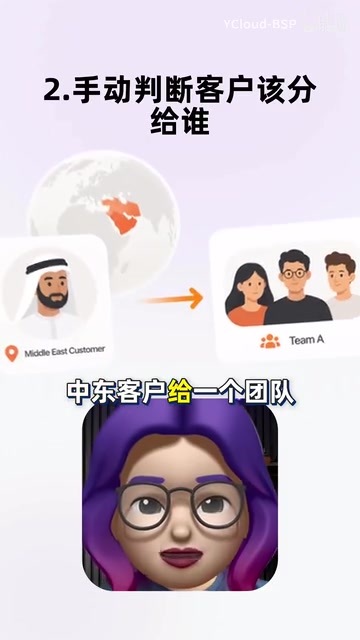
YCloud addresses this through rule-based automatic routing: messages can be automatically directed to the right team based on country, department, or customer need. Routing no longer depends on real-time human judgment, reducing both the delays and errors that come with manual forwarding — and ensuring each team only receives the conversations that are relevant to them.
Message Routing is one of the foundational capabilities of omnichannel support platforms. In the WhatsApp Business API ecosystem, all incoming customer messages are consolidated into a single backend inbox. Without an automatic routing mechanism, operations staff must read each message individually and manually forward it to the appropriate agent or team. Rule-based routing typically supports routing by sender region, message keywords, customer history tags, or current agent workload. More complex scenarios may also incorporate Skill-based Routing, which prioritizes assigning inquiries in specific languages or subject areas to agents with matching capabilities — striking a balance between efficiency and service quality.
Type 3: Relying on People to Remember Every Follow-Up
Payment reminders, appointment reminders, order notifications, incomplete applications — if all of these critical touchpoints depend on someone remembering to follow up, missing just one can directly hurt the customer experience and potentially cost you an order.
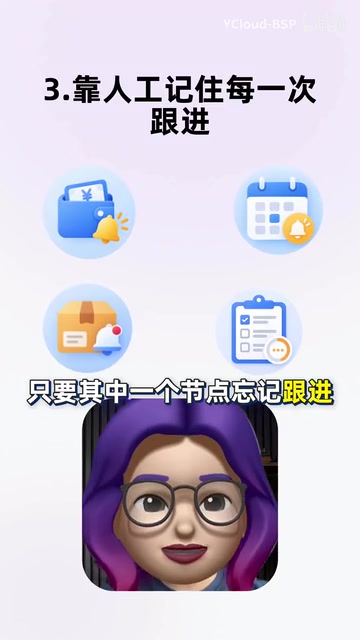
The biggest risk with manual follow-ups is inconsistency: support agents forget things when they're busy, and gaps become even more likely during holidays or handoffs. YCloud turns these critical nodes into automatically triggered message flows — payments, appointments, orders, and other milestones automatically prompt customers at the right time, without anyone needing to remember.
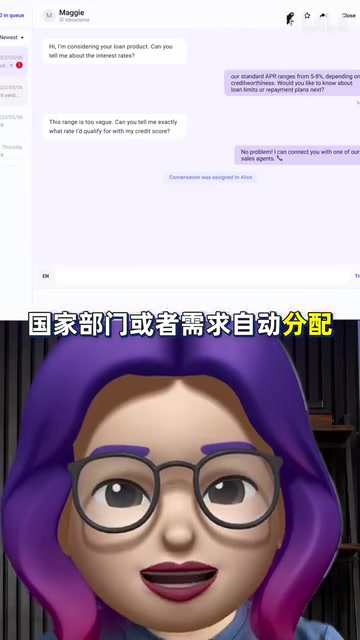
The value of automated follow-ups isn't just convenience — it's consistency and timeliness at every touchpoint in the customer journey, reducing order loss from missed moments.
Saving Human Effort for Conversations That Actually Matter
YCloud's overall approach uses AI Agents, Deeming Box, and automated workflows to remove the three types of repetitive work described above from the manual task list. Once basic inquiries are handled by AI, routing is completed by rules, and follow-ups are triggered automatically by workflows, the support team can focus their time on complex inquiries, high-value customers, and situations that genuinely require human judgment.
For customer service teams, the first step toward better efficiency may not be hiring more people — it might be taking a hard look at which tasks are being repeated dozens of times every day. Hand those standardizable steps to automation, and human effort can finally be applied where it matters most.
Note: This article is based on a single source (a Bilibili creator's walkthrough of the YCloud solution) and is promotional in nature. Actual results should be evaluated against your specific business context.
The "Deeming Box" mentioned in this article is a specific feature module within the YCloud platform. Based on context, it appears to function similarly to a smart inbox or conversation management hub that unifies the routing status of both human-handled and automated conversations. It's worth noting that the WhatsApp Business API imposes strict restrictions on businesses sending proactive messages — companies can only push content to users within a 24-hour window after a customer initiates a conversation, or by using Meta-approved Message Templates. This means the automated payment reminders, order notifications, and similar triggered flows described in this article rely on pre-approved template messages, not freely sendable standard messages. This platform rule is a compliance requirement that global businesses must understand before building any WhatsApp automation workflows.
Related articles

Why Does the Tesla Roadster Need to Fly? A Deep Dive into Musk's Wild Demo
Tesla's Roadster launch showed wall-climbing, upside-down driving, and flying stunts—but The Vergecast notes the demo car may lack a battery, the Rocket version is invite-only and not street-legal, and the website terms don't guarantee delivery. After nine years of delays, why does this car still need to exist?

AI Is Not a Replacement: Human-AI Collaboration Through the Lens of Factory Root Cause Analysis
Starting from factory root cause analysis, this article explains how AI accelerates evidence chain construction rather than replacing human experts, exploring the pragmatic implementation logic and business value of 'AI supporting people rather than replacing them.'

AI Agent Decision Auditing: Building an Evidence Chain in Regulated Workflows
Starting from a Reddit discussion, this article analyzes three core issues in AI agent decision auditing within regulated workflows: what fields audit records should contain, how to handle feedback latency for erroneous decisions, and how to continuously calibrate LLM judge consistency with human judgment.