Draft Calibration: Speeding Up Speculative Decoding by Another 10%

Post-hoc temperature scaling calibration narrows the draft-target distribution gap and raises speculative decoding acceptance length by about 10%.
The article examines the widespread "underconfidence" of draft models in speculative decoding, where low probability estimates for correct tokens cause persistent distribution mismatch with the target model and limit acceptance length and speedup. Researchers propose post-hoc calibration to narrow this gap; standard temperature scaling stands out, raising acceptance length by about 10% across tasks with almost no extra compute. Throughput analysis confirms direct serving efficiency gains, and the article notes room for further improvement via methods like token-wise calibration and the importance of distribution calibration when releasing open-source draft models.
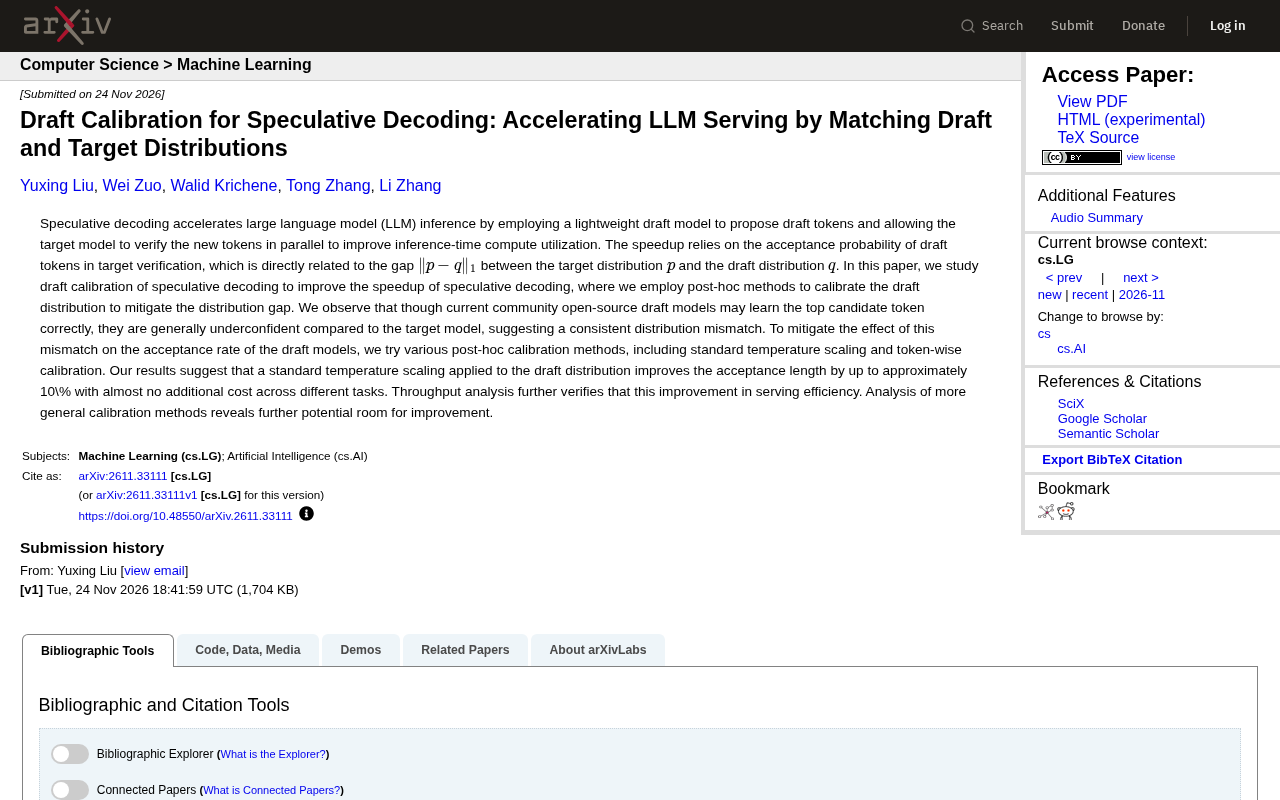
Speculative decoding is an important technique for accelerating large language model inference today. It uses a lightweight draft model to quickly generate candidate tokens, which are then verified in parallel by the target model, thereby improving compute utilization during inference. However, its speedup depends heavily on the acceptance probability of draft tokens during target verification, which in turn depends directly on the $|p-q|_1$ gap between the target distribution $p$ and the draft distribution $q$. A new study proposes using post-hoc calibration to narrow this distribution gap, thereby improving the speedup of speculative decoding.
Draft models are generally "underconfident"
The study observes a key phenomenon: although draft models open-sourced by the community can correctly learn the top-ranked candidate tokens, compared with the target model they usually exhibit underconfidence. This means that when the draft model outputs a probability distribution, its confidence in the correct token is too low, resulting in a persistent distribution mismatch with the target model.
This mismatch directly affects the acceptance rate. In speculative decoding, if the draft model's probability estimate for a token is lower than the target model's, the probability that the token is rejected during verification increases, thereby shortening the actually accepted sequence length and weakening the speedup.
Temperature scaling: simple and effective post-hoc calibration
To alleviate this problem, the researchers tried several post-hoc calibration methods, including standard temperature scaling and token-wise calibration. Among them, standard temperature scaling showed unexpectedly strong cost-effectiveness: applying temperature scaling only to the draft distribution can increase acceptance length by about 10% across different tasks, with almost no additional computational cost.
The core idea of temperature scaling is to adjust the "sharpness" of the distribution through a scalar parameter so that the draft model's output probabilities better match the target model's distribution. Because this method does not require retraining the draft model and only requires a simple transformation of the logits during inference, deployment cost is extremely low and it is suitable for rapid integration into existing serving stacks.
Throughput validation and broader calibration potential
Throughput analysis further confirms the practical value of this improvement for serving efficiency. The increase in acceptance length translates directly into higher effective throughput, meaning that more requests can be served under the same hardware conditions.
The study also analyzes more general calibration methods and finds that, beyond temperature scaling, there is still room for further improvement. This suggests that future work can explore more fine-grained calibration strategies, such as dynamically adjusting calibration parameters for different tokens or different contexts, to further narrow the distribution gap.
Implications for LLM serving practice
The practical significance of this work lies in pointing out a frequently overlooked optimization dimension: the quality of a draft model depends not only on its architecture and training data, but also on how well its output distribution matches the target model. For service teams that have already deployed speculative decoding, introducing simple temperature scaling calibration requires almost no additional cost, yet can bring considerable gains in acceptance length.
At the same time, the study reminds the community that when releasing open-source draft models, distribution calibration deserves attention in addition to metrics such as accuracy. An "underconfident" draft model may perform worse than expected in actual serving, and post-hoc calibration is a low-cost, high-benefit remedy.
As LLM inference costs continue to attract attention, "soft optimization" methods such as this for speculative decoding are expected to become a standard part of the serving optimization toolbox.
One-line Summary
Post-hoc temperature scaling calibration narrows the distribution gap between draft and target models, increasing speculative decoding acceptance length by about 10%.
Paragraph Summary
This article discusses the widespread "underconfidence" problem of draft models in speculative decoding, namely that draft models tend to underestimate the probability of correct tokens, leading to a persistent distribution mismatch with the target model and thus limiting acceptance length and speedup. The researchers propose post-hoc calibration to narrow this distribution gap, among which standard temperature scaling stands out: applying only a single scalar temperature parameter to the draft distribution can increase acceptance length by about 10% across different tasks with almost no additional computational cost. Throughput analysis further confirms that the increase in acceptance length can translate directly into improved serving efficiency. The article also analyzes more general calibration methods (such as token-wise calibration), points out that there is still room for further improvement, and emphasizes that distribution calibration should be considered when releasing open-source draft models. This work provides a low-cost, high-benefit optimization method for service teams that have already deployed speculative decoding.
Related articles

S&P Weighs Downgrading Nvidia's Credit Rating: Governance and Key Man Risk in Focus
S&P is considering downgrading Nvidia's credit rating to AA-, citing corporate governance and key man risk rather than financial performance. We analyze the drivers, potential impact, and the broader trend of governance scrutiny for large tech companies in the AI era.

Generating a 3D Stacking Game from a Few Prompts: Hands-on with the Playground Experimental Platform
Playground lets users generate the 3D stacking game One More Pie from a few text prompts. This article examines the capabilities and limits of prompt-based web game generation.
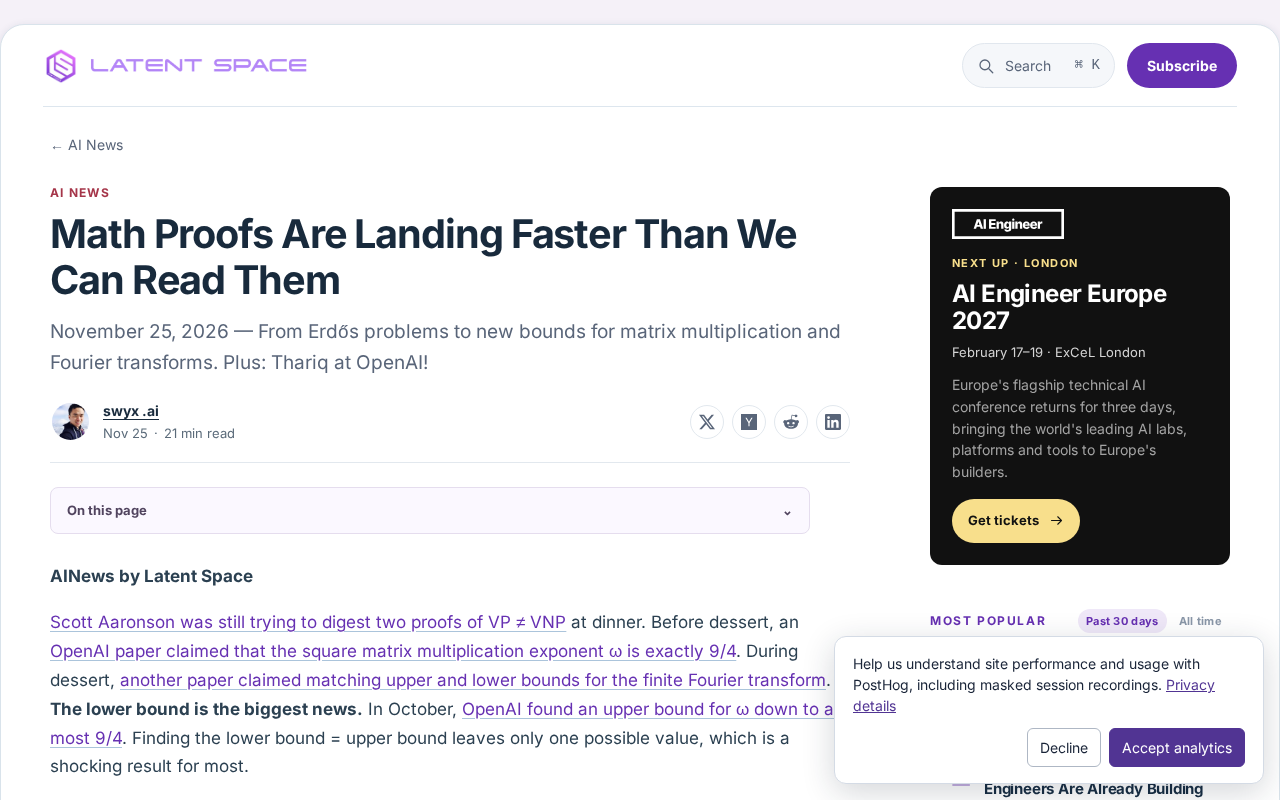
AI Math Proofs Are Exploding: Humans Can't Read Fast Enough
AI math proof output now outpaces human reading speed. AINews roundup covers Erdős problems, new matrix multiplication bounds, and Fourier transform bounds—verification is the new bottleneck.