DRET: Distilled Embedding Transfer Brings Lightweight Models to Biomedical Expert-Level Performance
DRET transfers biomedical expertise to lightweight models via embedding-level knowledge injection
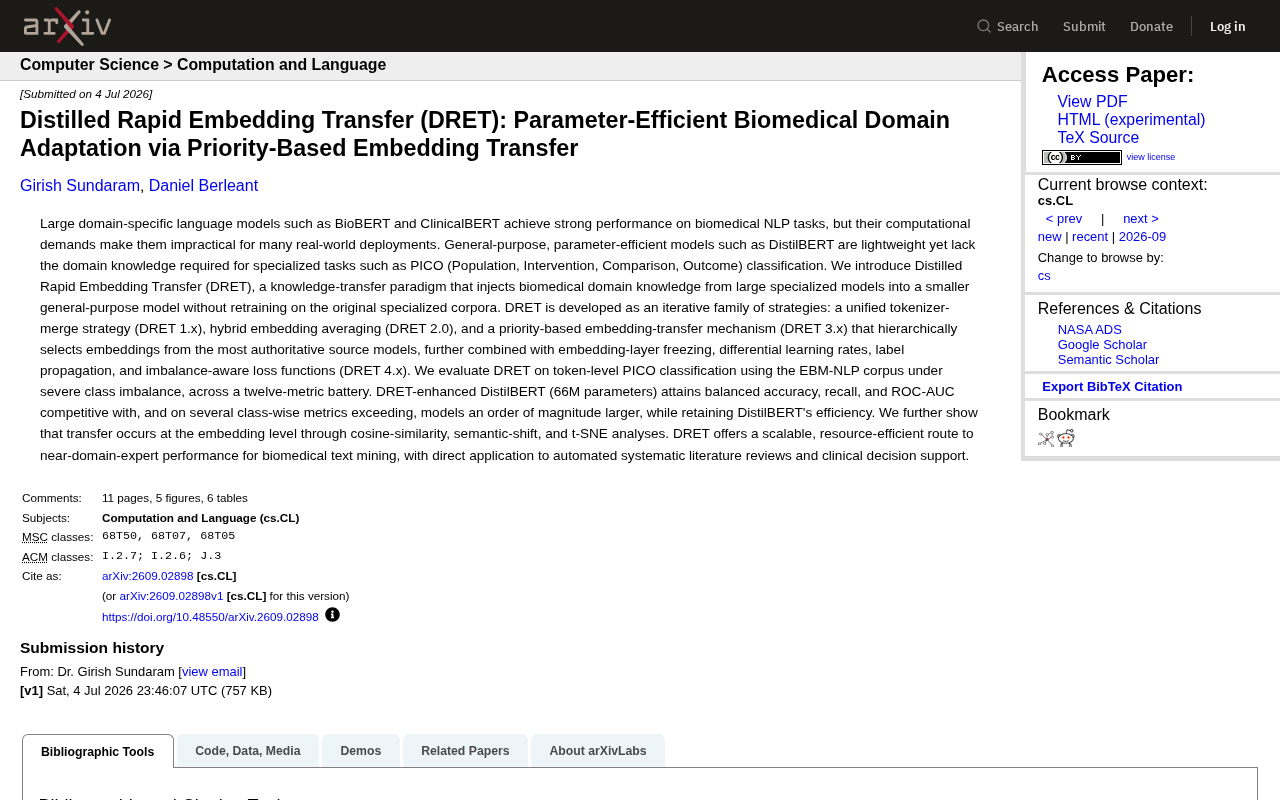
DRET is an embedding-level knowledge transfer method that enables lightweight models like DistilBERT (66M parameters) to achieve performance comparable to specialized biomedical models 10x larger on token-level PICO classification tasks, without requiring retraining on domain corpora. Through prioritized embedding transfer, freezing, and differential learning rates, it provides a resource-efficient path for deploying expert-level NLP in clinical and research settings.
The Performance vs. Deployment Dilemma of Large Models
In the field of biomedical natural language processing (NLP), domain-specific large models such as BioBERT and ClinicalBERT have long demonstrated strong task performance. BioBERT is a model that continues pretraining on Google's BERT base architecture using PubMed abstracts and PMC full-text articles, with training corpora exceeding billions of tokens, enabling it to capture deep semantic relationships of specialized terms like "myocardial infarction" and "monoclonal antibody." ClinicalBERT further trains on electronic health record data such as MIMIC-III, mastering clinical abbreviations (like "prn" for as-needed administration) and non-standard writing patterns. Through pretraining on massive biomedical corpora, these models have acquired professional terminology, clinical semantics, and even complex medical reasoning capabilities, enabling them to excel at challenging tasks such as PICO (Population, Intervention, Comparison, Outcome) classification.
PICO is a cornerstone framework of Evidence-Based Medicine (EBM), systematized by David Sackett and colleagues in the 1990s. When conducting systematic literature reviews, researchers need to accurately identify from thousands of clinical trial papers the subject population characteristics (P), experimental interventions (I), control group settings (C), and clinical outcome measures (O) described in each article. Traditionally, this work relies entirely on manual annotation, with literature screening for a single Cochrane systematic review often taking months. Automating PICO classification, especially at token-level precision, means being able to pinpoint exactly which words in the text describe population information and which describe intervention information—a transformative capability for accelerating the systematic review process.
However, strong performance comes at a steep computational cost. These models, typically ranging from 110 million to 350 million parameters (with single-text inference GPU memory usage reaching several GB), are often difficult to deploy in real-world medical scenarios—such as hospital information systems, edge devices, and batch literature screening pipelines—where inference latency, memory footprint, and deployment costs present tangible obstacles.
In contrast, lightweight general-purpose models like DistilBERT are small and fast but lack specialized domain knowledge, performing poorly on specialized tasks like PICO classification. How can we transfer domain knowledge from large models into small models without sacrificing efficiency? This is precisely the core problem that DRET (Distilled Rapid Embedding Transfer) aims to solve.
DRET's Core Idea: Bypassing Retraining Through Embedding-Level Knowledge Transfer
DRET is a knowledge transfer paradigm whose key innovation lies in: it can inject biomedical domain knowledge from large specialized models into smaller general-purpose models without retraining on the original specialized corpora.
This is highly significant. Traditional domain adaptation typically requires continued pretraining or full fine-tuning on specialized corpora—costly, time-consuming, and dependent on access to original data. DRET shifts the focus of knowledge transfer to the embedding level—performing a "transplant surgery" directly in the word vector space, enabling lightweight models to acquire semantic understanding capabilities approaching domain experts.
Notably, DRET's approach differs fundamentally from traditional Knowledge Distillation. Traditional knowledge distillation, proposed by Hinton et al. in 2015, involves having the student model mimic the teacher model's soft label outputs (soft logits)—learning the probability distribution the teacher assigns to each class rather than just hard labels. This method requires the teacher model to perform online inference or pre-generate outputs for all training samples, still incurring significant computational overhead. The embedding-level transfer employed by DRET is completely different: it directly operates on the embedding matrix, "transplanting" the teacher model's trained word vectors into the student model without requiring the teacher model to participate in inference. This operation is essentially a one-time matrix replacement and alignment with extremely low computational cost.
In other words, DRET doesn't compress the entire large model—it precisely transfers the most valuable "semantic assets"—the embedding representations. This approach is highly attractive for resource-constrained biomedical NLP scenarios.
Iterative Evolution: From Tokenizer Merging to Priority-Based Transfer
DRET is not a single method but an iterative strategy family, with the authors clearly demonstrating its evolution through version numbers:
DRET 1.x: Unified Tokenizer Merging
The first generation strategy focuses on tokenizer-merge. Due to vocabulary differences across models, specialized models often contain numerous biomedical-specific tokens. Different pretrained models use different subword tokenization algorithms (such as WordPiece, BPE, Unigram), resulting in significant vocabulary differences. For example, DistilBERT's general WordPiece vocabulary might split "metformin" into three subwords: "met"+"for"+"min", while BioBERT's vocabulary, built on biomedical corpora, might preserve it as a complete token. This inconsistency in tokenization granularity prevents direct alignment of embedding spaces—the same medical term corresponds to completely different vector sets in the two models. DRET 1.x resolves this fundamental obstacle by unifying tokenizers and merging vocabularies, ensuring source and target models can perform embedding mapping at a unified token granularity, laying the groundwork for subsequent embedding alignment.
DRET 2.0: Hybrid Embedding Averaging
The second generation introduces hybrid embedding averaging, which performs weighted fusion of embeddings from different source models, enabling lightweight model word vectors to possess both generality and domain specificity.
DRET 3.x: Priority-Based Embedding Transfer
This represents a critical methodological leap. DRET 3.x proposes a priority-based embedding-transfer mechanism, hierarchically selecting embeddings from the most authoritative source models. For each token, the system determines which source model provides the most "trustworthy" representation, making optimal choices rather than simple averaging. The intuition behind this strategy is: for generic academic phrases like "randomized controlled trial," the general model's embedding may already be sufficient; but for specialized drug names like "bevacizumab," the biomedical model's embedding is more authoritative. The priority mechanism ensures each token receives the most appropriate embedding source.
DRET 4.x: Engineered Combination
The latest generation builds upon priority-based transfer with a complete suite of training techniques:
- Embedding-layer freezing: Protects the transferred high-quality embeddings from being corrupted by subsequent training. The core logic is: transferred embeddings already encode high-quality domain semantic information; if gradient backpropagation to the embedding layer is allowed during downstream fine-tuning, this carefully transferred knowledge may be overwritten by task-specific gradient signals, producing the so-called "catastrophic forgetting" phenomenon.
- Differential learning rates: Applies different learning speeds to different layers. This technique, popularized by Howard and Ruder in ULMFiT, is based on the idea that different Transformer layers capture features at different abstraction levels—lower layers capture lexical and syntactic information, upper layers capture task-relevant semantic information—therefore lower layers should use smaller learning rates to preserve general features, while upper layers use larger learning rates to rapidly adapt to downstream tasks. Embedding freezing combined with differential learning rates forms a complete "protective fine-tuning" strategy for transferred knowledge.
- Label propagation: Addresses annotation scarcity
- Imbalance-aware loss: Handles severe class imbalance
This combination constitutes DRET's complete engineering solution.
Experimental Results: 66M Parameters Matching Models Ten Times Larger
The research team evaluated DRET on the EBM-NLP corpus for token-level PICO classification tasks, with particular attention to the real-world challenge of severe class imbalance. The EBM-NLP (Evidence-Based Medicine Natural Language Processing) corpus, constructed by Nye et al., contains approximately 5,000 randomized controlled trial (RCT) abstracts, with each token labeled as one of P, I, O, or a non-PICO category. The core challenge of this dataset is severe class imbalance: the vast majority of tokens belong to the "non-PICO" category (background text), while tokens truly belonging to P, I, O are proportionally small, with significant quantity differences among the three. Under this distribution, models easily develop "majority class bias"—tending to predict all tokens as non-PICO to achieve seemingly high accuracy, but with zero clinical value. This is why the research team adopted a "metric matrix" of twelve indicators, including balanced accuracy, macro-averaged F1, ROC-AUC, and other imbalance-sensitive metrics, rather than simple overall accuracy, to ensure comprehensive objectivity.
The results are impressive: DRET-enhanced DistilBERT (only 66 million parameters) achieved performance comparable to biomedical-specific models an order of magnitude larger on core metrics like balanced accuracy, recall, and ROC-AUC, even surpassing them on several per-class metrics—while fully retaining DistilBERT's original inference speed and deployment advantages.
This means that in actual deployment, users can achieve near-large-model performance at small-model cost.
Interpretability Validation of Knowledge Transfer
To validate the core hypothesis that "knowledge transfer occurs at the embedding layer," the authors provided multi-perspective interpretability evidence:
- Cosine-similarity analysis: Quantifies spatial changes in word vectors before and after transfer, calculating the angular change of the same token's vector before and after transfer, precisely measuring the magnitude of embedding "rewriting."
- Semantic-shift analysis: Observes how token semantics shift toward specialized directions, tracking the displacement of specific medical terms toward professional semantic directions in embedding space.
- t-SNE visualization: Intuitively demonstrates improved class separability in embedding space. t-SNE (t-distributed Stochastic Neighbor Embedding), a nonlinear dimensionality reduction technique proposed by Laurens van der Maaten in 2008, excels at mapping high-dimensional data (such as 768-dimensional BERT embedding vectors) onto a 2D plane for visualization while preserving local neighborhood structure. In DRET's validation, t-SNE visualization intuitively shows: before transfer, token embeddings of different PICO categories are highly mixed and difficult to distinguish in 2D space; after transfer, tokens of the same class cluster into tighter groups with clearer decision boundaries between different categories.
Together, these three elements construct a complete interpretability evidence chain for embedding-level knowledge transfer, demonstrating that DRET's knowledge transfer is not a black-box "trial and error" but an observable, interpretable semantic reconstruction occurring in embedding space.
Application Prospects: From Biomedicine to More Vertical Domains
DRET provides a scalable, resource-efficient path for biomedical text mining, enabling lightweight models to approach domain expert-level performance. Its most direct application scenarios include:
- Automated systematic literature review: Rapidly identifying and structuring PICO elements from massive medical literature, significantly improving evidence-based medicine research efficiency. Considering that a high-quality Cochrane systematic review typically requires 6-18 months for literature screening and data extraction, accurate PICO automatic classification could potentially compress this timeline several-fold.
- Clinical decision support: Providing fast, accurate text analysis capabilities in compute-constrained medical environments. Many primary care facilities and hospitals in developing countries lack the GPU infrastructure needed to deploy large models; DRET-enhanced lightweight models make intelligent text processing possible in these scenarios.
More broadly, the "embedding-level knowledge transfer" approach represented by DRET may have value beyond biomedicine. Any vertical domain with the contradiction of "large models perform well but are too heavy, small models are light but lack knowledge"—such as legal NLP, financial text analysis, materials science literature mining—could benefit from this parameter-efficient adaptation paradigm. As large models continue to expand, how to acquire specialized capabilities at lower cost is one of the most urgent propositions for industrial deployment.
Key Takeaways
- DRET enables embedding-level knowledge transfer from large biomedical models to lightweight general models without retraining on specialized corpora
- Through iterative evolution from tokenizer merging to priority-based transfer, DRET 4.x combines embedding freezing, differential learning rates, and imbalance-aware techniques
- A 66M-parameter DistilBERT enhanced by DRET matches the performance of specialized models an order of magnitude larger on token-level PICO classification
- Multi-angle interpretability evidence (cosine similarity, semantic shift, t-SNE) validates that knowledge transfer genuinely occurs in embedding space
- The approach is applicable to any vertical domain facing the "large model effectiveness vs. lightweight deployment" tradeoff
Related articles

Chain of Thought Isn't Just for AI: How Humans Can Use CoT to Improve Thinking Quality
Chain of Thought isn't just a prompt trick for large models. Starting from a Hacker News discussion, this article analyzes why CoT works for human thinking too, breaks down actionable ways to transfer it, and highlights the key differences between human CoT and machine CoT.
Cloudflare Teams Up with OpenAI: Closi…
Cloudflare Teams Up with OpenAI: Closing the Loop from Vulnerability Discovery to Defense with AI
Cloudflare uses OpenAI Daybreak to investigate security vulnerabilities and generate reviewable remediation plans, while developers use Codex to boost coding efficiency and quality.

Orca Multi-Agent Orchestration in Practice: A Guide to Parallel Collaboration with Claude and Codex
Orca is Stable AI's free open-source agent workbench supporting 34 agents like Claude Code and Codex in parallel. Learn its Git worktree isolation, multi-model orchestration, and mobile management.