Driven: A Deep Dive into the AI Investment Agent That Connects the Entire Research-to-Execution Pipeline

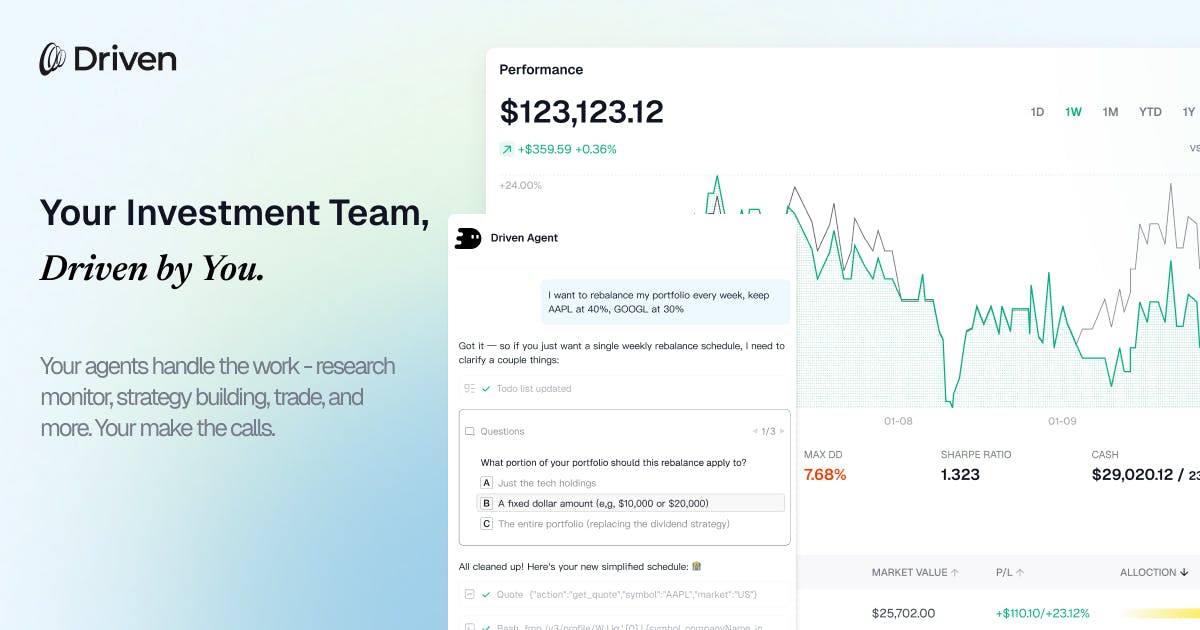
Driven is an AI investment agent that unifies idea generation, analysis, and trade execution in one workspace.
Driven is an AI investment agent that bridges the gap between market insight and actionable execution. By integrating 260+ APIs, offering customizable Skills and Playbooks, and supporting order workflows, it creates a unified workspace covering the full investment pipeline—from idea generation to trade execution—while keeping humans firmly in control of final decisions.
As AI applications accelerate their penetration into vertical industries, the financial investment sector is becoming a crucial battleground for agent technology deployment. Recently, an AI investment agent called Driven launched on Product Hunt, positioning itself around the core concept of "from insight to action." On launch day, it climbed to #3 on the product leaderboard with 127 upvotes.
Unlike most AI investment assistants on the market that merely "answer questions," Driven attempts to solve a more fundamental pain point: how to transform scattered market signals into executable investment decisions and actions.
Understanding AI Agents: From Chatbots to Autonomous Actors
Before diving into Driven, it's essential to understand the AI Agent paradigm. Unlike traditional large language models (LLMs) that can only generate text responses, Agents possess the ability to perceive their environment, plan autonomously, invoke tools, and execute tasks. Their core architecture typically includes: a perception layer (receiving external information), a reasoning layer (thinking and decision-making based on LLMs), a memory layer (maintaining context and historical information), and an action layer (calling external APIs or tools to complete specific operations). Since 2024, leading companies like OpenAI, Google, and Anthropic have all made Agents a strategic priority. The industry widely believes that Agents represent a critical step in AI's evolution from "information tool" to "work partner." It's against this technological wave that Driven chose financial investment—a high-value vertical—as its entry point.
Driven's Core Differentiator: Not Just Answering, But Completing the Entire Investment Loop
Driven's biggest differentiator lies in unifying "analysis" and "action" within a single workspace. Traditional investment research workflows often require investors to constantly switch between multiple tools—one platform for market data, another for research, another for portfolio management, and then to the broker for order execution. This fragmentation is not only inefficient but also makes it easy for critical signals to get lost in transit.
This pain point has long plagued the industry. A typical investment manager might use Bloomberg Terminal for market data, FactSet for financial modeling, Excel for building valuation models, internal research platforms for reading analyst reports, an OMS (Order Management System) for trade execution, and Portfolio Analytics tools for tracking performance. These systems often lack deep integration, data must be manually transferred, and the decision chain is artificially fragmented. According to McKinsey estimates, investment research professionals spend 30-40% of their daily time on data collection and organization rather than actual analysis and decision-making.
Driven's approach is to build an "Agent-driven unified workspace" covering the complete investment journey: idea generation → data gathering → analysis → action. Users no longer need to chase every scattered signal; instead, they can complete the entire pipeline from idea to order execution within a single interface.
The company describes it as "your AI investment team, while you stay in control." This statement reveals its product philosophy: AI handles the heavy lifting of information processing and workflow execution, while ultimate decision-making authority remains with humans.
Core Capabilities Breakdown: 260+ APIs and the Skills System
Based on disclosed product features, Driven's capability architecture is quite robust, spanning several layers:
Data & Interface Layer: Comprehensive Real-Time Data Coverage
Driven integrates 260+ APIs, forming the foundation of its data capabilities. For investment scenarios, the breadth and timeliness of data directly determine analysis quality. The product emphasizes "real-time data" and "24/7 monitoring," meaning it can not only passively respond to queries but also proactively monitor markets and issue alerts at critical moments.
Skills & Playbooks Layer: An Orchestratable Investment Strategy Engine
For capability abstraction, Driven offers built-in & custom Skills and a Playbooks mechanism. This design pattern is quite representative among current Agent products:
- Skills: Think of these as atomic capability modules that the agent can invoke. Users can utilize platform-preset skills or customize their own based on their strategies.
- Playbooks: These orchestrate multiple skills into reusable workflows corresponding to specific investment strategies or analytical paradigms.
This "Skills + Playbooks" combination draws from "microservices architecture" and "workflow orchestration" concepts in software engineering. Skills are essentially encapsulations of single capabilities—such as "fetch real-time price for a given stock," "calculate PE ratio," or "generate technical analysis charts"—each with clearly defined input/output interfaces. Playbooks are similar to DAG (Directed Acyclic Graph) workflows in the automation domain, chaining multiple Skills together with conditional logic to form reusable automated processes. The advantage of this design is that users can assemble complex strategies without programming, while the platform can achieve ecosystem expansion through an open Skill marketplace. Similar design philosophies have been extensively validated in automation tools like Zapier and n8n, and Driven applies them specifically to the investment domain.
This "Skills + Playbooks" combination evolves Driven from a general Q&A tool into an automation system capable of supporting complex investment logic.
Execution & Automation Layer: Genuine Participation in Trade Execution
Most noteworthy is Driven's execution capability. It supports scheduled tasks, portfolios, and order workflows. This means AI no longer stops at providing recommendations—it can genuinely participate in portfolio adjustments and trade execution. This is the most substantive manifestation of "from insight to action."
Why "From Insight to Action" Is a Key Breakthrough in AI Investing
Over the past two years, the market has seen a surge of AI investment research tools, but the vast majority remain at the "information aggregation + intelligent summarization" level. They can help you read earnings reports, summarize news, and generate analysis reports, but they cannot bridge the gap between "knowing" and "doing."
Driven's product design targets precisely this gap. When an agent simultaneously possesses data acquisition, analytical reasoning, task scheduling, and order execution capabilities, it truly approaches the complete form of an "investment assistant." This is actually a microcosm of the AI Agent technology trend: moving from conversational AI to task-oriented AI, from generating answers to completing work.
This paradigm shift is viewed as the second revolution in the AI application layer. Conversational AI is represented by chatbots like ChatGPT, with a core interaction pattern of "user asks → AI answers"—essentially an information retrieval and generation process. Task-oriented AI (Agentic AI) breaks through this limitation: it can understand users' high-level goals, autonomously decompose them into subtasks, invoke various tools and APIs to complete them step by step, and handle exceptions and make adjustments along the way. Gartner listed Agentic AI as the #1 strategic technology trend for 2024, predicting that by 2028, 15% of everyday work decisions will be made autonomously by AI Agents. This shift has particularly profound implications for the financial sector, as investment decisions are inherently complex task chains requiring multi-step reasoning and execution.
However, this direction also comes with significant challenges. Investment is inherently a high-risk, heavily regulated field. Having AI involved in order execution means higher reliability requirements and regulatory scrutiny. Driven's repeated emphasis on "you stay in control" is precisely a product-level response to this risk—preserving human ultimate decision-making authority, with AI playing an augmentation rather than replacement role.
Product Positioning and Market Outlook
On Product Hunt, Driven is categorized under Productivity, Fintech, and Artificial Intelligence—a cross-cutting positioning that confirms its product ambition: not merely a financial tool, but AI infrastructure for enhancing investment productivity.
From its leaderboard performance, ranking #3 on launch day with 127 upvotes indicates that its "unified investment agent" concept has resonated well with early users. For individual investors and small institutions long exhausted by juggling multiple tools, this convergent workspace genuinely holds appeal.
Key Questions to Consider Before Using Driven
- Data Quality and Latency: Integrating 260+ APIs seems powerful, but how different data sources' quality, latency, and costs are balanced will directly impact the actual experience.
- Execution Reliability: When order workflows go wrong, the cost is far higher than in typical AI applications. Ensuring accurate and secure execution is a core challenge.
- Regulatory Boundaries: AI involvement in trade execution faces multi-dimensional regulatory challenges. In the US, the SEC proposed regulations on "predictive data analytics" in 2023, requiring platforms using AI for investment advice or trade execution to eliminate conflicts of interest and ensure algorithmic decision explainability. In the EU, algorithmic trading rules under the MiFID II framework require all automated trading systems to undergo thorough testing and have appropriate risk controls (such as circuit breakers). Additionally, different markets have varying licensing requirements for "investment advisors"—in China, providing specific investment advice requires securities investment advisory qualifications; in the US, registration as an RIA (Registered Investment Adviser) is required. These compliance requirements mean AI investment Agents face significant legal complexity when expanding globally, which will directly impact Driven's expansion pace.
Conclusion: A Pragmatic Exploration of AI Agents Moving from "Can Talk" to "Can Do"
Driven represents a pragmatic exploration of AI Agents in the financial investment domain. Rather than betting on the aggressive narrative of "AI trades stocks for you," it has chosen a more measured path: using a unified workspace to connect the entire research-to-execution pipeline, letting AI handle the heavy lifting of information processing and execution, while keeping the steering wheel firmly in users' hands.
In the broader trend of AI moving from "can talk" to "can do," task-oriented agents like Driven deserve ongoing attention. Whether it can truly deliver on the promise of "from insight to action" will ultimately depend on long-term refinement across data, execution, and compliance.
Related articles

iPhone Duo Battery Life Tested: One Charge a Day Is Unavoidable, and the Large Screen Is the Culprit
iPhone Duo battery test: heavy use needs at least one charge a day, and about 30% remains after 6.5 hours of screen-on time. How often the large screen is unfolded is key; a MagSafe battery pack helps, and long-term degradation is also worth watching.

Kimi K3.1 Pro Open-Sourced: 2.8 Trillion Parameters Close In on Opus
Moonshot releases the open-source MoE model Kimi K3.1 Pro, with 2.8T total parameters and 104B activated, trailing Opus 5.5 by under 1 point on Terminal Bench 4.0.

Costco Tech Price Guessing: Are Monitors, Keyboards, Mice, and Bose Speakers Worth It?
A YouTube blogger guesses prices of Costco tech products: 2K 180Hz monitor, Logitech keyboard and mouse, Bose speaker, and CyberPower UPS, revealing warehouse-store selection and brand premium.