DryFox v0.3.3: AI Agent Team Collaboration + Composable UI Panels Explained

DryFox v0.3.3 turns AI into a collaborative team with composable UI panels and hot-reload plugins.
DryFox v0.3.3 introduces three core features: multi-role AI agent teams that divide labor via a file mailbox and Stop Hook mechanism, reusable YAML-based team templates for one-click restoration, and a block-style composable UI panel system with hot-reload plugin development—elevating AI-assisted dev from a Q&A tool to a customizable workstation.
In an era where LLM-assisted development has become the norm, the model of "letting one model handle everything" is revealing clear limitations. In its latest v0.3.3 release, DriFoxx (officially pronounced DryFox) offers an answer rooted in engineering thinking: break the AI down into a team where each member has a defined role, and turn the software interface into a workbench that can be freely assembled. This article, based on official demonstrations, walks through the three core features of this release.
Agent Teams: Making AI Truly Divide Labor and Collaborate
In practice, we often find that when a single model is simultaneously responsible for requirements analysis, solution design, coding, and review/testing, it tends to lose focus and lack depth. There's an underlying technical reason for this: research shows that a single model exhibits an "attention dilution" phenomenon when handling complex cross-domain tasks—once the context window is occupied by multiple objectives, the model's performance on each subtask degrades.
This phenomenon is rooted in the core mechanism of the Transformer architecture—Self-Attention. When processing long sequences, the model must compute the relevance weights between each token and all other tokens, with a computational complexity of O(n²). When the context is filled with task objectives from multiple different domains, attention weights are dispersed across a broader semantic space, causing a systematic decline in the model's "focus" on each subtask. It's worth noting that the self-attention mechanism itself was formally established by Google in the 2017 paper Attention Is All You Need. It completely replaced the earlier RNN/LSTM sequence modeling approach, enabling models to process entire sequences in parallel—but the price of this parallel capability is precisely the O(n²) attention matrix computation, which is also the root cause of the "attention dilution" problem. Stanford University's 2024 "Lost in the Middle" study further confirmed that LLMs exhibit structural forgetting of information located in the middle portion when processing long contexts, and multi-role division of labor precisely circumvents this architectural flaw by shortening the effective context length of each model. Experiments from institutions like OpenAI and Anthropic have also confirmed that a model focused on a single role significantly outperforms the same model under a "jack-of-all-trades" prompt in tasks corresponding to that role.
This is the core reason why the Multi-Agent System (MAS)—a classic architectural paradigm in the AI field—has been reactivated in the LLM era. MAS is not a new concept—as early as the 1980s, distributed artificial intelligence (DAI) researchers proposed the MAS framework to solve complex problems that a single agent could not handle efficiently. Classic MAS theory defines four core attributes of an agent: Autonomy, Social Ability, Reactivity, and Pro-activeness. The theoretical framework for these four attributes was systematically articulated by computer scientists Wooldridge and Jennings in their foundational 1995 paper, which has since become the standard reference for MAS research. After 2023, with the explosive growth of LLM capabilities, frameworks such as AutoGPT, MetaGPT, and CrewAI transplanted MAS concepts into LLM collaboration scenarios, forming the widely discussed AI Agent ecosystem of today. Among them, MetaGPT's "SOP (Standard Operating Procedure)-driven multi-agent framework" and CrewAI's "role-playing collaboration" each represent different paths in LLM-MAS engineering practice, and both have accumulated numerous production-grade use cases in the open-source community.
In the engineering practice of multi-agent systems, coordination methods between agents fall into two major schools: Centralized Orchestration and Decentralized Negotiation. The former has a master controller agent (Orchestrator) coordinate task allocation, while the latter has each agent determine its own division of labor through message negotiation. DryFox's Team Join mechanism belongs to the former—having users manually specify roles is equivalent to static orchestration, with the Leader role assuming the Orchestrator's responsibilities to coordinate and schedule each specialized agent. This approach sacrifices adaptive flexibility in exchange for predictability and debuggability; the behavior of any role can be traced back to a specific role configuration, making it more suitable for engineering deployment scenarios. By contrast, while decentralized negotiation is theoretically more flexible, it easily produces uncontrollable problems such as "agent argument loops" in LLM scenarios, resulting in significantly higher engineering deployment costs.
DryFox's agent team system was born precisely to solve this pain point—it lets each conversation window play a professional role, collaborating to complete complex tasks.
The usage is quite intuitive. In any conversation window, enter Team Join = RoleName, and the current window will join the team and take on the specified responsibilities. For example:
Team Join = Build: Builder, specializing in coding implementationTeam Join = Plan: Planner, responsible for solution designTeam Join = Review: Reviewer, focused on code quality control
DryFox comes with 11 built-in system roles, covering Leader (overall coordination), Explore (code exploration), Task Executor (task execution), Summary (conversation summarization), and more, spanning the complete chain from planning to delivery. When you want to leave the team, a single Team Leave command does the trick—flexible and free.
File Mailbox: A Serialized Team Communication Mechanism
Once a team is formed, how do roles communicate? DryFox employs an original file mailbox system. When the AI determines that a teammate's assistance is needed, it automatically invokes the Team Send Message tool to send a task email to the designated teammate. For example, after Build finishes writing code, it automatically sends a review email to Review, and when Review finds problems, it sends modification suggestions back to Build.
From an engineering perspective, the file mailbox system is essentially a lightweight implementation of a persistent message queue. In distributed system design, the message queue is a classic pattern for decoupling producers from consumers and ensuring orderly task processing—this concept can be traced back to the ARPANET email protocol design of the 1980s and was systematized during the Enterprise Service Bus (ESB) era into the "Message-Oriented Middleware (MOM)" architecture. DryFox introduces this enterprise-grade architectural concept into AI collaboration scenarios: each role corresponds to an independent inbox, and messages are processed in FIFO (First-In-First-Out) order. FIFO is one of the most fundamental data structure principles in computer science, widely applied in industrial-grade message queue systems (such as RabbitMQ and Apache Kafka) to guarantee message ordering and prevent logical chaos caused by later messages arriving first. DryFox serializes messages into files stored on disk, using file creation timestamps to determine processing order—compared to in-memory queues, file-based message queues have inherent persistence capabilities. Even if a process crashes unexpectedly, unprocessed tasks are not lost, ensuring the recoverability of collaborative workflows.
The entire process is serialized: each role processes only the earliest-arriving pending task at a time, automatically replies upon completion, and continues after confirmation. While serialized processing sacrifices parallel efficiency, it greatly reduces the risk of state inconsistency between roles—it's especially well-suited for strongly dependent chains such as code review → modification → re-review. At the same time, it avoids state contention problems during concurrent multitasking. Members can view online teammates and their role identities at any time via Team List Members, making the collaboration status clear at a glance.
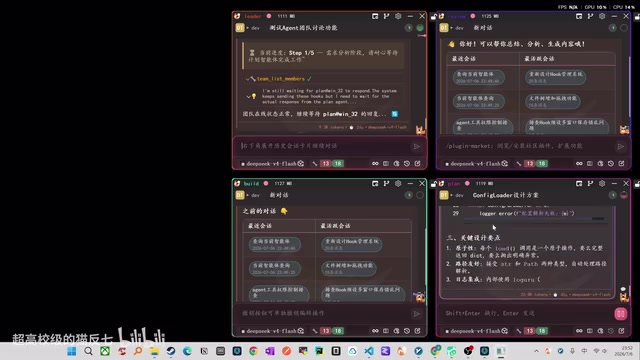
Stop Hook: The Key Mechanism for Maintaining Stable Team Operation
In a regular AI conversation, the model finishes one round of response and the interaction ends. But in a team collaboration scenario, after Build receives modification requests from Review, it needs to automatically continue working—the conversation cannot be interrupted. The Stop Hook mechanism is designed precisely for this—it makes a final judgment at the natural end of each AI round, and if it finds unconsumed task emails, it automatically "extends" the conversation for another round.
In terms of design philosophy, the Stop Hook falls within the realm of Event-Driven Programming. Traditional AI conversations use a request-response model where each round is independent; the Stop Hook registers callback logic on the "event" of the conversation ending naturally, enabling the system to dynamically decide whether to continue execution based on runtime state. This shares the same design philosophy as Node.js's Event Loop and the Signal/Slot mechanism in GUI frameworks—replacing active polling with event-driven design so the system consumes no extra resources while waiting and only triggers the corresponding processing logic when the state changes. Event-driven architecture was first embodied in operating system interrupt mechanisms in the 1970s—the CPU responds to peripheral events via hardware interrupts rather than continuous polling, which is precisely the hardware-level practice of this idea. Node.js brought it into mainstream server-side programming, while DryFox applies it to the lifecycle management of AI conversations.
What's commendable is its engineering restraint: the Stop Hook has a hard limit—it extends at most once—to avoid falling into an infinite loop. This is similar to the role of a Watchdog Timer (WDT) in embedded systems. The watchdog timer originated in fields with extremely high reliability requirements, such as aviation and automotive electronics: a normally running system needs to periodically send a "heartbeat" signal to the WDT; if the system cannot send a heartbeat due to a deadlock or infinite loop, the WDT automatically triggers a system reset after timing out. In modern automotive ECUs, industrial PLCs, and even the Linux kernel (via the /dev/watchdog device), the watchdog timer is a standard component for ensuring system reliability. DryFox's "extend at most once" hard limit plays the role of a timeout threshold, ensuring the automation process doesn't deadlock due to abnormal states. It is also triggered when the user cancels at any time, ensuring the cancel operation truly takes effect. This design strikes a balance between automation and controllability and is the core guarantee for the stable operation of the entire multi-agent team system.
Team Templates: Reusable and One-Click Shareable Configurations
Assembling a mature agent team requires carefully curating the role combination, and configuring it from scratch every time is obviously too tedious. DryFox's team template feature lets you save your current configuration in full and restore it with one click next time.
The operation is extremely simple: once multiple windows have been assigned roles, enter Team Save = MyTeam in any window, and the system saves the role information and team structure of all online windows as a template file in YAML format, stored in a user-defined directory. YAML (Yet Another Markup Language) was designed by Clark Evans and others in 2001, with the core design goal of "human-friendly data serialization"—compared to XML's verbose tags and JSON's lack of comment support, YAML expresses hierarchical relationships through indentation and has syntax close to natural language, becoming the configuration standard for mainstream tools like Kubernetes, Docker Compose, and GitHub Actions. Serializing agent team configurations into YAML files means team templates can be version-controlled, code-reviewed, and shared just like code—this is precisely the extension of the Infrastructure as Code (IaC) philosophy into the AI workflow domain.
Compared to peer formats like JSON and TOML, YAML has a unique advantage widely recognized by engineers: support for comments. This seemingly minor difference is highly significant in configuration file scenarios—a team template can not only record "which roles are configured" but also explain in comments "why it's configured this way" and "what kind of tasks a particular role is suited to handle." This makes AI team configuration files both executable and self-documenting; when team members take over someone else's configuration, they can understand the configuration's intent without consulting separate documentation. This is one of the deeper reasons YAML is widely adopted in the DevOps field.
IaC is a core practice spawned by the DevOps movement, whose central idea is to use code (typically declarative configuration files) to describe and manage computing infrastructure, making environment configuration version-controllable, reviewable, and repeatably executable just like application code. Terraform, Ansible, and Pulumi are currently the most mainstream IaC tools. The core value of IaC lies in eliminating "Configuration Drift"—the problem where production environments gradually deviate from their expected state due to manual operations, a historically painful ops issue in large multi-person collaborative systems. DryFox solidifies AI team topology, role responsibilities, and collaboration rules into human-readable text form, effectively extending this idea into the domain of "AI Workflow as Code"—team configurations can be brought under Git version control, achieving traceability and cross-team sharing of AI workflows.
To reuse it next time, you only need Team Load = MyTeam, and DryFox automatically creates the corresponding number of new windows and assigns roles, bringing the team back to life in seconds.

The template system uses a three-tier source design: user-created templates have the highest priority, followed by templates provided by plugins, and finally system-built-in presets (such as Default Team). This priority resolution strategy borrows from the dependency resolution mechanism of package managers (such as npm and pip); when templates with the same name coexist, the highest-priority version is automatically selected. Combined with commands like Team Load (list) and Team Delete (delete, effective only for user-created templates), team templates have complete lifecycle management, truly achieving manageability, reusability, and shareability.
UI Plugin System: Customizing Your Development Interface Like Building with Blocks
Another major feature of v0.3.3 is the UI plugin system, allowing users to assemble the interface into whatever shape they prefer, like building with blocks. The current version comes preloaded with five UI plugins:
- File Tree: A project file tree panel that lets you browse the project structure without switching to a file manager
- Context Usage Stats: Displays the current conversation's Token consumption in real time—how much was used for input, how much for output, and how much remains in the context window—extremely useful for heavy users
- System Cleaner: One-click cleanup of cache files to free up disk space
- Plugin Manager: Centrally manage installed plugins, view details, and enable/disable them
- Plugin Marketplace: Browse and install various community-contributed plugins
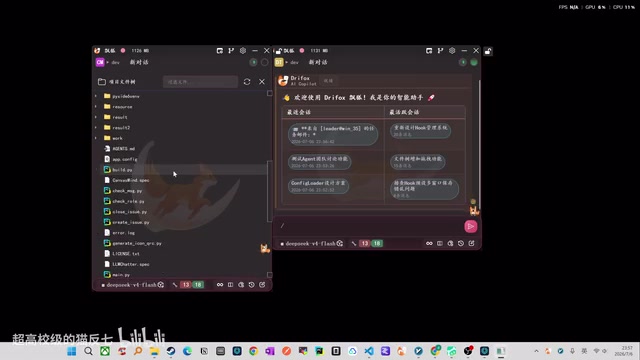
Among these, the Context Usage Stats plugin solves a practical problem that is often overlooked when using LLMs. A Token is the basic unit by which an LLM processes text, a concept originating from tokenization technology in the field of natural language processing (NLP)—the model doesn't directly process characters or words but rather splits text into subword units through algorithms such as BPE (Byte-Pair Encoding). The BPE algorithm originally came from the data compression field and was introduced into NLP by Sennrich and others in 2016; its core idea is to progressively merge high-frequency character combinations into longer subword units, striking a balance between vocabulary size and coverage. A single Chinese character typically corresponds to 1-2 Tokens, an English word to about 1-1.5 Tokens, and special symbols in code such as indentation and brackets often each occupy a Token of their own. Every model has a fixed "context window" limit (Context Window), such as 128K Tokens for GPT-4o and 200K Tokens for Claude 3.5 Sonnet. When conversation history accumulates near the limit, the model begins to "forget" earlier content, leading to degraded response quality or even task failure.
Tokens are not only a technical unit but also the billing unit for LLM APIs. Mainstream model providers all bill input Tokens and output Tokens separately: taking GPT-4o as an example, the input price is about $2.5 per million Tokens and the output about $10 per million Tokens. More critically, due to the stateless nature of the Transformer architecture, each API call resends the complete conversation history to the model, meaning that the longer the conversation, the more the cost per call grows linearly. In a typical multi-round development conversation, as code files, error logs, and design documents are continuously injected into the context, the Token consumption of a single conversation can easily exceed several hundred thousand.
Real-time usage statistics essentially provide developers with Resource Awareness, enabling them to proactively compress the context at the right time (such as summarizing historical conversations) and make conscious trade-offs between task completion quality and API cost. When Token usage approaches the limit, a deeper solution is Retrieval-Augmented Generation (RAG) technology—instead of stuffing full documents into the context, it retrieves only the most relevant snippets through a vector database and injects them, replacing "complete memory" with "on-demand retrieval." RAG was formally proposed by Meta AI Research in the 2020 paper Retrieval-Augmented Generation for Knowledge-Intensive NLP Tasks and has now evolved into one of the standard architectures for enterprise-grade LLM applications, its core value being precisely the ability to break through the physical limits of the context window, enabling models to access external knowledge bases far exceeding the window capacity "on demand." The real-time monitoring of Context Usage Stats provides a clear decision-making moment for this type of proactive intervention, helping developers adjust their strategy in time before hitting the context boundary, rather than realizing the problem only after a task fails silently.
Freely Assembling Multiple Panels to Build Your Own Workbench
The value of these panels goes far beyond using them individually. DryFox's window system supports duplication and branching functionality: a new window can duplicate the current project context and pop out independently, while the branch button opens a brand-new branch while preserving the full conversation history.
This means you can build your own AI development workbench: the main conversation window in the center handles writing code, the file tree on the left lets you view files at any time, the system cleaner panel on the right keeps things smooth, the Token usage stats in the bottom-right corner prevents exceeding limits, and a Git log panel is open at the bottom. Each window independently runs its AI conversation, has its own conversation history and team role identity, and yet shares the same project context.
This design philosophy of freely combining multiple panels borrows, in engineering terms, from the concept of the Tiling Window Manager—tools like i3, Sway, and Hyprland have long been popular in the Linux developer community, their core appeal being precisely that they allow users to split screen space into fully customizable workspace layouts, eliminating the switching cost caused by overlapping windows. The design philosophy of tiling window managers can be traced back to Xerox PARC in the 1980s, whose early graphical workstations adopted non-overlapping window layouts; modern tools like i3/Hyprland carried this idea forward, letting developers precisely control the allocation of every pixel through configuration-file-driven approaches, forming a unique "keyboard-driven workflow" culture. DryFox integrates this philosophy into the interface design of an AI tool, allowing developers to seamlessly integrate workflows such as coding, review, document lookup, and resource monitoring within a single interface, without repeatedly switching between multiple application windows.
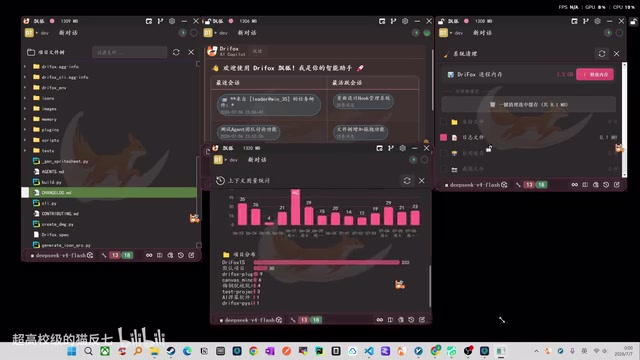
More importantly, there's extensibility—requirement boards, API documentation, browsers, database query tools; as long as it can be written in front-end code, it can be made into a UI plugin and assembled at will. This design truly transforms DryFox from a single conversation tool into a highly customizable intelligent development workstation.
Hot Reload: WYSIWYG Plugin Secondary Development
UI plugins can not only be used directly but also undergo secondary development while the software is running, thanks to a powerful hot reload mechanism. DryFox runs a file monitoring service in the background, and when you modify any plugin source code—whether adjusting the layout, adding components, or modifying interaction logic—the system detects the change within two seconds and precisely reloads the modified plugin.
Underneath the file monitoring service, it calls operating-system-level file system event notification APIs: inotify on Linux, FSEvents on macOS, and ReadDirectoryChangesW on Windows. inotify was introduced into the kernel in Linux 2.6.13 (2005), replacing the poorer-performing dnotify mechanism, and pushes file change events directly through the kernel, compressing monitoring latency from the second level of polling to the millisecond level; macOS's FSEvents provides similar capabilities and additionally supports historical event replay, serving as the underlying dependency for system-level features like Time Machine. Python's watchdog library unifies these three platform APIs, making cross-platform file monitoring possible. Compared to polling—periodically checking a file's modification timestamp—the kernel-event-notification-based approach consumes almost no additional CPU resources, and latency drops from the second level to the millisecond level. It is precisely this system-level event push mechanism that enables DryFox to reliably detect code changes within two seconds, without consuming system resources through continuous background polling.
Hot Reload technology is already very mature in the front-end development field, with Webpack's HMR (Hot Module Replacement) being a representative implementation. Achieving hot reload in the Python ecosystem is more challenging. Python's module system design is essentially optimized for static loading: when the interpreter imports a module for the first time, it caches the compiled bytecode (.pyc files) to the __pycache__ directory and registers the module object in the sys.modules dictionary; subsequent import statements directly return the cached object without reading from disk again. This design is a performance optimization in normal workflows, but it becomes an obstacle in plugin hot-update scenarios: simply calling importlib.reload() only re-executes the module's top-level code, but old object references already held by other modules are not updated, leading to a "ghost reference" problem of mixing new and old code. Jupyter Notebook's %autoreload magic command and Django's development server auto-restart essentially circumvent this problem by restarting the interpreter process.
DryFox's solution is to simultaneously clean up the __pycache__ bytecode files and the old entries in sys.modules, forcing Python to recompile and load the latest code from disk. This clean reload strategy trades a slightly higher loading overhead for state consistency, avoiding the mixing of new and old code caused by "ghost references"—for plugin-level code volumes, the overhead of recompiling bytecode is nearly negligible, making it a mature solution in Python plugin system engineering practice.
The entire process requires no closing the software, no connecting a debugger, no restarting windows, and not even a manual refresh. For plugin developers, the experience of "change a line in the editor, switch back to the window, and it takes effect" is extremely smooth, maxing out development efficiency.
Summary
From multi-agent team collaboration and reusable team templates to freely assembled UI panels and a hot-reload development experience, every feature of DryFox v0.3.3 points to the same goal: enabling developers to harness LLM capabilities more efficiently and build an intelligent development workstation that is truly their own.
For users accustomed to single-window AI conversations, this "multi-role + multi-panel" paradigm offers a new approach worth paying attention to—AI-assisted development is continuously evolving from a "Q&A tool" toward a "customizable work platform."
Related articles

Andrew Ng's New Company LearnVector: Achieving One-on-One Personalized Learning with AI
Andrew Ng launches LearnVector, using generative AI to deliver one-on-one personalized learning. Explore its core vision, potential capabilities, challenges, and how LLMs can solve education's scalability problem.

Truth Has No Direction: How the Tarski Paradox Challenges LLM Truth Probe Techniques
How a Tarski-style attack challenges LLM truth probes from the foundations of logic. Is the linear representation hypothesis valid, or is the "truth direction" in AI activations just a statistical illusion?

Andrew Ng's New Company LearnVector: Achieving One-on-One Personalized Learning with AI
Andrew Ng launches LearnVector, leveraging generative AI to create one-on-one personalized learning experiences. Explore its core vision, potential capabilities, challenges, and how LLMs could solve education's scalability problem.