Dual-Stream Refinement Framework QuirkyMind: Solving the LLM Persona Inconsistency Challenge

QuirkyMind decouples identity definition from expression via dual-stream refinement, resisting persona drift while preserving authentic inconsistency.
The article introduces QuirkyMind, a framework addressing the challenge of modeling stable traits alongside context-bound atypical stances in LLM persona customization. Prompting drifts and fine-tuning flattens quirks. QuirkyMind decouples identity definition from expression in three stages: dual-stream latent states via Traits Anchoring, alternating InfoNCE and cross-entropy refinement, and parameter-efficient adapters for generalization. Validated on Persona-Steered QA and Narrative Inference, though scale is limited.
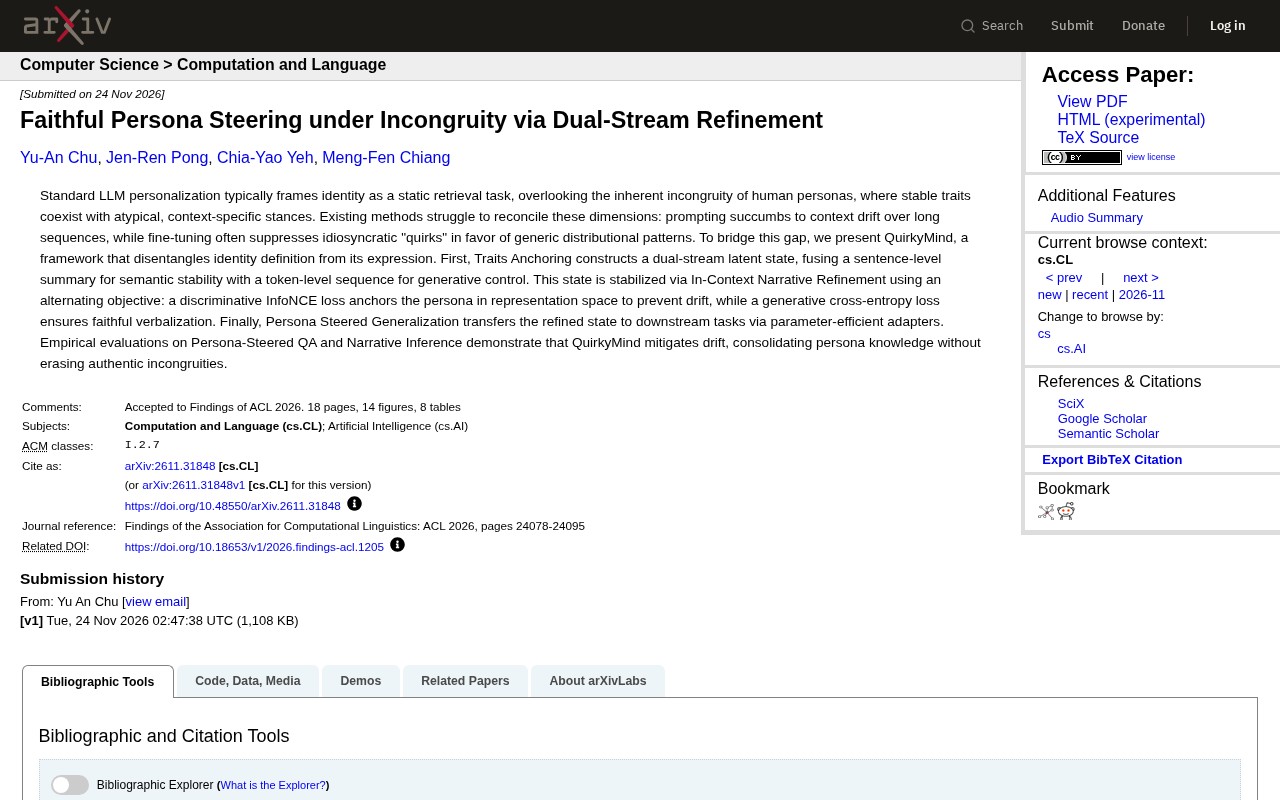
LLM persona customization has long been treated as a static retrieval task, but real human personalities are full of contradictions—stable traits coexist with context-bound atypical stances. This inherent inconsistency is precisely the pain point that current methods struggle to faithfully model. A recent paper proposes the QuirkyMind framework, which uses dual-stream latent states and alternating objective refinement to mitigate persona drift while preserving idiosyncratic traits.
Problem Background: Why Persona Inconsistency Is Hard to Model
Mainstream LLM personalization approaches treat identity as a fixed profile that can be statically retrieved from an external knowledge base. However, psychological research shows that personality includes both core traits that are stable across contexts and atypical stances tightly bound to specific situations—for example, a meticulous person occasionally showing an unconventional, relaxed attitude on a particular topic. This incongruity is not noise; it is a component of authentic personality.
Existing methods run into trouble in two directions. Prompting is prone to context drift over long interaction sequences, with stable traits diluted by subsequent information; fine-tuning tends to pull the personality distribution toward the generic patterns of the training data, flattening idiosyncratic "quirks." The paper's authors point out that the core contradiction lies in conflating identity definition with identity expression.
The QuirkyMind Framework: Decoupling Definition from Expression
QuirkyMind's design principle is to separate "who this person is" from "how this person speaks." The framework consists of three progressive stages: Traits Anchoring, In-Context Narrative Refinement, and Persona Steered Generalization.
Traits Anchoring: Dual-Stream Latent States
The first stage constructs dual-stream latent states. One stream is a sentence-level summary, responsible for capturing semantic stability and preventing the persona core from deforming over long conversations; the other is a token-level sequence, responsible for fine-grained generation control, preserving idiosyncratic details such as tone and wording preferences. The two streams fuse to both anchor identity and preserve expressive freedom.
Alternating Objective Refinement: InfoNCE and Cross-Entropy in Concert
The second stage stabilizes the aforementioned dual-stream states through In-Context Narrative Refinement, using an alternating optimization objective. A discriminative InfoNCE loss anchors the persona in representation space to prevent representation drift; a generative cross-entropy loss ensures the persona is faithfully verbalized. The two are trained alternately, which amounts to continuous calibration between "the representation space stays on track" and "the generated output sounds like the person." This design directly addresses the respective shortcomings of prompting and fine-tuning.
InfoNCE loss (Information Noise Contrastive Estimation) originates from contrastive learning. Its core idea is to compare a target sample against a set of negative samples and learn discriminative representations by maximizing the mutual information between positive sample pairs. In persona modeling, InfoNCE treats different expressions of the same persona as positive pairs and other personas or random fragments as negatives, thereby pulling vectors of the same persona closer and pushing different personas apart in representation space—serving an "anchoring" role. Compared with regression losses such as mean squared error, InfoNCE imposes stronger geometric constraints on the representation space and can effectively suppress representation drift over long sequences.
Cross-entropy loss is the standard objective for autoregressive language modeling, measuring the difference between the model's distribution over the next token and the true token. It acts directly on the output layer, ensuring that what the model "says" literally matches the target persona's wording habits. When the two are optimized alternately, InfoNCE is responsible for identity consistency in latent space and cross-entropy for expressive faithfulness in visible space, forming a complementarity: optimizing only cross-entropy easily overfits surface wording while losing identity semantics, whereas optimizing only InfoNCE may yield correct representations but fail to generate natural language.
Parameter-Efficient Adapters for Generalization
The third stage, Persona Steered Generalization, transfers the refined persona state to downstream tasks through parameter-efficient adapters. This means persona customization does not require retraining the entire model; the adapters serve as a lightweight bridge between persona state and task execution.
Parameter-Efficient Adapters are a class of transfer learning techniques that train only a small number of新增 parameters while freezing the backbone model weights. Common forms include inserting small feed-forward modules between Transformer layers (such as Houlsby Adapters), low-rank decomposition matrices (LoRA), or prefix vectors (Prefix Tuning). Their advantages are that the number of new parameters is typically only 0.1%–5% of the original model, significantly reducing storage and training costs, while avoiding the catastrophic forgetting brought by full fine-tuning. In QuirkyMind, the adapters take the refined persona state vector as conditional input and "inject" it into each layer of computation for downstream tasks, so that the same persona state can be reused across question answering, narrative inference, and other tasks without retraining the entire persona model for each task. This design also facilitates parallel deployment of multiple personas—each adapter corresponds to one persona profile, and switching costs are extremely low.
Experimental Performance and Limitations
The paper evaluates on two tasks: Persona-Steered QA and Narrative Inference. Results show that QuirkyMind can mitigate persona drift, consolidating persona knowledge without erasing authentic incongruities. However, the current experimental scale and task diversity remain limited, and the framework's stability in more open-ended scenarios needs verification. In addition, the dual-stream states and alternating objectives introduce extra training complexity, and the actual deployment cost requires further trade-off analysis.
Industry Significance: A New Approach to Personalized AI
QuirkyMind's value lies in proposing an operational approach to persona decoupling: rather than making a persona more "consistent," it lets the persona accommodate real inconsistency while maintaining a stable core. For AI applications requiring long-term companionship, role-playing, or personalized customer service, this direction is closer to the essence of human personality than simply scaling up prompts or fine-tuning data. If future work can extend to inference efficiency and multimodal persona expression, the dual-stream refinement paradigm could become important infrastructure for LLM personalization.
One-line Summary
QuirkyMind uses dual-stream latent states and alternating objective refinement to decouple identity definition from expression, resisting persona drift while preserving authentic inconsistent traits.
Paragraph Summary
The article introduces the QuirkyMind framework, which aims to solve the modeling challenge in LLM persona customization where "stable traits coexist with context-bound atypical stances." Mainstream methods treat persona as a static retrieval profile; prompting is prone to context drift, while fine-tuning flattens idiosyncratic quirks. QuirkyMind decouples identity definition from expression in three stages: Traits Anchoring builds dual-stream latent states with sentence-level summaries and token-level sequences; In-Context Narrative Refinement alternates between InfoNCE and cross-entropy losses to anchor representation space and ensure faithful generation respectively; Persona Steered Generalization transfers the persona to downstream tasks via parameter-efficient adapters. Anti-drift effectiveness is validated on Persona-Steered QA and Narrative Inference, but experimental scale is limited and training complexity is relatively high.
Related articles

Nothing CMF Buds 2A Drops to $17.89 on Black Friday: A New Low for ANC Earbuds
Nothing CMF Buds 2A wireless earbuds Black Friday deal: just $17.89 on Amazon, about $11 off retail and a record low. ANC earbuds at an entry-level price.

When AI Creation Gets Accused of "Spitting": Hacker News Heats Up Over the Glaude Controversy
A Hacker News post, "Spitting in the Face of Glaude," sparks debate on AI creation transparency and attribution ethics. This analysis examines the blurred creator identity behind the controversy and offers practical advice for AI content production.

Akai Embraces Custom Firmware: MPC Sample 1.4 Lets Users AI-Program Their Sampler
Akai embraces the modding community with MPC Sample 1.4 firmware, supporting vibe-coded custom firmware and effects. We analyze the impact of this open strategy on music hardware and AI-assisted programming.