DuckDB 2.0.0 LTS Released: The Analytical Database Gets a Long-Term Support Edition

DuckDB releases 2.0.0 LTS, shifting the competitive focus from performance to reliability.
DuckDB has released version 2.0.0 LTS, codenamed Cinnamon Teal, drawing 296 points on Hacker News. The article argues the LTS label matters more than any single feature: it gives teams embedding DuckDB in production pipelines a longer support window and guarantees around API and file-format stability, reducing ongoing retesting costs. The jump from 1.x to 2.0 implies incompatible changes, so existing users should first run regression tests with current workloads, focusing on extensions like httpfs, parquet, and iceberg as well as custom UDFs. It also notes that DuckDB's in-process OLAP positioning complements cluster solutions like ClickHouse and Doris rather than replacing them, and that LTS shifts the competitive dimension from speed to trustworthiness.
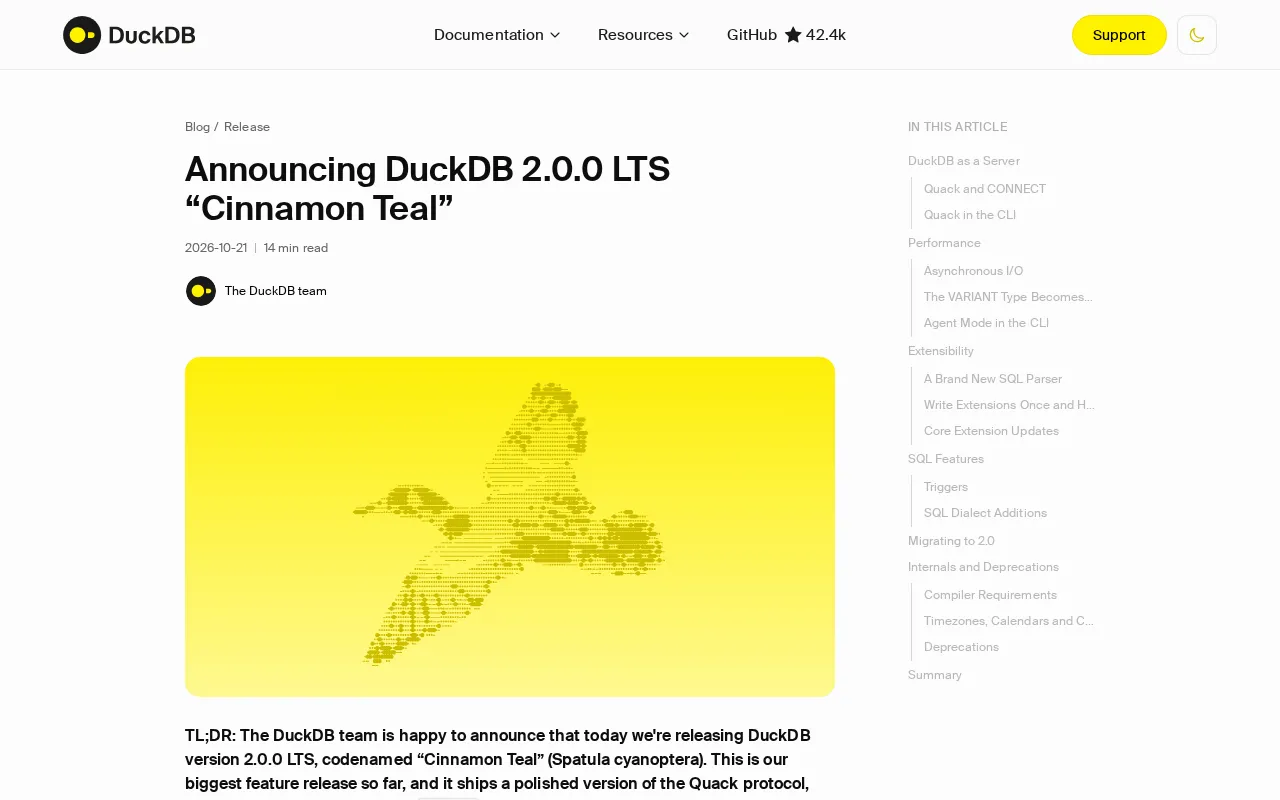
DuckDB has released version 2.0.0 LTS, codenamed "Cinnamon Teal." The release drew 296 points and 31 comments on Hacker News — a sign that the embedded analytical database is moving beyond the data science niche and into the broader engineering spotlight.
Why the LTS Label Matters
Over the past few years, DuckDB has been known for its extremely fast release cadence, with new features appearing almost monthly. For experimental projects, that pace is an advantage. But for teams embedding it into production pipelines, logging systems, or BI backends, frequent breaking changes mean ongoing retesting costs.
Attaching the LTS suffix to 2.0.0 is the project's way of sending a clear signal: this version will get a longer support window, with guarantees around API and file-format stability. For a library used as "the SQLite of analytics," that does more to lower the barrier to adoption than any single feature.
Some in the HN discussion noted that an LTS branch often marks a shift in an open-source project from "growth first" to "reliability first." DuckDB reaching this stage is itself a milestone.
LTS (Long Term Support) is a maintenance convention from the software industry: the publisher commits to providing bug fixes and security patches for a specific version over an extended period, typically without introducing breaking changes, while new features go into a separate fast-moving branch. Ubuntu, Node.js, Java, and other ecosystems all have mature LTS practices, whose core value is turning "upgrading" from a continuous burden into a plannable event. For database-class infrastructure, LTS also implies a commitment to freeze on-disk file formats and SQL semantics, so that downstream tools, backup strategies, and query logs can be reused over the long term without frequent adjustments as versions change.
Release Cadence and Ecosystem Maturity
Jumping straight from 1.x to 2.0.0 — a major version bump usually corresponds to incompatible changes under semantic versioning. Although the original announcement page did not yield a specific changelog, DuckDB's direction of evolution suggests 2.0 likely adjusted boundary behavior in extension mechanisms, storage formats, or the SQL dialect.
For existing users, the most practical step is to run regression tests on 2.0.0 with current workloads first, focusing on the compatibility of extensions (such as httpfs, parquet, and iceberg) and any custom UDFs that rely on internal behavior. The value of LTS is precisely that, after this one migration, you can stay stable for a long time without further churn.
Semantic Versioning (SemVer) specifies version numbers in the form "major.minor.patch": a major bump indicates backward-incompatible API changes, a minor bump indicates new backward-compatible features, and a patch bump indicates bug fixes. So going straight from 1.x to 2.0.0 conventionally means public interfaces may have undergone breaking changes, and upgraders need to review proactively rather than replace passively. Note that DuckDB used 0.x version numbers for a long time before 1.0, and its version semantics differ from strict SemVer; the actual scope of changes should be based on the official release notes rather than inferred from the version number alone.
The Competitive Landscape for Embedded Analytical Databases
DuckDB has always positioned itself as "in-process OLAP" — no standalone service, no network connection, embedded directly into applications as a library. This positioning makes it complementary to, rather than a replacement for, cluster-based solutions like ClickHouse and Doris.
The arrival of 2.0.0 LTS objectively shifts the competitive dimension from "who is faster" to "who is more trustworthy." Once analytical workloads enter production, the determinism of query results and the predictability of version upgrades quickly outweigh millisecond differences in benchmarks.
In-process OLAP refers to an analytical engine loaded into the application process as a library, with queries executed directly against local memory and disk without starting a separate service process or communicating over network protocols. This architecture eliminates network round-trips and serialization overhead, and removes cluster deployment and operations costs — at the price of sharing compute resources with the application and being difficult to scale horizontally across machines. Columnar storage and vectorized execution are its performance foundation: data is stored contiguously by column to improve compression and cache hits, while the execution engine processes data in batches of arrays, reducing the overhead of row-by-row interpretation. This is exactly why DuckDB can approach dedicated cluster solutions in single-machine analytical scenarios.
Who Should Pay Attention to This Release
Teams already using DuckDB in production should add 2.0.0 LTS to their upgrade evaluation plans and use the LTS window to reduce future maintenance churn. Teams still on the fence can see this as an opportunity to lower their "technology selection regret rate" — an embedded database with a long-term support commitment is easier to get through architecture reviews.
As for individual users who treat DuckDB as a temporary analytical scripting tool, upgrading is not urgent, but reviewing the 2.0 changelog can still help surface scripts that depend on old behavior.
Conclusion
The significance of DuckDB 2.0.0 LTS lies not in any specific feature, but in the project making its commitment to "stability" public. For analytical infrastructure, that is often scarcer than performance numbers.
One-line Summary
DuckDB releases 2.0.0 LTS, shifting the competitive focus from performance to reliability with a long-term support commitment.
Paragraph Summary
DuckDB has released version 2.0.0 LTS, codenamed Cinnamon Teal, drawing 296 points on Hacker News. The article argues that the LTS label matters more than any single feature: it gives teams embedding DuckDB in production pipelines a longer support window and guarantees around API and file-format stability, reducing ongoing retesting costs. The jump from 1.x to 2.0 implies incompatible changes, so existing users should first run regression tests with current workloads, focusing on the compatibility of extensions like httpfs, parquet, and iceberg as well as custom UDFs. The article also notes that DuckDB's in-process OLAP positioning complements rather than replaces cluster solutions like ClickHouse and Doris, and that LTS shifts the competitive dimension from speed to trustworthiness.
Related articles
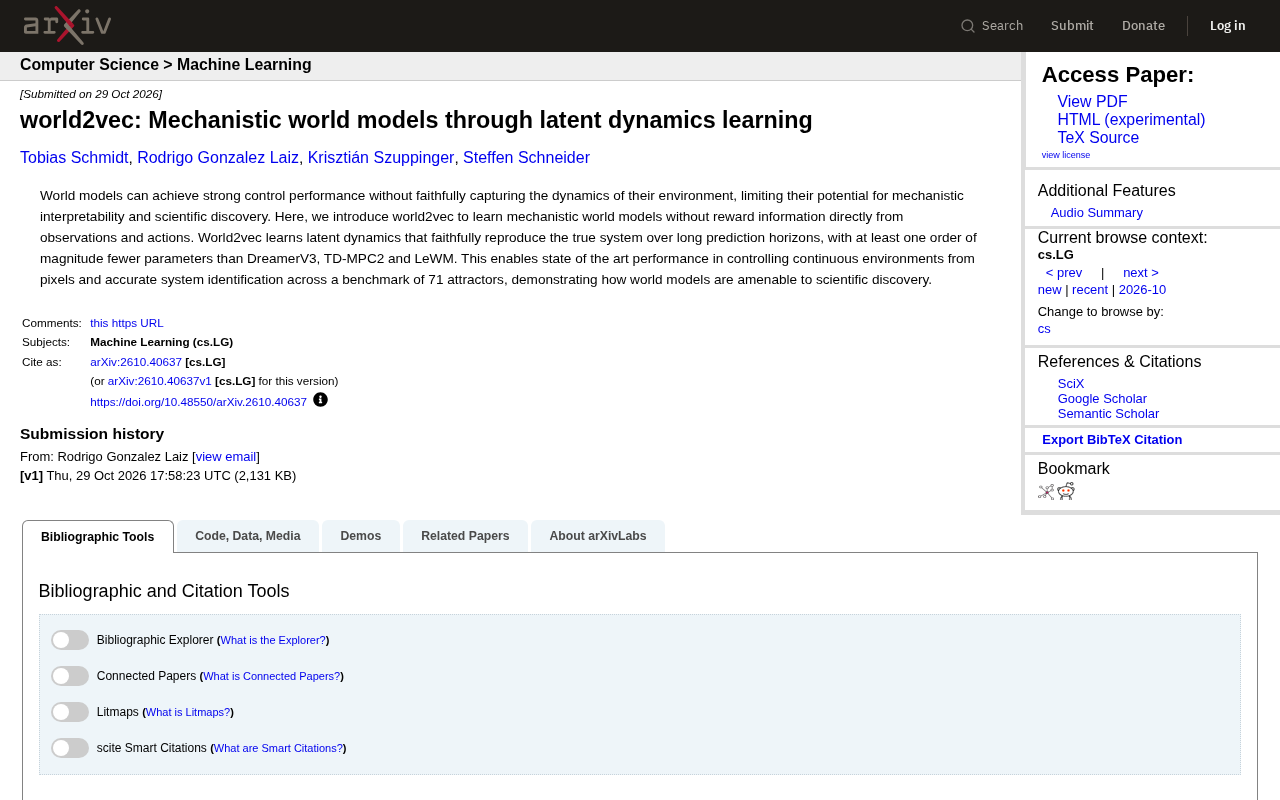
world2vec: Building Mechanistic World Models with Latent Dynamics Learning
world2vec proposes a reward-free method for learning mechanistic world models via latent dynamics, faithfully reproducing systems over long horizons with at least an order of magnitude fewer parameters than DreamerV3, TD-MPC2, and LeWM, and achieving accurate system identification on 71 attractor benchmarks.

A New KL-DRO Paradigm: Adaptive Scenario Generation Around a Learned Density Model
KL-DRO research proposes centering the KL ball on a learned density model instead of the empirical distribution, with adaptive scenario generation guiding sampling toward the worst case. Experiments show lower cost under distribution shift when records are scarce and the model can extrapolate, with comparable in-distribution cost.

ODE Samplers for Discrete Diffusion Models: Exponential Residual Flows Accelerate Generation
Discrete diffusion models lack deterministic ODE sampling? This article introduces Exponential Residual Flows (ERFs), which introduce continuous residual variables per token to construct piecewise ODEs for deterministic sampling and support consistency distillation acceleration. Superior to prior methods on code and text generation tasks.