Dueling DQN Explained: Decoupling State Value and Advantage Functions

Dueling DQN improves network representational efficiency by decoupling state value and advantage functions, and can be combined with Double DQN.
Based on the "RL From Scratch" series on Reddit, this article systematically reviews the core concepts, design motivation, and implementation points of Dueling DQN. Dueling DQN is an off-policy, model-free value-based method that splits the final layer of the Q-network into two branches for state value V(s) and advantage function A(s,a), then combines them via Q = V + A - mean(A). This architecture allows the network to learn state values separately, making it more efficient in tasks where action influence is weak or state evaluation is more critical. The article uses a highway driving example to illustrate that not all states require precise Q values for every action. Compared with Double DQN, Dueling DQN addresses network representation optimization rather than overestimation, and the two can be combined. Implementation requires little change to the original training pipeline but can improve representational efficiency. Finally, it notes that the architecture is not a panacea and should be evaluated for specific problems.
Reinforcement learning (RL) has advanced rapidly in recent years, yet many learners still struggle with DQN and its variants. A Reddit blogger is publishing a series of notes titled "RL From Scratch," and the latest installment focuses on Dueling DQN, attempting to answer three core questions: what it is, why use it, and how to implement it. This article draws on the key points of those notes and combines them with fundamental RL theory to organize and analyze the design motivation and engineering value of Dueling DQN.
What Is Dueling DQN?
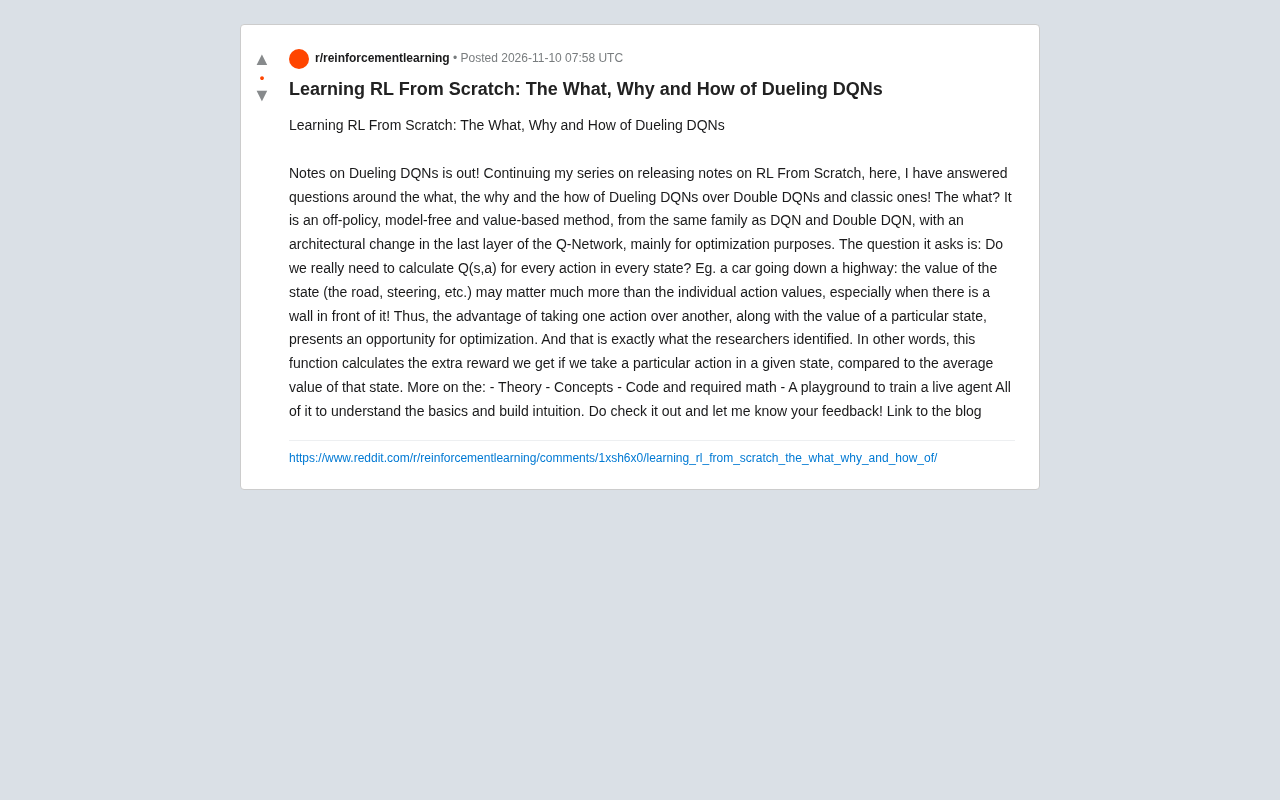
According to the blogger's definition, Dueling DQN is an off-policy, model-free, value-based method that belongs to the same family as DQN and Double DQN. Its most distinctive feature is an architectural adjustment at the final layer of the Q-network, splitting the structure that originally outputs Q(s,a) directly into two branches: one estimating the state value V(s), and the other estimating the advantage function A(s,a). The main purpose of this change is optimization rather than altering the core assumptions of reinforcement learning.
Mathematically, Dueling DQN still ultimately outputs Q values, but the decomposition allows the network to learn more efficiently. The state value V(s) measures the long-term return of being in a given state, while the advantage function A(s,a) measures the extra return from taking a specific action relative to the average. Adding the two together (and subtracting the mean of the advantages to ensure identifiability) recovers the Q value.
The Advantage Function A(s,a) and Identifiability
The advantage function A(s,a) is defined as Q(s,a) - V(s), i.e., the extra return from taking action a relative to the average action performance in that state. This definition is inherently underdetermined (unidentifiable): given a Q value, there are infinitely many ways to decompose it into V and A. Dueling DQN eliminates this ambiguity by forcing the mean of the advantage function to zero (i.e., subtracting mean(A)), thereby guaranteeing a unique Q value from the network output. Mathematically, this constraint is equivalent to making V(s) an unbiased estimate of the state value, while A(s,a) reflects only the relative differences among actions. Understanding this helps clarify why the Dueling architecture can still learn Q values correctly while allowing the V branch to focus on capturing the overall quality of a state.
Why Use Dueling DQN?
In the notes, the blogger poses a straightforward question: do we really need to compute Q(s,a) for every action in every state? He uses the example of a car driving on a highway—the value of the road, steering, and other states may be far more important than the subtle differences among individual actions, especially when there is a wall ahead, where the danger level of the state directly determines the urgency of the decision.
This example reveals a potential inefficiency in traditional DQN: in many states, the value differences among actions are not large, and what really matters is the quality of the state itself. The Dueling architecture allows the network to learn state values separately, thereby allocating fewer computational resources to action selection. The advantage function focuses on learning the "extra reward," i.e., the advantage of taking a certain action relative to the average performance in that state. This decoupling makes the network more stable when evaluating states, especially in scenarios with large action spaces or weak action influence.
Compared with Double DQN, Dueling DQN addresses a different dimension of the problem. Double DQN primarily mitigates Q-value overestimation, whereas Dueling DQN focuses on optimizing the network's representational capacity. The two can be combined, and such combinations are common in practice.
Double DQN and Q-Value Overestimation
Double DQN is another important improvement to DQN, aimed at mitigating Q-value overestimation. Standard DQN uses the same network to both select and evaluate actions, which easily leads to optimistic bias in Q values. Double DQN decouples action selection from evaluation: the online network selects the action, and the target network evaluates the value of that action. This change significantly reduces overestimation and makes training more stable. Unlike Dueling DQN, Double DQN does not change the network structure but adjusts how the target Q value is computed. The two can be combined orthogonally, i.e., Dueling Double DQN, enjoying both improved representational efficiency and reduced overestimation.
How to Implement and Learn?
In the notes, the blogger promises to cover theory, concepts, code, and the necessary math, and provides a playground for training a real-time agent to help readers build intuition. Although the original text does not elaborate on specific code details, the key implementation points of Dueling DQN typically include: after the convolutional or fully connected layers, splitting into two streams that output a scalar V(s) and a vector A(s,a), respectively, and finally combining them via Q = V + A - mean(A). This architectural change has little impact on the original DQN training pipeline but can bring improvements in representational efficiency.
For learners, the key to understanding Dueling DQN is not memorizing formulas but grasping the intuition behind it: separating state value from action advantage allows the network to make reasonable decisions even when it does not need to precisely distinguish every action. This aligns with human driving experience—most of the time we focus on the road conditions themselves rather than every tiny operational difference.
Engineering Details of the Combination Formula Q = V + A - mean(A)
In practical implementation, the combination formula Q = V + A - mean(A) requires attention to several points: first, V(s) typically outputs a scalar, while A(s,a) outputs a vector of length equal to the action space; second, subtracting the mean is performed along the action dimension, ensuring that the mean advantage is zero in each state; finally, this combination is end-to-end for the network's forward pass, and gradients flow to both the V and A branches simultaneously. Another common variant is subtracting the maximum advantage (Q = V + A - max(A)), but subtracting the mean is more common because it is more stable and computationally simple. In implementation, one only needs to add two parallel fully connected layers after the final layer and then combine them according to the formula, with almost no modification to the original DQN training loop.
Positioning from Multiple Perspectives
It should be noted that current discussion of Dueling DQN mainly comes from this blogger's series of notes. In the reinforcement learning community, Dueling DQN, as one of the classic improvements to DQN, has been widely accepted and applied to various value-based methods. Its core idea—decoupling state value and advantage function—has also been borrowed by subsequent research. However, regarding the specific magnitude of its benefits across different tasks, the community holds different views: some argue that the improvement is limited when the action space is small, while the advantage is more pronounced in tasks where state evaluation is more important. This divergence itself indicates that the Dueling architecture is not a universal key and needs to be evaluated in the context of specific problems.
Overall, Dueling DQN offers an elegant perspective: rather than having the network learn the values of states and actions simultaneously, let them each focus on their own. For readers building their reinforcement learning knowledge system from scratch, this note is worth reading.
Related articles

Jensen Huang Returns to Nvidia: The Power Game Behind an "Aggro Reset"
Nvidia's board reappointed Jensen Huang as CEO less than two weeks after his scandal-driven resignation. This analysis explores the board's decision-making, Trump's political intervention, media power failure, and market reaction behind the dramatic return.

Why Voice AI Can't Understand Kenyans' Everyday Conversations
Swahili speech recognition hits 3.24% error on read text, but everyday Kenyan speech mixes English, Sheng slang, and accents—leaving mainstream voice AI struggling.

Data Centers Build Their Own Natural Gas Plants: AI Compute's Breakout Around a Decade-Long Grid Wait
Grid interconnection approvals can take a decade, so xAI and others are building off-grid natural gas plants to power AI clusters. This article analyzes the drivers, costs, and impact of behind-the-meter generation on AI infrastructure.