DySR-GNN: Dynamic Sensor Relationship Graph Neural Network Solves Automotive HiL Root Cause Analysis Challenges

DySR-GNN dynamically reconstructs sensor relationship graphs for each input window, achieving a record-level Macro-F1 of 0.9524 in automotive HiL multi-label root cause identification.
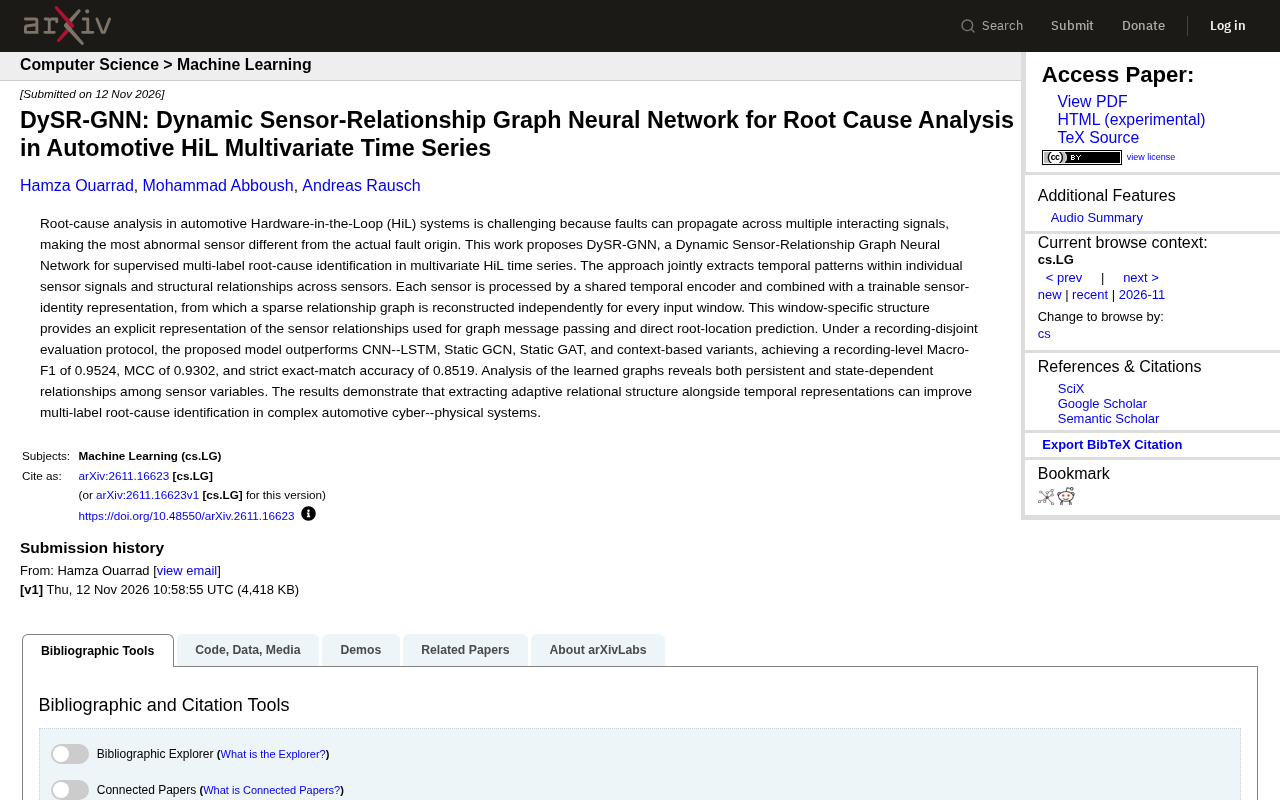
To address the issue in automotive Hardware-in-the-Loop testing where fault signals propagate across sensors and the most anomalous signal may not be the fault source, DySR-GNN proposes a Dynamic Sensor Relationship Graph Neural Network for supervised multi-label root cause identification. The model uses a shared temporal encoder and trainable sensor identity representations to reconstruct a sparse relationship graph in a data-driven manner for each input window, then directly predicts root cause locations through graph message passing, modeling both temporal patterns and structural relationships. In record-level disjoint evaluation, it achieves record-level Macro-F1 of 0.9524, MCC of 0.9302, and strict exact match accuracy of 0.8519, outperforming CNN-LSTM and static GCN/GAT baselines. The learned graph structure contains both persistent and state-dependent relationships, providing interpretability to help engineers narrow down the investigation scope.
In automotive Hardware-in-the-Loop (HiL) testing, fault signals often propagate across multiple interrelated sensors, so the most anomalous sensor is not necessarily the true source of the fault. To address this pain point, a study called DySR-GNN proposes using a Dynamic Sensor Relationship Graph Neural Network for supervised multi-label root cause identification. The method stands out among multiple baselines, achieving a record-level Macro-F1 of 0.9524, offering a new approach for fault localization in complex automotive cyber-physical systems.
Why HiL Root Cause Analysis Is So Difficult
In automotive HiL systems, sensor signals do not exist in isolation. A fault in one sensor may propagate to other sensors through physical coupling or control logic, creating the dilemma that "anomalous signal ≠ fault root cause." Traditional methods often focus only on temporal anomalies of individual signals, ignoring the structural relationships between sensors, making it difficult to distinguish propagation effects from the true fault source.
The core insight of this research is that the relationships between sensors are themselves dynamic—the dependency structure among signals differs under different operating conditions. If a sensor relationship graph can be reconstructed individually for each input window, fault propagation paths can be characterized more accurately, thereby pinpointing the root cause.
Hardware-in-the-Loop (HiL) testing is a key validation method in automotive electronics development: real ECUs (Electronic Control Units) are connected to a virtual vehicle environment built by a real-time simulator, with software simulating the engine, transmission, sensors, and other controlled objects, thereby reproducing real-vehicle conditions in the laboratory. Compared with real-vehicle road testing, HiL testing can safely and repeatably inject faults and collect massive amounts of signals, making it an important data source for fault diagnosis algorithms. However, precisely because the simulation environment is highly coupled, a fault injected at one sensor propagates through control logic to multiple related signals, forming a multi-label anomaly pattern—this is exactly the difficulty that root cause identification must face.
How DySR-GNN Works: Temporal Encoding and Dynamic Graph Reconstruction
The design of DySR-GNN revolves around two key modules. First is a shared temporal encoder that independently extracts temporal patterns from each sensor signal; second is a trainable sensor identity representation that, combined with each sensor's temporal features, reconstructs a sparse relationship graph for each input window.
This window-specific graph is not a static prior but is generated in a data-driven manner, and is then used for graph message passing and direct root cause location prediction. In other words, the model simultaneously learns "how signals change over time" and "how sensors influence each other," fusing both into a multi-label classification framework.
This design stands in sharp contrast to static graph methods: static GCN or GAT use fixed adjacency matrices and cannot reflect relationship changes during operating condition switches; whereas DySR-GNN's dynamic graph structure can capture state-dependent sensor associations.
Graph Neural Networks (GNNs) are a class of models that perform representation learning directly on graph structures: nodes carry features, edges represent relationships between nodes, and through message passing mechanisms each node aggregates information from its neighbors. In the sensor scenario, nodes are the sensor signals and edges are the dependencies between sensors. The key advantage of GNNs is that they can explicitly exploit structural priors, whereas traditional temporal models (such as CNN-LSTM) can only treat multiple signals as parallel channels. The innovation of DySR-GNN lies in making the "edges" learnable as well—the adjacency matrix is no longer fixed but jointly generated from sensor identity representations and temporal features, allowing the graph structure to adaptively change with the input window.
Experimental Results: Dynamic Graph Structure Brings Significant Advantages
Under a record-level disjoint evaluation protocol, DySR-GNN was compared with CNN-LSTM, static GCN, static GAT, and context-based variants. The results show that DySR-GNN leads on multiple metrics: record-level Macro-F1 of 0.9524, MCC of 0.9302, and strict exact match accuracy of 0.8519.
Behind these numbers is a key conclusion: temporal modeling alone is insufficient to handle fault propagation in HiL scenarios; only by explicitly modeling the adaptive relationship structure between sensors can the accuracy of multi-label root cause identification be effectively improved. In particular, you may not have noticed the strict exact match metric—it requires the model to hit all root causes exactly under the multi-label setting, which is far more difficult than single-label accuracy. A score of 0.8519 indicates that the model can provide completely correct root cause combinations on most record segments.
Macro-F1, MCC, and strict exact match are three commonly used metrics for evaluating multi-label classification, each with different emphases. Macro-F1 first computes the harmonic mean of precision and recall for each class individually, then averages across classes, so it is equally sensitive to minority-class root causes and will not be overshadowed by high-frequency classes. MCC (Matthews Correlation Coefficient) comprehensively considers true positives, true negatives, false positives, and false negatives, ranges from -1 to 1, and is more robust than accuracy under class imbalance. Strict exact match requires that the set of root causes predicted for a sample be exactly identical to the true set—any over-reporting or under-reporting is judged incorrect—making it the most stringent of the three. A score of 0.8519 means that about 85% of record segments had their root cause combinations fully hit.
What the Learned Graph Structure Reveals
The research team analyzed the relationship graphs learned by the model and found that both persistently stable associations and state-dependent relationships exist among sensor variables. This finding has dual significance. On one hand, persistent relationships may correspond to physically fixed couplings or hard connections in the system design; on the other hand, state-dependent relationships reflect the dynamic switching of fault propagation paths under different operating conditions.
This interpretability makes DySR-GNN more than a black-box classifier—it can provide engineers with a reference for fault propagation structure. For automotive HiL testing, understanding "which sensors are linked under specific operating conditions" helps narrow the scope of investigation and accelerates the root cause localization process.
Record-level disjoint evaluation is the key experimental design that ensures the credibility of the study's conclusions: all time windows within the same test record segment appear only on one side of the training or test set, and are never split across both. If windows were randomly divided, adjacent windows would be highly similar, and the model could "cheat" by memorizing record segment features, leading to inflated metrics. Record-level splitting simulates the real deployment scenario of facing entirely new test record segments, so the Macro-F1 of 0.9524 better reflects the model's generalization ability to unseen operating conditions.
Implications for Automotive Cyber-Physical Systems
The value of DySR-GNN is not limited to HiL scenarios. Any system involving multivariate time series where faults propagate across variables—such as in-vehicle networks, powertrain monitoring, or even industrial control systems—could benefit from dynamic relationship graph modeling.
The methodological signal from this research is clear: in multi-sensor systems, "relationships" are as important as "values." Jointly learning adaptive graph structures and temporal representations is a viable path to improving root cause analysis capabilities in complex systems. As automotive electronic architectures become increasingly complex, methods that balance accuracy and interpretability like this are expected to become an important supplement to HiL test analysis tools.
One-line Summary
DySR-GNN dynamically reconstructs sensor relationship graphs for each input window, achieving a record-level Macro-F1 of 0.9524 in automotive HiL multi-label root cause identification.
Paragraph Summary
To address the problem in automotive Hardware-in-the-Loop testing where fault signals propagate across sensors and the most anomalous signal is not necessarily the fault source, DySR-GNN proposes using a Dynamic Sensor Relationship Graph Neural Network for supervised multi-label root cause identification. The model consists of a shared temporal encoder and trainable sensor identity representations, reconstructing a sparse relationship graph in a data-driven manner for each input window, then directly predicting root cause locations through graph message passing, thereby simultaneously modeling signal temporal patterns and inter-sensor structural relationships. In record-level disjoint evaluation, it achieves a record-level Macro-F1 of 0.9524, MCC of 0.9302, and strict exact match accuracy of 0.8519, outperforming baselines such as CNN-LSTM and static GCN/GAT. The learned graph structure contains both persistently stable relationships and state-dependent relationships, offering interpretability that can help engineers narrow the scope of investigation.
Related articles

Gemini 4 Neon Leak: A Potential Strong Contender Against Opus 5.5
A Hacker News thread suggests Gemini 4 Neon looks like an Opus 5.5 competitor. This article unpacks the product positioning behind this community signal, shifts in the top-model competitive landscape, and what it means for developers' model selection strategy.

Claude Fable 5.2's Self-Authored Short Film 'Fable' Sparks Discussion
A short film 'Fable,' credited to Claude Fable 5.2 for script, visuals, and directing, appears on Hacker News. This article analyzes the significance of full-pipeline AI creation, community reactions, and what it means for content creators.

Anthropic IPO Pricing: A Signal of AI Giants Going Public
Anthropic's IPO pricing draws attention. This article analyzes its potential impact on AI industry valuation, commercialization paths, and the competitive landscape, and highlights public-market expectations and challenges for AI companies.