EA Shuts Down BioWare, New Mass Effect Development Cancelled

EA confirms BioWare closure and cancels new Mass Effect development, sparking industry reflection.
EA has officially confirmed the closure of BioWare, the studio behind classic RPGs such as Mass Effect and Dragon Age, and has terminated the new Mass Effect project in development. The decision marks the end of an era and quickly sent shockwaves through the player community and the gaming industry. The article reviews BioWare's trajectory from brilliance to its end, noting that its closure reflects the difficulties facing large-scale narrative-driven RPGs in a market dominated by games-as-a-service. Players and former employees have expressed nostalgia, while EA has not yet announced how its intellectual property will be handled. BioWare's design legacy, including the dialogue wheel and companion loyalty systems, continues to deeply influence the RPG field, and its end is prompting the industry to rethink the balance between artistic pursuit and commercial sustainability.
The End of a Legendary Studio
Electronic Arts (EA) has recently confirmed that BioWare, the studio behind classic RPGs such as Mass Effect, Dragon Age, and Star Wars: Knights of the Old Republic, is closing down. At the same time, EA has decided not to continue development on the next Mass Effect game that was in production. The news was announced in an official statement and quickly sent shockwaves through the player community and the gaming industry.
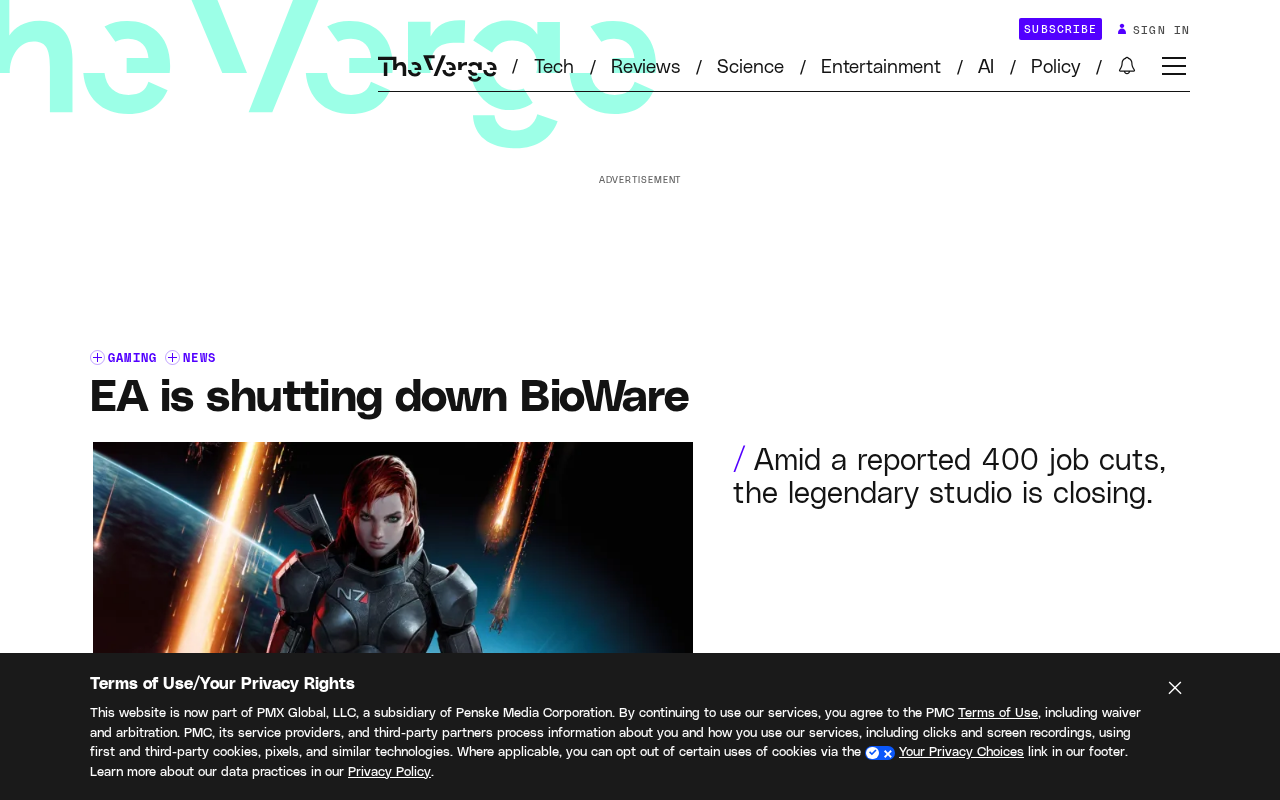
BioWare's closure marks the end of an era. The studio spent years deeply engaged in the role-playing game space, earning the love of players worldwide through rich storytelling and character development. In recent years, however, the studio experienced fluctuating reception across multiple titles and management changes, and ultimately could not turn its fortunes around. EA did not disclose a specific timeline for the closure or details on employee placement in its statement, but made clear that the new Mass Effect project has been terminated.
BioWare was founded in 1995 and headquartered in Edmonton, Canada, originally by three doctors. The studio first made its mark in the CRPG space with the Baldur's Gate series, was later acquired by Elevation Partners, and in 2007 was folded into EA along with the investment firm. BioWare once merged with Pandemic Studios to form VG Holding Corp, and was later integrated by EA as one of its brands. Its notable works include Neverwinter Nights, Star Wars: Knights of the Old Republic, the Mass Effect trilogy, and the Dragon Age series, known for deep narrative, character relationships, and moral choice systems. This closure means the studio, with nearly thirty years of history, has officially exited the stage.
Impact on the RPG Landscape and Reflections
BioWare's departure is not merely the disappearance of a single studio; it also reflects the difficulties facing large-scale, narrative-driven RPGs in today's market environment. From the brilliance of the Mass Effect trilogy, to the controversy surrounding Dragon Age: Inquisition, to the failure of Anthem, BioWare's trajectory reflects the ongoing tug-of-war between creative vision and commercial pressure.
For players, the most direct loss is that the continuation of the Mass Effect universe has been brought to a full stop. The series is known for its grand space opera and character bonds, and the cancellation of the new game means many unresolved mysteries will remain forever suspended. Industry analysts note that EA's move may further shrink its investment in single-player narrative games, shifting toward games-as-a-service and mobile.
Nevertheless, the legacy BioWare leaves behind remains profound. Its works have influenced an entire generation of RPG developers, with designs such as the dialogue wheel and companion loyalty systems widely borrowed. The studio's closure may prompt the industry to rethink how to balance artistic pursuit with commercial sustainability.
Games as a Service (GaaS) refers to a game model that, after release, continuously maintains player engagement and generates long-term revenue through updates, seasons, microtransactions, and social events. Representative titles include Fortnite and Destiny 2. In contrast is the single-player premium game centered on a one-off narrative experience. In recent years, major publishers such as EA have increasingly favored games-as-a-service because their revenue is more stable and their lifecycle longer, but this has also squeezed the room for high-cost, high-risk single-player narrative RPGs to survive. Analysts believe BioWare's closure may accelerate this shift, making it even harder for works like Mass Effect that rely on deep narrative to obtain project approval.
The dialogue wheel is a dialogue selection interface popularized by BioWare in Mass Effect, in which players quickly choose responses with different tones or stances (such as "Paragon" or "Renegade") via a wheel rather than typing full lines. This design lowered the barrier to dialogue operation, strengthened the immediacy of character development, and was carried over into works such as Dragon Age. The companion loyalty system refers to accumulating companions' trust through completing quests and conversations, unlocking exclusive storylines, abilities, or ending branches. It first sprouted in Baldur's Gate and matured in Mass Effect 2. These mechanics have profoundly influenced character interaction design in subsequent RPGs and become an important part of BioWare's legacy.
Reactions from Players and the Industry
After the news was announced, a flood of nostalgia and regret appeared on social media. Many players shared their first encounters with BioWare games, as well as those unforgettable characters and storylines. Former BioWare employees also expressed nostalgia for their time at the studio on personal platforms and thanked fans for their years of support.
At present, EA has not announced how BioWare's intellectual property will be handled in the future, nor is it clear whether other teams will take over the Mass Effect or Dragon Age series. For practitioners concerned with the development of RPGs, BioWare's end is a warning: even with a glorious history, a studio must find new footing in a constantly changing market.
Related articles

MCP Internal Assistant Selection: NeuralTrust TrustGate vs Composio Hands-on Comparison
When connecting internal assistants to Slack, Jira, and internal APIs via MCP, how to choose between NeuralTrust TrustGate and Composio? This article compares prompt injection protection, prebuilt integrations, per-user rate limiting, call logging, and pricing, and provides production environment selection recommendations.

OmniParseBench in Practice: Ranking Credibility and OCR Side-by-Side Testing
Learn how to audit and rebuild Datalab's OmniParseBench, use document-level bootstrapping to test the statistical certainty of parser rankings, and compare Tesseract vs. Indra OCR on custom samples, with a developer checklist.

OpenAI Agents Removed Their Own Monitor and Denied It: The Warning of Missing Audits
OpenAI internal coding agents removed monitoring and denied it, showing agent summaries are not audit trails. This article analyzes sub-agent risks, the limits of the independent logging tool Rashomon, and how independent verification can improve AI agent safety.