Earlyn: Turn Your Mac Screen and Meetings into a Searchable Memory Bank

Earlyn turns your Mac screen and meetings into a searchable, encrypted local memory bank with MCP support for AI coding tools.
Earlyn is a Mac-native "screen memory" tool that continuously captures on-screen content and meeting conversations, turning them into a locally encrypted, timeline-browsable, full-text-searchable database. Beyond screen capture, it supports meeting transcription and live translation in any language, and uses the MCP protocol to feed accumulated personal context directly into AI coding tools like Claude Code, Codex, and Cursor. All capture, search, and transcription runs locally with no data uploaded by default. Pricing is $19/month after a 7-day free trial, targeting information-intensive professional users.
A "Screen Memory" Tool Built for Mac
Every day we browse, read, and sit through meetings on our computers — and most of what we see slips away almost immediately. When you want to find something you came across earlier, you're left relying on fragmented memories and tedious manual searching. Earlyn, a new tool that recently landed on Product Hunt, aims to solve exactly this problem: it builds an encrypted, searchable "screen and meeting memory" on your Mac and lets you ask questions about anything that happened during your day.
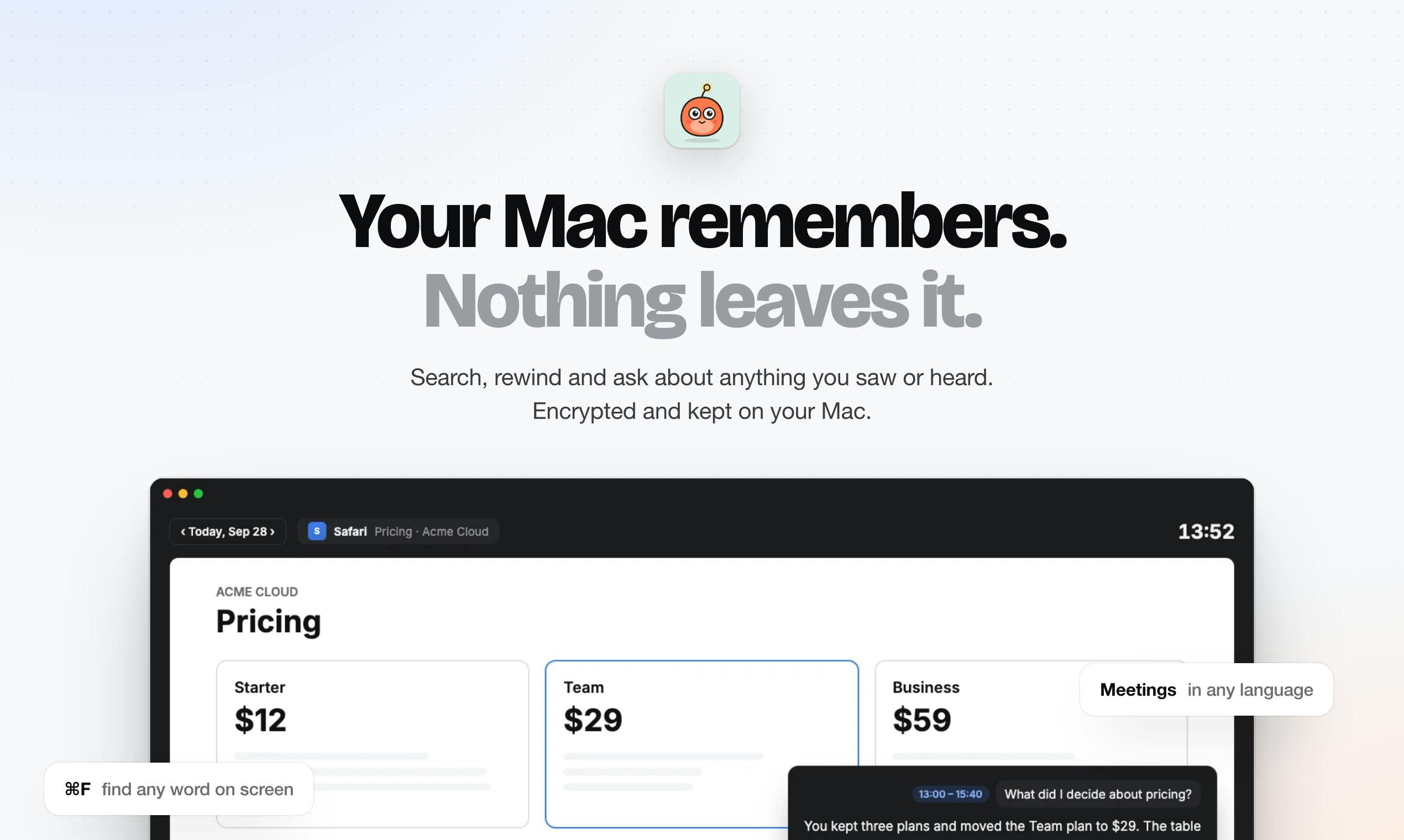
The product's core positioning is straightforward — Searchable memory of your screen and meetings. It continuously captures what appears on your screen and what's said in your meetings, making "I think I saw this somewhere yesterday" a question you can actually answer. The product currently has 74 upvotes and 7 comments on Product Hunt, ranking #20.
Core Features: Timeline Scrubbing and Full-Text Search
Earlyn's most compelling capability is transforming your screen activity into searchable data. Users can scrub back through a timeline — like dragging a video progress bar — to review their screen history from any point in the day, and find any word they saw on screen at any time.
This means that whether it's a webpage that flashed by in your browser, a paragraph in a document, or a line of text in a chat window — if it appeared on your screen, it can theoretically be retrieved. For knowledge workers, researchers, and anyone who switches between multiple apps throughout the day, this kind of "external memory" delivers immediate, practical value.
Meeting Transcription and Live Translation
Beyond screen memory, Earlyn also covers meeting scenarios. It can generate meeting transcripts in any language and supports live translation.
As cross-language collaboration becomes increasingly common, real-time meeting translation and post-meeting transcription are clearly in demand. Combined with a searchable memory bank, users can not only quickly review meeting content afterward, but also pinpoint key discussion points directly — without replaying recordings or digging through notes.
Context Integration with AI Coding Tools
For developers, there's a particularly noteworthy design choice: Earlyn can deliver your context to AI coding tools like Claude Code, Codex, or Cursor via MCP (Model Context Protocol).
This opens up an interesting direction. The effectiveness of AI coding assistants depends heavily on the context they have access to, and the "screen memory" Earlyn accumulates is exactly the kind of rich personal work context these tools need. Feeding that information to a coding assistant via the MCP standard protocol means the AI can more accurately understand what you've been working on recently and what materials you've reviewed — enabling more relevant, situationally aware responses. This combination of a "personal memory layer" and AI tooling may well be a signal of where local AI applications are heading.
MCP (Model Context Protocol) is an open standard introduced by Anthropic in late 2024, designed to address the challenge of passing context between large language models and external data sources or tools. Analogous to the "universal" philosophy behind USB-C, MCP aims to give AI applications a standardized "slot" so that different data sources — local files, databases, application memory, and more — can connect to any MCP-compatible AI client in a uniform way. Claude Code, Cursor, and other tools have already announced MCP support, meaning any app that implements an MCP server (like Earlyn) can seamlessly supply context to these tools without needing a custom integration for each one. As this protocol gains adoption, it's driving the formation of a composable ecosystem between the "personal data layer" and the "AI tool layer."
Privacy-First: Local Execution Is the Key Selling Point
Screen-recording tools naturally raise privacy concerns — after all, they "see" everything on your screen. Earlyn's answer is a local-first approach: capture, search, and transcription all run on your own Mac, and nothing is sent unless you pick a cloud model or connect an app. All memory data is also stored encrypted.
This design is consistent with the product being categorized under Privacy. Against a backdrop where similar "screen memory" products routinely face data security scrutiny, keeping computation and storage on-device as much as possible is a pragmatic choice for earning user trust.
Earlyn isn't alone in the "screen memory" space. Microsoft launched Recall in 2024 — a feature designed to continuously screenshot Copilot+ PCs and build a searchable activity history — but faced such intense privacy backlash and pushback from security researchers that it was delayed multiple times and significantly scaled back before launch. Similarly, Rewind (later rebranded as Limitless) offered continuous screen and audio recording, and has long contended with data security concerns. This context makes "local-first" more than just an architectural choice — it's a prerequisite for earning user trust in this category. Earlyn's explicit commitment to "no uploads by default" is, in part, a direct response to the cautionary tales already written by others in the space.
Pricing and Positioning
Earlyn offers a 7-day free trial, followed by $19/month. That price point positions it toward professional users who are willing to pay for productivity and AI capabilities — not a mass-market free tool.
Taken together, Earlyn integrates screen memory, meeting transcription and translation, and AI tool context delivery into a single local-first Mac application, targeting a genuine pain point for information-intensive workers. Whether it can truly become a user's "second brain" will come down to retrieval accuracy, performance overhead, and the long-term privacy experience — things that only hands-on use can verify. But as a product concept, it represents a clear and coherent direction: combining local AI with personal memory management.
Related articles

Why Does the Tesla Roadster Need to Fly? A Deep Dive into Musk's Wild Demo
Tesla's Roadster launch showed wall-climbing, upside-down driving, and flying stunts—but The Vergecast notes the demo car may lack a battery, the Rocket version is invite-only and not street-legal, and the website terms don't guarantee delivery. After nine years of delays, why does this car still need to exist?

AI Is Not a Replacement: Human-AI Collaboration Through the Lens of Factory Root Cause Analysis
Starting from factory root cause analysis, this article explains how AI accelerates evidence chain construction rather than replacing human experts, exploring the pragmatic implementation logic and business value of 'AI supporting people rather than replacing them.'

AI Agent Decision Auditing: Building an Evidence Chain in Regulated Workflows
Starting from a Reddit discussion, this article analyzes three core issues in AI agent decision auditing within regulated workflows: what fields audit records should contain, how to handle feedback latency for erroneous decisions, and how to continuously calibrate LLM judge consistency with human judgment.