Earth's Diameter Is Exactly 500 Million Inches? Unpacking This Eerie Mathematical Coincidence

Earth's diameter ≈ 500 million inches because the meter's definition and a π/8 coincidence cancel out perfectly.
Earth's pole-to-pole diameter is approximately 500 million inches — accurate to within a tenth of a percent. This isn't cosmic design; it's two layers of human and mathematical coincidence stacking up. First, the 1790 definition of the meter made Earth's circumference a round 4 billion centimeters. Second, the cm-to-inch conversion factor (0.3937) happens to be very close to π/8. When you divide by π to get the diameter and then multiply by π/8 to convert units, the two π values cancel, leaving 4 billion ÷ 8 = 500 million — a surprisingly clean integer.
A Seemingly Absurd Unit Hiding a Stunning Pattern
The inch was originally defined as the width of three barleycorns laid end to end. That sounds laughably arbitrary — by that logic, a yard might as well equal "the length of a child's dream," and a gallon could hold "four wishes." Units based on grains and gut feelings have long been dismissed as imprecise and unscientific.

And yet this "made-up" inch produces a spine-tingling coincidence at planetary scale. Ask yourself: how many inches fit across Earth's diameter, from pole to pole? Intuition suggests the answer should be some messy decimal — the kind of number you'd expect when mixing informal units with cosmic distances.
The Answer Is Exactly Five Hundred Million Inches
The actual result: approximately 500 million inches, accurate to within one-tenth of a percent. Earth's diameter is almost precisely a clean, round number of inches.

Does Earth somehow "prefer" the inch? Of course not. This is a coincidence — and one triggered by another coincidence. To understand it, we need to go back to how the meter was defined.
The Hidden Setup: How the Meter Was Defined
In 1790, the meter was defined as one ten-millionth of the distance from the equator to the North Pole along the meridian passing through Paris. That definition deliberately injected a round integer into the system — which means Earth's full meridional circumference comes out to exactly 40 million meters, or 4 billion centimeters.

The "4 billion" is a human-engineered round number. Nothing mysterious there. The problem arises when you want to go from circumference to diameter: diameter equals circumference divided by π. And π, being irrational, turns any tidy integer into an ugly mess the moment it enters the equation.
This measurement project was led by the French Academy of Sciences during the Revolutionary era. Astronomers Delambre and Méchain spent seven years surveying the arc from Dunkirk to Barcelona, then extrapolating to the full quarter-meridian from equator to pole. The "one ten-millionth" ratio was a deliberate choice — designed to keep everyday numbers clean. But due to the limitations of 18th-century instrumentation, their estimate of Earth's oblateness contained a small error, meaning the actual meridional circumference under the modern metric system is not a strict 40,000,000 meters but approximately 40,007,863 meters. This tiny discrepancy actually makes the "500 million inches" coincidence both more fragile and more fascinating: it rests on a human-defined approximation that was itself imprecise, yet still holds to within a tenth of a percent.
Two Irrational Numbers That Cancel Each Other Out
Converting centimeters to inches requires multiplying by 0.3937 — an awkward-looking factor. But it turns out to be remarkably close to π/8. In other words, 8 centimeters is approximately π inches.
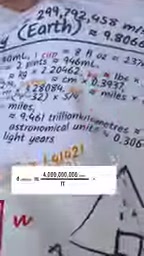
Now chain the whole calculation together:
- Earth's circumference = 4 billion centimeters
- Diameter = circumference ÷ π (introducing one π)
- Convert to inches = multiply by approximately π/8 (introducing another π)
The key: dividing by π and then multiplying by π/8 means the two π values cancel each other out. The entire calculation collapses to: 4 billion ÷ 8 = 500 million. A clean, whole number emerges from the fog.
π/8 ≈ 0.39270, while the exact centimeter-to-inch conversion factor is 0.393701 (the reciprocal of 2.54 cm per inch). The difference is about 0.00100, a relative error of roughly 0.25%. It's this "small but nonzero" gap that makes the result approximately 500 million rather than a perfect 500,000,000 — the "within a tenth of a percent" claim in the article refers to this ~0.25% deviation. Approximating irrational numbers is extremely common in engineering and physics (think π ≈ 22/7 or π ≈ 355/113); the relationship 0.3937 ≈ π/8 is an accidental discovery, not anything historically designed.
The Mathematical Beauty Behind the Coincidence
What makes this result feel "eerie" isn't that nature follows some mystical order. It's that two independent factors — one human, one mathematical — happened to align: the definition of the meter artificially produced a round circumference of 4 billion centimeters, and the centimeter-to-inch conversion factor happened to be close to π/8. The two π values cancelled in the formula, leaving 500 million as a clean integer.
This is a reminder that many apparently revelatory "laws of the universe," when traced to their foundations, turn out to be accidental alignments of definitional choices and constant approximations. Coincidences like this carry no supernatural significance, and they don't suggest that any one unit system is superior to another. But they do reveal the fascinating hidden connections that numbers sometimes form — elegant enough to be genuinely delightful, and just strange enough to make you smile.
Related articles

A Single Prompt Triggers a Global PHP Security Storm: Is AI a Savior or a Hidden Risk?
A single AI prompt triggered a global PHP security crisis affecting Wikipedia and the Internet Archive. This article reviews the incident, analyzes the OpenAI-Amazon controversy, and explores the security paradox of lowered vulnerability discovery barriers in the AI era and developer response strategies.

When AI Is Taken Away: How Reliance on Shortcuts Undermines Your Problem-Solving Resilience
A study of 1,222 people found that after using AI to answer questions, once AI was removed, people gave up on more problems than a control group that never used AI. The article analyzes the impact of AI reliance on learning resilience and metacognition, and explores design implications for AI learning tools.

Carta and NewView Partner to Let Startup Employees Cash Out Equity Early
Carta and NewView Capital partner to simplify startup tender offers, helping employees sell equity early. Analysis of the mechanism, liquidity pain points, and impact.