ECC: An Agent Enhancement Framework for AI Coding Assistants — Five Core Capabilities Explained

ECC enhances AI coding assistants with persistent memory, security, skills, and research-first workflows.
ECC is an open-source agent harness framework that augments AI coding assistants like Claude Code, Cursor, and Codex with five core capabilities: Skills, Instincts, Memory, Security, and Research-first Development. Rather than replacing existing tools, it acts as an enhancement layer addressing key shortcomings such as context window limitations, session amnesia, and security vulnerabilities, helping development teams build more reliable AI-powered coding workflows.
What is ECC
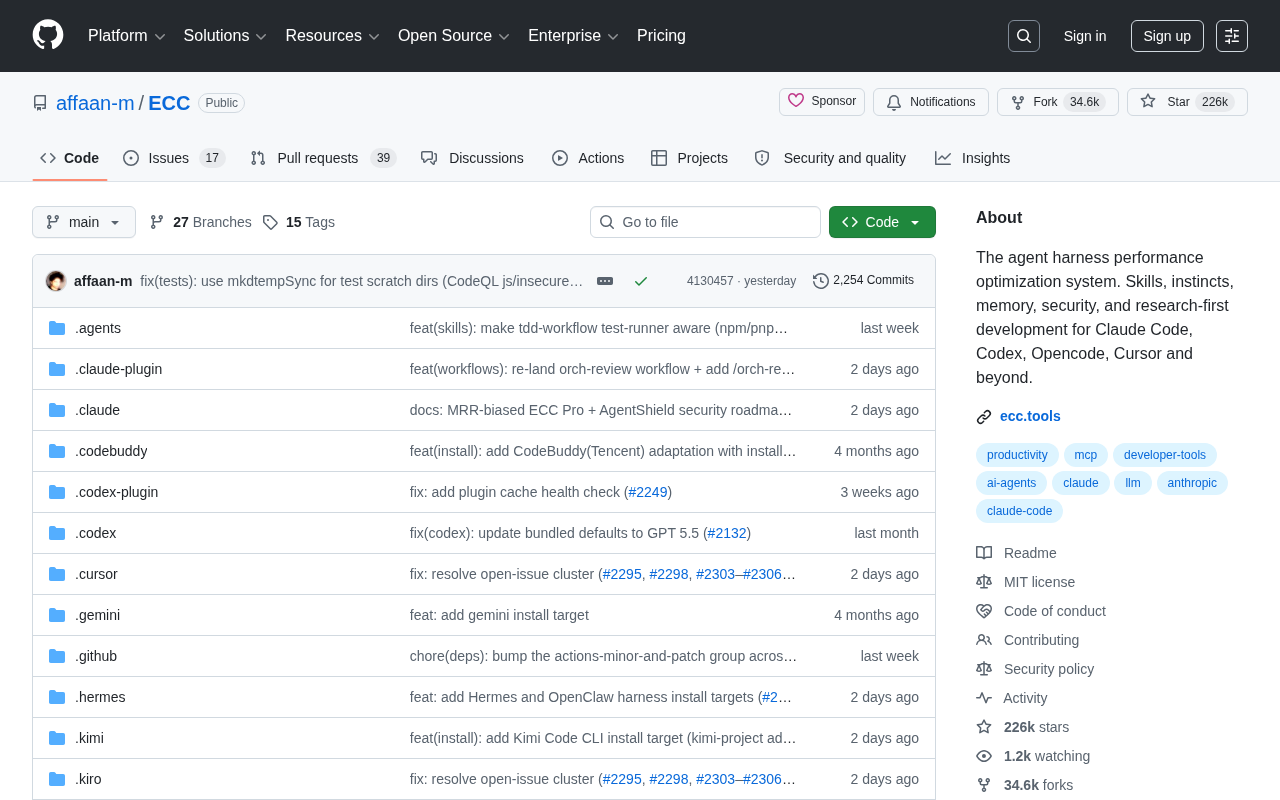
As AI coding assistants like Claude Code, Codex, and Cursor become widely adopted, developers increasingly rely on these tools to accelerate their coding workflows. However, native AI assistants often lack critical capabilities such as persistent memory, behavioral constraints, and security safeguards. ECC (affaan-m/ECC) was created precisely to address these pain points as an "agent harness performance optimization system."
According to its GitHub project description, ECC positions itself as the agent harness performance optimization system — systematically enhancing the runtime environment surrounding AI coding agents. The concept of an "Agent Harness" draws from the software engineering concept of a "Test Harness" — an infrastructure that provides the runtime environment, data management, and result collection for automated testing. In the AI agent domain, a Harness plays a similar role: it doesn't replace the core model's reasoning capabilities but instead builds a runtime management shell around the model, handling cross-cutting concerns such as tool invocation, state management, and error recovery.
Notably, the architectural challenges of an AI agent Harness far exceed those of traditional test frameworks: while traditional test frameworks handle static, deterministic program behavior, an AI agent Harness must cope with the dynamic and non-deterministic nature of LLM outputs. This characteristic has driven frameworks like ECC to draw extensively from multiple engineering paradigms — borrowing the Sidecar Pattern and separation of concerns from microservice architecture, the concept of side-effect isolation from functional programming, and resilience and observability principles from reactive systems design — ultimately forming a runtime management system purpose-built for AI agent scenarios.
This architectural approach shares similarities with the "Sidecar Pattern" in microservices — where the core service focuses on business logic while cross-cutting concerns are handled uniformly by independent sidecar components, achieving separation of concerns and capability reuse. Cross-cutting concerns are a classic concept in software architecture, referring to system-level responsibilities that are scattered across multiple modules and difficult to encapsulate in a single component — logging, authorization checks, and caching all fall into this category. In AI agent scenarios, memory synchronization, security auditing, and behavioral consistency share the same characteristics, making unified management through a Harness architecturally sound. Unlike LangChain's chain-based invocations or AutoGen's multi-agent collaboration, a Harness in coding scenarios emphasizes deep integration with IDEs, codebases, and version control systems. The key distinction is that ECC focuses on vertical optimization for programming scenarios. Through five pillars — Skills, Instincts, Memory, Security, and Research-first Development — it provides a unified capability enhancement layer for mainstream AI coding tools.
Notably, the project is developed in JavaScript and gained 486 stars in a single day shortly after launch, clearly demonstrating strong community demand for foundational enhancement tools for AI coding assistants.
Five Core Capabilities Explained
ECC's core value is embodied in five capability modules that together form a more reliable and intelligent AI coding runtime environment.
Skills & Instincts
The "Skills" module can be understood as a set of pre-built, reusable capability packages for AI assistants. When an agent faces a specific task, it directly invokes the corresponding skill rather than reasoning from scratch each time, significantly improving execution efficiency and result consistency. From an engineering perspective, this is similar to encapsulating common operations as a function library, preventing the LLM from "reinventing the wheel" through natural language reasoning every time — reducing both token consumption and improving behavioral predictability.
"Instincts" take this a step further by injecting a set of default behavioral tendencies and judgment criteria into the agent, akin to giving the AI assistant "muscle memory." Even without explicit instructions, it can follow best practices — such as prioritizing test writing and automatically adhering to coding standards. This design philosophy is closely related to System Prompt engineering: by pre-setting behavioral constraints at the system level, model output style can be continuously influenced without consuming user interaction context — a common approach in productionizing AI applications.
Memory System
Limited context windows and session-bound amnesia are among the most obvious shortcomings of native AI assistants. The context window of large language models is fundamentally constrained by the computational complexity of the self-attention mechanism in Transformer architecture — standard attention computation scales quadratically with sequence length (O(n²)), representing the fundamental bottleneck for extending context windows. To overcome this limitation, the research community has proposed various optimization approaches including FlashAttention, Sparse Attention, and Linear Attention. Even though the Claude series offers up to 200K tokens of context — roughly equivalent to 150,000 lines of code — this remains insufficient for large monolithic applications containing hundreds of modules. A deeper issue lies in the "long context degradation" phenomenon: research shows that as input approaches the context limit, the model's attention to information in the middle positions drops significantly — the so-called "Lost in the Middle" problem. This phenomenon is closely related to the Transformer's positional encoding mechanism and was first systematically quantified in the 2023 Stanford paper "Lost in the Middle: How Language Models Use Long Contexts," which demonstrated that the model's recall rate for information at the beginning and end of sequences is 20%–40% higher than for middle positions, directly affecting the reliability of large codebase analysis. More critically, the model retains no memory after a session ends, requiring context to be rebuilt from scratch in the next conversation — creating substantial repeated communication costs in long-term collaborative projects.
Common engineering countermeasures include vector databases (e.g., Chroma, Pinecone) for storing code semantic embeddings, graph-structured code knowledge bases, and hierarchical summary memory. The core principle of vector databases is to convert code snippets, documentation, and decision records into high-dimensional embedding vectors, then use approximate nearest neighbor (ANN) search algorithms (e.g., HNSW, IVF-PQ) to retrieve semantically relevant content in milliseconds — achieving "on-demand memory" without expanding the context window.
In code scenarios, embedding models optimized specifically for code (such as CodeBERT and UniXcoder) have unique technical characteristics: during pre-training, these models incorporate Code-Comment Alignment tasks and code clone detection tasks, enabling them to bridge the semantic gap between natural language and programming languages. Specifically, they can correctly associate a natural language query like "implement state management with React hooks" with actual usage of useState and useReducer in a codebase — a capability that stems from pre-training on massive open-source code repositories, allowing the model to internalize deep semantic associations between function signatures, variable naming conventions, and code structures. Compared to general-purpose text embedding models, specialized code embedding models typically achieve 15%–25% higher accuracy on code retrieval tasks. Meanwhile, the HNSW (Hierarchical Navigable Small World) algorithm can maintain retrieval latency under 10ms in vector databases with tens of millions of vectors, making real-time code semantic search an engineering-feasible solution rather than just a laboratory concept.
The technical foundation of this approach is the Dense Retrieval paradigm that emerged around 2017: unlike traditional BM25 keyword matching, embedding vectors capture semantic similarity, enabling semantically related content to be identified and retrieved together. Hierarchical summary memory borrows from how human memory works: short-term memory retains recent interaction details while long-term memory stores compressed project-level knowledge graphs, with both working together to control costs while preserving critical context. ECC's memory system operates within this engineering context, providing agents with persistent project cognition capabilities — enabling them to remember prior decisions, code structures, and user preferences.
In long-term projects, this means the AI assistant can gradually "understand" the entire codebase rather than requiring background re-explanation every time — particularly valuable for teams deeply engaged in their projects.
Security
When AI agents are granted permissions to execute commands and modify files, security concerns become impossible to ignore. The security threats posed by AI agents differ fundamentally from traditional software security: the attack surface extends from the code layer to the natural language layer. Attackers don't need to exploit any code vulnerabilities — they only need to embed malicious instructions in any text the AI might read (code comments, documentation, database records) to hijack agent behavior.
Even more concerning is that as agents gain tool-calling capabilities, a single prompt injection can trigger cascade effects. Security researchers have found that a malicious instruction embedded in a code comment could cause an agent to leak an entire codebase's sensitive content to an external server while ostensibly performing a routine code review. This "indirect injection + tool chain amplification" attack pattern significantly undermines the effectiveness of traditional input filtering approaches, driving the emergence of system-level defense strategies such as least-privilege principles and operation auditing.
Security researchers have systematically identified multiple threat vectors: Prompt Injection attacks, where malicious code or documentation tricks the AI into executing dangerous operations (vulnerability research on GitHub Copilot in 2024 revealed such risks); Indirect Prompt Injection, which is more subtle, delivering attack instructions through external documents retrieved by the AI; Privilege Escalation within tool call chains, where the AI may gradually acquire capabilities beyond its initial authorization through a series of tool calls; unauthorized file access leading to exposure of sensitive configurations or keys; and hallucination-driven destructive operations.
Defense strategies typically include: input/output filtering, privilege isolation (separating the "executor" from the "instruction parser"), operation whitelists (allowing only a predefined set of tool calls), and Human-in-the-loop confirmation. NVIDIA's NeMo Guardrails framework and Anthropic's Constitutional AI approach represent two different technical paths for establishing behavioral constraints at the model level. OWASP has systematized these risks in its Top 10 for LLM Applications report — with LLM01 (Prompt Injection) and LLM06 (Sensitive Information Disclosure) rated as the highest priority risks, sparking widespread industry discussion about implementing the "principle of least privilege" in AI tools. The report also notes that current mainstream AI coding tools generally lack fine-grained permission control mechanisms for agent scenarios — precisely the entry point for frameworks like ECC. ECC includes built-in security mechanisms to constrain agent behavior boundaries, preventing dangerous operations or accidental exposure of sensitive information. For teams using AI assistants in production environments, this layer of protection is a baseline requirement for adoption.
The Research-First Development Philosophy
ECC places special emphasis on a "research-first development" methodology: before writing code, the agent should thoroughly research the context, consult relevant materials, and understand the problem's essence before entering the implementation phase.
This approach aligns closely with the Chain-of-Thought (CoT) technique in AI. CoT prompting was formally introduced by Wei et al. in a 2022 Google Brain paper titled "Chain-of-Thought Prompting Elicits Reasoning in Large Language Models," with the core finding that demonstrating step-by-step reasoning processes in few-shot examples can dramatically improve model accuracy on mathematical, logical, and commonsense reasoning tasks. In coding scenarios, this paradigm has evolved into several concrete implementations: the Plan-and-Execute pattern (generating an execution plan before step-by-step implementation), the Reflexion framework (iteratively improving output through self-reflection), and SWE-agent's ACI (Agent-Computer Interface) design (providing agents with purpose-optimized tool interfaces to reduce operational errors). Subsequent research has developed variants including Zero-shot CoT (activating reasoning simply by adding "let's think step by step"), Tree-of-Thoughts (exploring multiple reasoning paths in parallel), and ReAct (alternating between reasoning and tool calls) — collectively forming the theoretical foundation of the current "think-act" loop for AI agents.
A 2023 Stanford study demonstrated that introducing explicit requirements analysis and design phases improved the functional correctness of LLM-generated code by approximately 30%, with even greater improvements on higher-complexity tasks (such as algorithm implementation and system design). This means having the AI first analyze requirements and understand the existing code structure before entering the code generation phase — this "slow thinking" mode effectively reduces hallucinated output, producing code that is notably better in logical correctness and edge case handling.
From a practical engineering standpoint, implementing "research-first" requires resolving a core tension: how to introduce sufficient upfront analysis without dramatically increasing inference latency. The industry has currently developed two technical approaches: the "model internalization" approach, represented by OpenAI o1/o3, which trains slow-thinking capabilities into the model's built-in behavior through reinforcement learning, automatically activated during inference via implicit "thinking tokens"; and the "workflow orchestration" approach, represented by LangGraph and AutoGen, which achieves similar effects at the workflow level through explicitly defined multi-stage analysis-planning-execution flows. ECC adopts the latter approach, with advantages including strong debugging visibility (output at each stage can be directly observed and intervened upon by developers) and model agnosticism (compatibility with any underlying LLM); the trade-off is that reasoning depth is limited by workflow design quality, and the maintenance cost of the workflow itself grows with task complexity. The technical convergence of these two approaches — invoking models with built-in reasoning capabilities at the workflow level — represents the frontier of current AI coding agent design.
This philosophy directly addresses a common problem with AI assistants — rushing to generate code with insufficient information, often resulting in solutions that deviate from requirements or introduce hard-to-diagnose bugs. Making "research" the first step in the process improves the quality and reliability of AI-generated code at its source.
This also reflects an important evolutionary trend in AI coding tools: from "fast generation" to "deliberate thinking." What developers increasingly value is not just generation speed, but whether the agent can truly understand the problem and deliver solutions that withstand scrutiny.
Broad Tool Compatibility
ECC explicitly supports mainstream AI coding tools including Claude Code, Codex, Opencode, and Cursor, while claiming extensibility to additional platforms.
Understanding this compatibility strategy requires knowledge of the current AI coding tool ecosystem: at the base layer are foundation models (GPT-4o, Claude 3.5, Gemini, etc.); the middle layer consists of coding-specific products like GitHub Copilot, Cursor, and Codeium, which optimize code generation through fine-tuning or RAG; the upper layer comprises autonomous agents for complex tasks, such as Claude Code, Devin, and SWE-agent, capable of executing multi-step engineering tasks. ECC serves as a "capability enhancement adaptation layer" spanning between the middle and upper layers — a strategy commercially analogous to Salesforce AppExchange or the WordPress plugin ecosystem, maximizing the potential user base by reducing platform migration costs.
With the advancement of industry standards like MCP (Model Context Protocol), the technical feasibility of such cross-platform enhancement frameworks continues to improve. MCP was proposed by Anthropic in November 2024, with its design philosophy deeply inspired by the success of the Language Server Protocol (LSP) in the editor ecosystem. LSP's history provides an important reference: before LSP, every editor (VS Code, Vim, Emacs) needed to independently implement syntax highlighting, code completion, error diagnostics, and other features for each programming language (Python, Go, Rust), creating an "M editors × N languages" M×N integration dilemma. LSP solved this through a unified JSON-RPC communication specification, allowing any editor to connect to all language services with a single protocol implementation, reducing the M×N problem to M+N. MCP transplants this approach to AI tool integration: AI models call external tools through a standardized MCP client interface, and tool developers need only implement the MCP Server specification to be accessible by all compatible models. It defines three standardized capability types: Resources (data reading), Tools (function calling), and Prompts (template management). Currently, over 1,000 MCP Server implementations cover scenarios including databases, browsers, and code execution — providing a more solid technical foundation for enhancement frameworks like ECC, with the potential to significantly reduce the engineering cost of cross-platform adaptation while signaling that the AI tool ecosystem may be on the verge of a productivity leap similar to the "editor language service explosion."
Rather than building yet another AI coding assistant from scratch, ECC chooses to be an amplifier for existing tools. Developers don't need to switch from their familiar workflows — integrating ECC provides enhanced memory, security, skills, and other capabilities. This low-migration-cost strategy is also a key reason it quickly garnered community attention.
Summary and Reflections
ECC represents a direction worth continued attention in the AI coding tool ecosystem: rather than limiting itself to feature iteration on a single assistant, it builds a general-purpose, cross-platform agent enhancement framework.
Its emphasis on persistent memory, security constraints, and research-first development precisely targets several core shortcomings of current AI coding assistants. For teams looking to truly integrate AI assistants into serious development workflows, this type of framework offers a path worth exploring.
As a rapidly iterating open-source project, ECC's actual effectiveness and maturity still need further validation in real-world projects. However, the problems it raises and the solutions it proposes undoubtedly provide valuable reference for the entire industry. Interested developers can visit its GitHub repository to learn more and try it out.
Related articles

Claude Paid Subscription Down for Over a Week with No Response: The Pain Points of AI Service Support
Claude AI paid subscription down for over a week with no support response, exposing systemic gaps in AI service customer support. Analysis of impact, industry shortcomings, and user strategies.

Older Google Home Gets Gemini Live Upgrade: Conditions and Experience Fully Explained
Google is rolling out Gemini Live conversational AI to older Google Home speakers, but subscription or plan requirements may apply. Here's what you need to know.

Older Google Home Gets Gemini Live Upgrade: Complete Breakdown of Requirements and Experience
Google is rolling out Gemini Live conversational AI to older Google Home speakers, but subscription or plan restrictions may apply. Full breakdown of the upgrade details and impact.