Economic Death Sentence in the AI Era: Banned Means Unemployed?
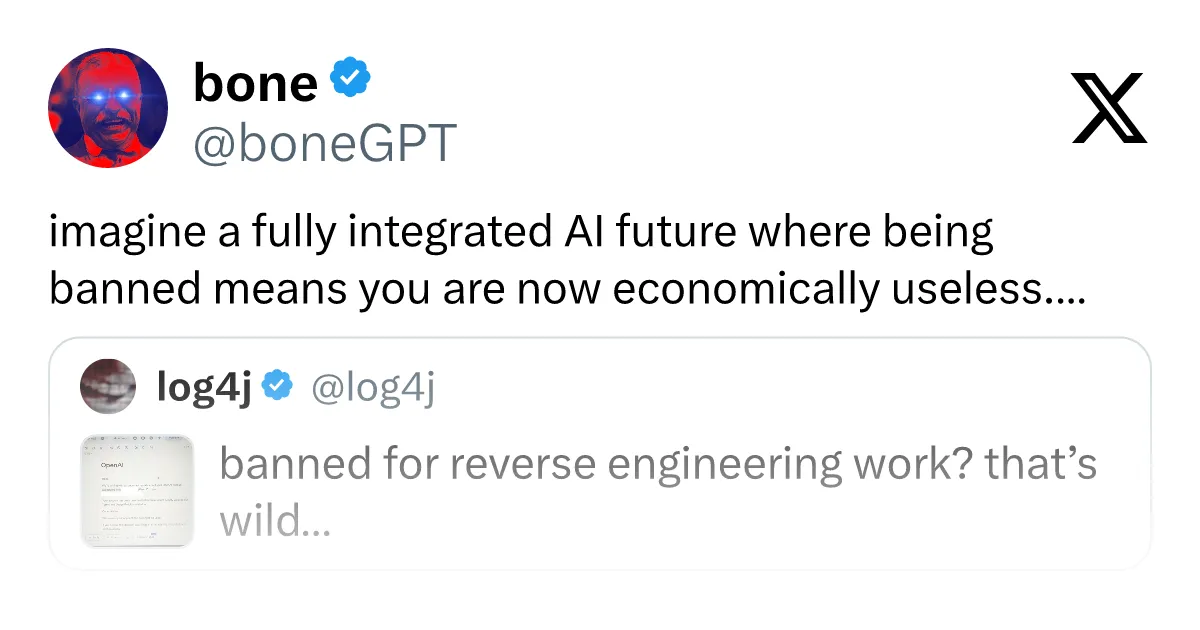
When AI becomes economic infrastructure, being banned from access may mean expulsion from economic activity.
Starting from a Hacker News hypothesis that "being banned means economic uselessness," the article explores the public nature of access rights as AI becomes deeply embedded in the economy. As AI agents take over transactions, production, and job seeking, banning accounts or API keys no longer just means losing tools but severing individuals' channel to the economic system, with consequences similar to gig platform bans but broader in scope. The author identifies the core risk as governance gaps: platforms unilaterally define violations, lack transparent procedures and independent appeals, yet hold quasi-public power. Community discussions converge on "bans need transparency" and "decentralization is the antidote," with divergence on risk urgency. The article recommends individuals enhance digital resilience and policymakers incorporate AI access rights into digital rights frameworks.
When "Being Banned" Equals "Economic Death"
On Hacker News, a short but piercing headline sparked discussion: "Imagine an AI future where being banned means you are now economically useless." The statement offers no lengthy argument, but its impact comes precisely from its stark assumption—in an economy heavily dependent on AI agents, losing access to AI could mean losing the qualification to participate in economic activity.
This scenario is not unfounded. As AI agents gradually take over schedule management, transaction execution, content production, and even job communication, individual dependence on AI is leaping from "tool-level" to "survival-level." If a platform or regulator bans a person's AI account or API key on grounds of "violation," the consequences could far exceed a social media ban—it directly severs that person's channel to the economic system.
How Silencing Evolves into Economic Exclusion
To understand this extreme scenario, we need to break down AI's role in the future economy. Currently, AI is deeply embedded in coding, customer service, data analysis, and more. If future individual economic output is primarily achieved through collaboration with AI, then "prohibiting AI use" equates to "prohibiting work."
This risk already has precursors in the platform economy. When gig workers are banned by algorithmic platforms, their income often instantly drops to zero, with limited appeal channels. The difference in the AI era is that bans may expand from a single platform to the cross-platform AI infrastructure layer. A user blacklisted by major AI service providers could simultaneously lose productivity tools, payment channels, and reputation credentials.
The deeper issue lies in governance mechanisms. Who defines "violation"? Are ban decisions transparent? Are there independent appeal channels? Without checks and balances, AI service providers could acquire quasi-public power without bearing corresponding procedural justice obligations.
AI Agent refers to software systems capable of autonomously perceiving the environment, formulating plans, and executing tasks to achieve goals, distinct from traditional chatbots that only respond to single user commands. Typical forms include office assistants that automatically handle emails, financial agents that autonomously execute trading strategies, and workflow systems that can invoke multiple tools to complete end-to-end tasks. Their key features are "autonomy" and "tool invocation capability": agents can access APIs, operate software, and initiate payments on behalf of users, thereby translating human intent into actual economic behavior. For this reason, AI agents are no longer just efficiency tools but the execution layer through which individuals connect to the economic system. Once the accounts or keys on which agents rely are banned, users lose not just software interfaces but the entire ability to convert labor and transactions into income.
API Key is a credential issued by service providers to developers or users for identity verification and billing during program calls. It is typically bound to a single account; once revoked, all automated processes relying on that key are simultaneously interrupted. In personal economic activities, API keys often serve triple functions of identity authentication, billing settlement, and access authorization, so banning a key can cut off productivity tools, payment interfaces, and data services. This "single point of failure" structure is the technical root of the "one ban blocks all" risk, and explains why key management and multi-account redundancy become part of digital resilience.
Procedural Justice in Platform Bans refers to the due process that should be followed before and after depriving users of access rights, typically including prior public disclosure of clear rules, notification of specific reasons at the time of ban, and review and appeal channels independent of the original decision-maker. Traditionally, this obligation is mainly borne by state organs, but when private platforms hold de facto access rights, their banning behavior takes on the nature of quasi-public power. Academic and regulatory practices often invoke the "common carrier" or "essential facilities" principles, advocating non-discrimination and due process requirements for services with infrastructure attributes. The article's concern is precisely the absence of such obligations: platforms can unilaterally define "violations," need not disclose evidence, and appeals are often reviewed by the same team, resulting in asymmetric power and responsibility.
Consensus and Divergence in Multi-Source Discussions
Although the original post provides limited information, combining Hacker News comments and discussions in similar communities (such as Reddit's r/ArtificialInteligence), several points of consensus can be observed:
Consensus One: Banning power needs transparency. Most discussants agree that if AI access becomes a prerequisite for economic participation, bans must follow due process, including clear rules, notification of reasons, and independent review.
Consensus Two: Decentralization is a potential antidote. Some argue that open-source models and decentralized AI networks can reduce dependence on single service providers, thereby mitigating the "one ban blocks all" risk.
Divergence centers on severity assessment. Some view this as a long-term concern—current AI tools remain replaceable, and bans will not lead to absolute economic uselessness; others emphasize that the trend is already evident, especially in highly automated industries where human roles are being compressed to "AI supervisors," and once supervisory access is lost, there is no foothold.
Decentralized AI Networks refer to architectures that do not rely on a single company's servers but instead have distributed nodes jointly provide model inference and data services. Common implementation paths include open-source weight models (locally deployable with full user control), federated inference networks (multiple parties providing computing power and settling according to protocols), and blockchain-based identity and reputation systems (making access credentials not bound to a single platform). Their value lies in decoupling "access rights" from a company's account system: even if one node or service provider bans a user, the user can migrate to other nodes and continue running the same model. However, decentralization also brings new problems, such as varying model quality, difficulty in reviewing malicious nodes, and lack of a unified responsible entity. Therefore, it should be viewed as a supplementary means to reduce single-point dependence rather than a complete replacement for platform governance issues.
Implications for Individuals and Policymakers
For individuals, this prospect highlights the importance of digital resilience. Do not bind your entire economic identity to a single AI platform or account; retaining localized tools, open-source alternatives, and diversified income sources are practical strategies to hedge against ban risks in the AI era.
For policymakers, "AI access rights" need to be proactively incorporated into digital rights discussions. When a service becomes de facto infrastructure for economic participation, it is no longer a pure commodity but carries public good attributes. The corresponding regulatory framework should require platforms to provide pre-ban notification, effective post-ban appeals, and data and model portability.
Conclusion: Rebalancing Power and Dependence
The assumption that "being banned means economic uselessness" may not fully materialize, but it reveals a real tension: while AI empowers individuals, it also concentrates power in the hands of the few entities controlling AI infrastructure. How to enjoy AI dividends while preventing individuals from becoming nodes that can be disconnected at any time is a challenge facing the tech community, enterprises, and regulators alike.
This brief hypothesis from Hacker News is more like a wake-up call—reminding us that in designing the AI future, fairness and security of access rights are as important as economic efficiency.
One-line Summary
When AI becomes economic infrastructure, being banned from access may mean being expelled from economic activity.
Paragraph Summary
Starting from a Hacker News hypothesis that "being banned means economic uselessness," the article explores the public nature of access rights as AI becomes deeply embedded in the economy. As AI agents take over transactions, production, and job seeking, banning accounts or API keys no longer just means losing tools but severing individuals' channel to the economic system, with consequences similar to gig platform bans but broader in scope. The author identifies the core risk as governance gaps: platforms unilaterally define violations, lack transparent procedures and independent appeals, yet hold quasi-public power. Community discussions converge on "bans need transparency" and "decentralization is the antidote," with divergence on risk urgency. The article recommends individuals enhance digital resilience and policymakers incorporate AI access rights into digital rights frameworks.
Related articles

OpenAI Math Breakthrough, Anthropic IPO, and Reasoning Model Tutorial
OpenAI unveils math, CS, and physics results, claiming proof that ETH is false; Anthropic files for IPO, disclosing revenue and customer data; SpaceX gets $40B GPU financing; open-source model tool-calling accuracy issues and constrained decoding; 8-video reasoning model tutorial.

14 Core Concepts of Reasoning Models: From Chain of Thought to GRPO Explained
A systematic breakdown of 14 core concepts of reasoning models: chain of thought, test-time compute, verifiers, RLVR and GRPO, distillation, and reward hacking, plus rules for controlling thinking-token costs to help you decide when reasoning is worth paying for.

OpenAI's Claimed Refutation of ETH Sparks Debate, Meta Bets Big on AI Infrastructure
OpenAI claims an AI-assisted discovery that challenges the Exponential Time Hypothesis (ETH) and launches the mid-tier GPT-6.1 Tera. Cloudflare discloses a cross-customer data leak postmortem, and Meta plans $95B in AI infrastructure financing.