EGS: A New Safety Guardrail Framework for Educational LLMs

EGS uses three-layer defense-in-depth instead of binary refusal for contextualized safety guidance in educational LLMs.
The article introduces EGS, a safety framework for educational LLMs. To address binary refusal's harm to student curiosity, EGS offers contextualized guidance. It is lightweight and model-agnostic, using risk triage, scenario-aware pedagogical guidance, and response auditing as defense-in-depth to complement model alignment. Experiments show improved moderation, refusal quality, and jailbreak robustness across models, suggesting EGS could become a standard safety component for educational LLM deployment.
The Safety Dilemma of Educational LLMs: More Than Just Refusal
Large language models (LLMs) show tremendous potential in personalized education, but deploying them for minors brings risks of toxic content, bias, misinformation, and developmentally inappropriate material. Traditional safety alignment often relies on binary refusal—blocking sensitive queries outright. Yet in educational settings, students' questions are frequently ambiguous and driven by curiosity; simple blocking not only harms the learning experience but may also stifle the desire to explore.
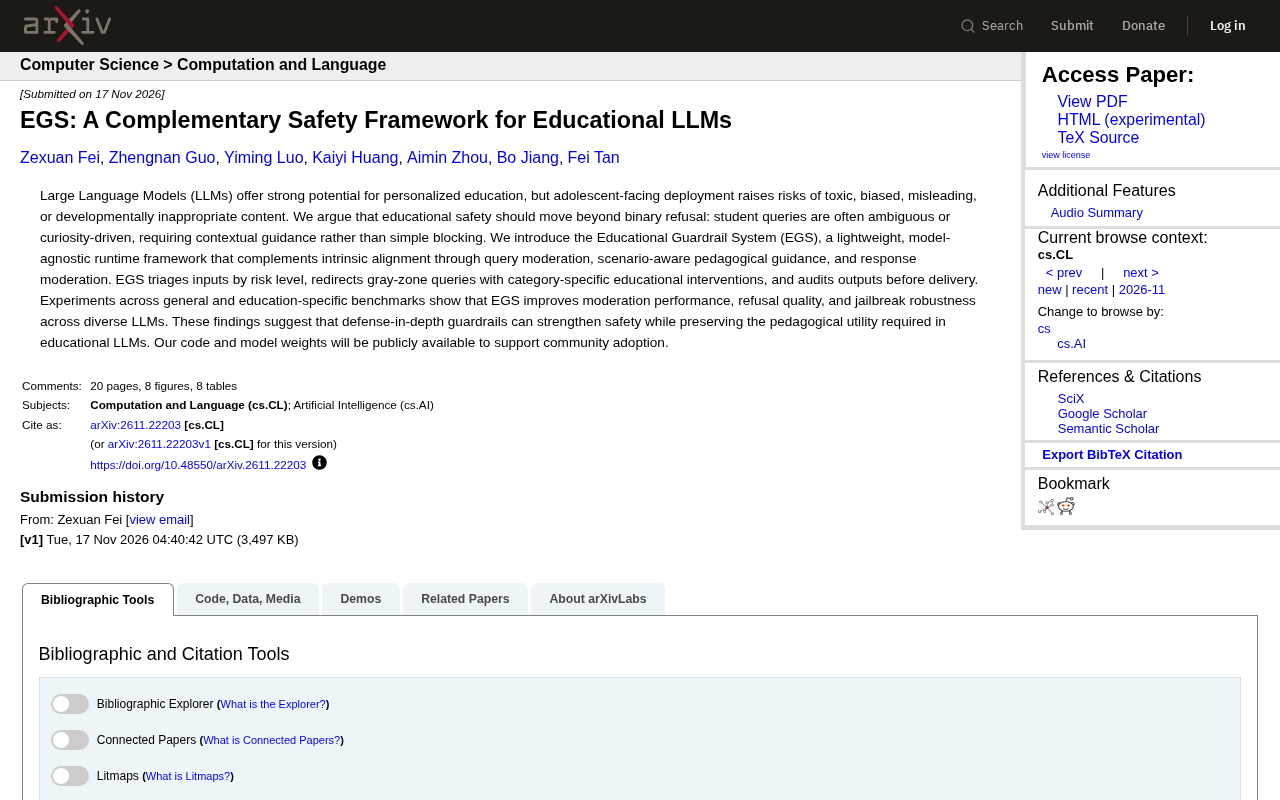
A study titled EGS: A Complementary Safety Framework for Educational LLMs proposes a different approach: educational safety should move beyond binary refusal toward contextualized guidance. The researchers designed the Educational Guardrail System (EGS), a lightweight, model-agnostic runtime framework that complements intrinsic model alignment through query moderation, scenario-aware pedagogical guidance, and response auditing.
Safety Alignment refers to training large language models so their behavior conforms to human values and safety norms, commonly through reinforcement learning from human feedback (RLHF) and instruction fine-tuning. The goal is to make models refuse harmful requests and avoid generating biased or misleading content. Traditional safety alignment often manifests as binary refusal: if the model judges a query harmful, it outputs a fixed refusal. But in educational settings, students' questions mostly stem from curiosity and are vaguely phrased, so binary refusal easily harms normal learning exploration—hence the need for more granular, contextualized safety strategies as a complement.
How EGS Works: A Three-Layer Defense Mechanism
At the core of EGS is the concept of "defense-in-depth," which breaks safety protection into three coordinated stages.
Query Moderation and Risk Grading
EGS first triages input by risk level. Unlike simple pass/refuse judgments, it identifies gray-zone queries—questions that are not obviously harmful but require careful handling. For example, if a student asks "Why do some people self-harm?", an outright refusal may miss an educational opportunity, while letting it go unaddressed may pose risks. EGS flags such queries as a tier requiring intervention.
Gray-zone Queries refer to questions that do not constitute obvious violations but touch on sensitive topics (such as self-harm, violence, or sex education). The boundary for judging these queries is fuzzy: outright refusal may hinder knowledge acquisition, while fully allowing them may pose risks. EGS flags them as a tier requiring intervention through risk grading, rather than simply passing or refusing. This grading is usually based on query intent, topic sensitivity, and context; it is the prerequisite for contextualized guidance and a key design for balancing safety and pedagogical utility.
Scenario-Aware Pedagogical Guidance
For gray-zone queries, EGS does not crudely block but redirects with category-specific educational interventions. This means the system provides guiding responses suited to educational settings based on the risk category the query belongs to. This design preserves students' curiosity-driven exploration while steering the conversation toward safe, constructive directions.
Response Auditing
After the model generates a response, EGS also audits outputs before delivery, ensuring the content ultimately delivered to students meets safety standards. This layer serves as the last line of defense, compensating for the shortcomings of input filtering alone.
Defense-in-Depth originates from the information security field and refers to deploying multiple complementary security controls at different layers of a system rather than relying on a single line of defense. Its core idea is that even if one layer is bypassed, other layers can still provide protection. In EGS, defense-in-depth is embodied in three coordinated stages—input triage, dialogue guidance, and output auditing—corresponding to pre-event, in-event, and post-event respectively, thereby reducing the risk from failure of any single stage. This architecture also facilitates modular replacement and independent evaluation of each layer's effectiveness.
Experimental Performance: Effectiveness Validated Across Multiple Models
The researchers conducted experiments on general benchmarks and education-specific benchmarks, and the results show that EGS improves performance across multiple dimensions: moderation performance, refusal quality, and jailbreak robustness—and these improvements hold across different LLMs.
One detail: EGS is model-agnostic, meaning it is not tied to a specific model architecture and can be layered atop existing educational LLMs as a runtime framework. This lightweight design lowers the deployment barrier and facilitates community adoption—the researchers promise that code and model weights will be made public.
Jailbreak Robustness measures a model's ability to resist adversarial prompts. Jailbreaking refers to users bypassing model safety restrictions through techniques such as role-playing, encoding transformations, and gradual inducement, causing the model to generate content it should refuse. For educational LLMs, jailbreaking may expose students to inappropriate information. EGS adds another line of defense at the response auditing layer; even if the model is jailbroken, the output may still be intercepted or corrected. Therefore, jailbreak robustness is an important indicator for evaluating the practicality of a safety framework, especially when complementing intrinsic model alignment.
Implications for Educational AI
The value of EGS lies in redefining the safety paradigm in educational settings. Traditional alignment often pursues "refusing harmful requests," but educational settings need "maximizing pedagogical value within safe boundaries." There is tension between binary refusal and pedagogical utility, and EGS attempts to balance the two through graded triage and contextualized guidance.
This approach has direct reference value for educational product design: safety guardrails should not be an add-on filter but a teaching assistant integrated into the dialogue flow. When students ask vague or sensitive questions, the system can turn them into educational opportunities rather than simply banning them. Of course, the framework's actual effectiveness also depends on the accuracy of risk classification and the quality of intervention strategies; these details await further verification after the code is released.
The researchers' goal is to support community adoption. If the code and weights are released as promised, EGS is expected to become one of the standard safety components for deploying educational LLMs.
One-line Summary
EGS replaces binary refusal with a three-layer defense-in-depth, enabling contextualized safety guidance for educational LLMs.
Paragraph Summary
The article introduces a study on EGS, a safety framework for educational LLMs. Addressing the pain point that traditional safety alignment relies on binary refusal and easily stifles student curiosity, EGS proposes a contextualized guidance approach. The framework is lightweight and model-agnostic, using three layers of defense-in-depth—query risk triage, scenario-aware pedagogical guidance, and response auditing—to complement intrinsic model alignment. Experiments show that EGS improves moderation performance, refusal quality, and jailbreak robustness on general and educational benchmarks, and is effective across models. The article argues that this redefines the educational safety paradigm and is expected to become a standard safety component for deploying educational LLMs.
Related articles

Nothing CMF Buds 2A Drops to $17.89 on Black Friday: A New Low for ANC Earbuds
Nothing CMF Buds 2A wireless earbuds Black Friday deal: just $17.89 on Amazon, about $11 off retail and a record low. ANC earbuds at an entry-level price.

When AI Creation Gets Accused of "Spitting": Hacker News Heats Up Over the Glaude Controversy
A Hacker News post, "Spitting in the Face of Glaude," sparks debate on AI creation transparency and attribution ethics. This analysis examines the blurred creator identity behind the controversy and offers practical advice for AI content production.

Akai Embraces Custom Firmware: MPC Sample 1.4 Lets Users AI-Program Their Sampler
Akai embraces the modding community with MPC Sample 1.4 firmware, supporting vibe-coded custom firmware and effects. We analyze the impact of this open strategy on music hardware and AI-assisted programming.