ElevenLabs Launches ElevenAI: All-in-One Meeting Notes and Dictation

ElevenLabs launches ElevenAI, a team meeting notetaking and dictation app, extending from voice APIs to end-user productivity tools.
ElevenLabs has launched ElevenAI, a new app combining meeting notetaking and dictation for teams and enterprises. It marks a shift from voice synthesis and cloning APIs for developers toward directly delivering end-user productivity tools in the competitive enterprise collaboration space. The article notes this fits its voice tech strengths and that merging two high-frequency needs eases tool switching and procurement, but established competitors and enterprise demands for accuracy, data security, and office suite integration mean success remains uncertain given undisclosed features, pricing, and platform support.
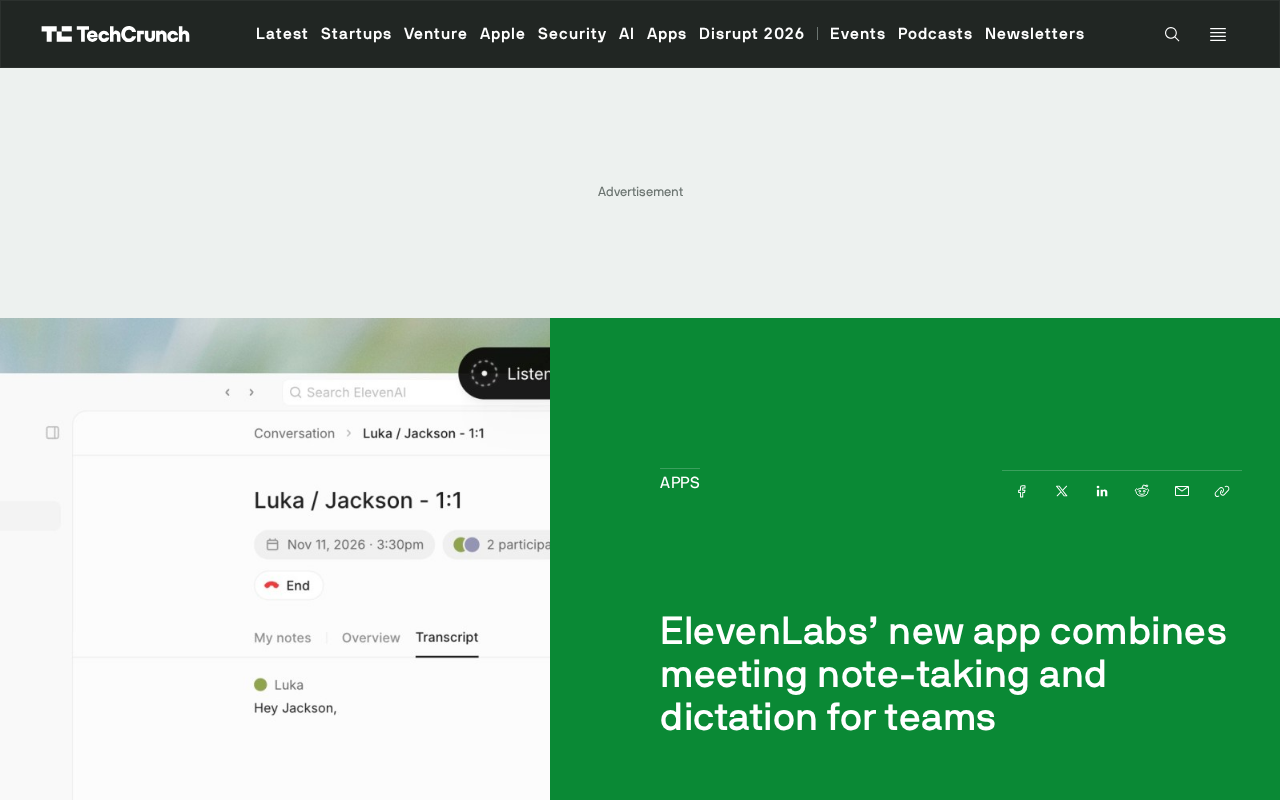
ElevenLabs is pushing its voice technology from developer APIs into everyday enterprise workflows. According to RSS sources, the company has launched a new app called ElevenAI, which combines meeting notetaking and dictation into a single product aimed at teams and enterprises.
From Voice API to Team Productivity Tool
ElevenLabs was previously best known among developers and content creators for its speech synthesis and voice cloning capabilities. The launch of ElevenAI signals that it is now moving directly into the enterprise collaboration tool space of meeting notes and voice input.
This direction is hardly surprising. Meeting notetaking and dictation are fundamentally both speech-to-text use cases, and ElevenLabs already has technical depth in voice processing. Packaging its capabilities into a team-facing application lets it reach enterprise users who don't call APIs directly.
Voice APIs and the voice tech stack: ElevenLabs' core capabilities are built on text-to-speech (TTS) and voice cloning. TTS synthesizes written text into natural-sounding speech, while voice cloning learns a speaker's timbre from a small number of audio samples. These capabilities are typically offered as APIs, with developers paying per call volume and embedding them into their own applications. The so-called "voice tech stack" refers to the full set of technical components spanning audio capture, speech recognition (ASR), speech synthesis, and audio post-processing. The meeting notetaking and dictation involved in ElevenAI rely primarily on speech recognition rather than speech synthesis—a reverse application of the same tech stack, turning sound into text. By packaging some of its capabilities as an end-user application, ElevenLabs is shifting from "selling capabilities" to "selling products," changing its business model from pay-per-call to subscription or per-seat pricing, and shifting its customer relationships from developers to enterprise IT and business departments.
What Problems ElevenAI Aims to Solve
Based on available information, ElevenAI is positioned as a "meeting notetaker and dictation app" targeting teams and enterprises. This suggests it may cover two high-frequency needs at once: automatic recording and organization in meeting scenarios, and voice-to-text input in everyday work.
Putting both in a single app has some appeal for team users—employees don't have to switch between multiple tools, and enterprises find it easier to manage procurement in a unified way. However, the source material does not disclose specific feature details, pricing models, or supported platforms.
Meeting notetaking and dictation: A meeting notetaker typically joins online meetings as a bot, transcribes speech in real time, and generates structured minutes, action items, and summaries after the meeting. Dictation, by contrast, is an input method in which the user speaks and the system transcribes to text in real time. Both share the same technical foundation—automatic speech recognition (ASR)—whose quality is commonly measured by word error rate (WER) and affected by accents, background noise, overlapping speakers, and specialized terminology. Enterprise scenarios additionally require speaker diarization (distinguishing who is speaking), timestamp alignment, multilingual support, and integration with calendars, video conferencing, and document tools. Merging the two functions essentially means reusing the same recognition and post-processing pipeline while increasing per-user frequency of use and raising switching costs for the product.
Market Competition and Challenges
The meeting notetaking space already has several established players, and dictation tools are fiercely competitive as well. ElevenLabs' advantage lies in its own voice tech stack, but the enterprise market places greater weight on accuracy, data security, and integration with existing office suites.
Whether ElevenAI can stand out depends on whether it can deliver a sufficiently smooth team collaboration experience beyond transcription quality. Public information is currently limited, and the product's actual performance remains to be seen.
Integration and compliance for enterprise collaboration tools: The dimensions on which enterprises evaluate meeting notetaking products often go beyond transcription accuracy itself. Common requirements include deep integration with meeting platforms such as Microsoft Teams, Zoom, and Google Meet; data connectivity with systems like Slack, Notion, and Salesforce; single sign-on (SSO) and permission management; and compliance certifications such as SOC 2 and GDPR. On data security, enterprises typically care about where audio and transcribed text are stored, retention periods, whether the data is used for model training, and whether localized or private deployment is supported. These capabilities constitute barriers to entry and are key variables when startup products compete with mature office suites. For ElevenLabs, whether its technical edge can translate into enterprise trust depends on its investment in these non-technical dimensions.
Signals Worth Watching
For readers tracking the real-world adoption of AI applications, ElevenAI is a development worth noting: voice technology companies are moving from providing underlying capabilities to directly delivering end-user products. Whether this strategy works in the enterprise market will be a key focus of follow-up observation.
One-line Summary
ElevenLabs launches ElevenAI, a team-facing meeting notetaking and dictation app, extending from voice APIs to end-user productivity tools.
Paragraph Summary
ElevenLabs has launched a new app called ElevenAI that combines meeting notetaking and dictation for teams and enterprise users. This marks a shift from providing speech synthesis and voice cloning APIs to developers and content creators toward directly delivering end-user productivity tools, entering the highly competitive enterprise collaboration space of meeting notetaking and voice input. The article argues that this extension aligns with its accumulated voice technology, and that merging two high-frequency needs helps reduce tool switching and simplifies enterprise procurement. However, the meeting notetaking space already has established players, and the enterprise market places greater emphasis on accuracy, data security, and office suite integration. Since feature details, pricing, and platform support have not yet been disclosed, whether ElevenAI can stand out remains to be seen, and its moves reflect a broader trend of voice technology companies shifting from selling capabilities to selling products.
Related articles

Gemini 4 Neon Leak: A Potential Strong Contender Against Opus 5.5
A Hacker News thread suggests Gemini 4 Neon looks like an Opus 5.5 competitor. This article unpacks the product positioning behind this community signal, shifts in the top-model competitive landscape, and what it means for developers' model selection strategy.

Claude Fable 5.2's Self-Authored Short Film 'Fable' Sparks Discussion
A short film 'Fable,' credited to Claude Fable 5.2 for script, visuals, and directing, appears on Hacker News. This article analyzes the significance of full-pipeline AI creation, community reactions, and what it means for content creators.

Anthropic IPO Pricing: A Signal of AI Giants Going Public
Anthropic's IPO pricing draws attention. This article analyzes its potential impact on AI industry valuation, commercialization paths, and the competitive landscape, and highlights public-market expectations and challenges for AI companies.