Embage: Building Customer AI Agents for Enterprises with Real-Time Conversation Analysis

Embage combines multi-channel AI chat/voice agents, sub-agent workflow orchestration, and automatic conversation evaluation and scoring.
Embage, ranked fifth on Product Hunt, is an AI agent-building platform positioned to "build agents for customers, run workflows, and analyze." Its capabilities span three layers: multi-channel chat and voice agents for websites, Telegram, and more; specialized sub-agents that orchestrate back-end tasks across knowledge bases, data stores, and hundreds of third-party tools in real time; and an analytics layer that automatically evaluates each interaction, scores lead quality, and extracts structured data. The article argues this combination turns AI agents from cost centers into data entry points, but notes that public information comes mainly from the Product Hunt page — tool coverage, evaluation accuracy, and voice performance still need independent verification, and the product faces competition from agent platforms, workflow tools, and conversation analytics tools alike.
In today's crowded landscape of AI agent tools, most products simply wrap a general-purpose LLM in a chat shell. Embage, ranked fifth on Product Hunt, takes a different approach: it not only lets you build multi-channel AI chat and voice agents for customers, but also emphasizes real-time workflow orchestration during operation, along with automatic evaluation of every interaction and structured data extraction.
From Chatbot to Workflow Hub
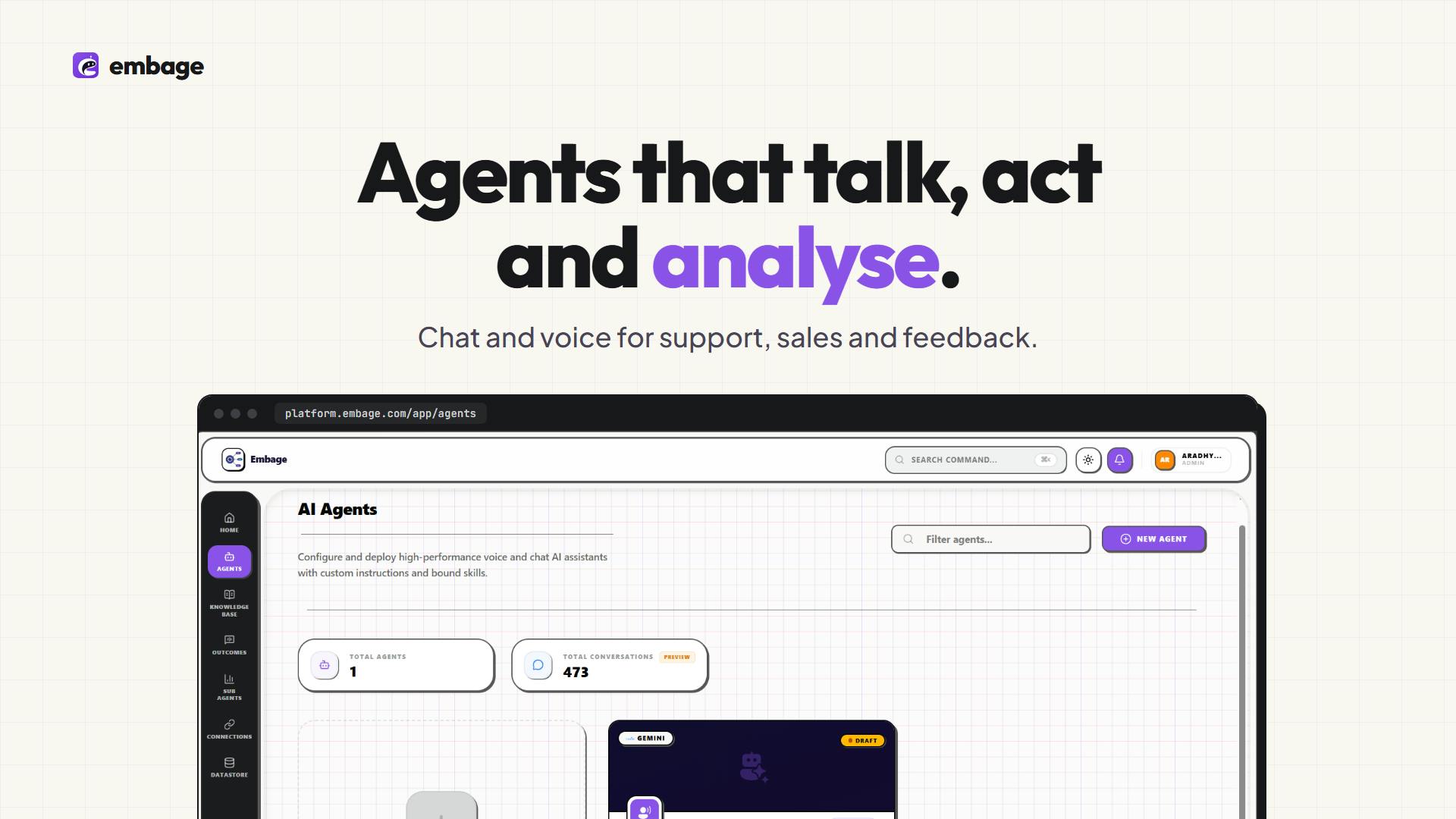
Embage positions itself as a tool to "build agents for your customers, run workflows, and analyze." Its core capabilities break down into three layers: chat and voice agents handle front-end engagement, sub-agents orchestrate back-end workflows, and the analytics layer turns conversations into usable structured data.
Unlike many competitors that only support web embedding, Embage explicitly covers websites, Telegram, and "more channels" — meaning enterprises can deploy agents directly on platforms where customers are already active, rather than forcing users back to the company website.
Multi-channel agent deployment refers to connecting the same agent logic to website chat windows, Telegram, WhatsApp, and other channels through different adapter layers, rather than maintaining a separate bot for each channel. The technical challenge lies in the fact that message formats, rate limits, rich media support, and session state synchronization differ across channels, requiring an abstracted unified session model and tool-calling interface. The practical value for enterprises is reduced deployment and maintenance costs, along with consistent response standards across platforms; but it also imposes higher demands on identity recognition, cross-channel context continuity, and data compliance.
Sub-Agent Orchestration: Connecting Knowledge Bases and Third-Party Tools
One notable design is "specialized sub-agents." The main agent handles customer conversations, while sub-agents can dispatch tasks in real time across knowledge bases, data stores, and hundreds of third-party tools.
The significance of this architecture: customer questions are often not simple Q&A, but composite tasks that require querying order systems, reading internal documents, and triggering external APIs. Splitting orchestration logic into a sub-agent layer keeps the main conversation flowing smoothly while avoiding cramming all tool calls into a single prompt.
Sub-agent architecture refers to decomposing complex tasks into multiple dedicated agents driven by independent prompts or models, each with its own toolset, knowledge scope, and objective function, dynamically invoked by the main agent based on conversation context and with results aggregated. Compared to a monolithic agent stuffing all tools into one prompt, sub-agent architecture reduces prompt length, minimizes tool misselection, improves task parallelism, and makes it easier to debug and iterate on each sub-agent individually. The cost is additional routing and coordination overhead, plus the need to design clear context-passing protocols — otherwise information loss or circular calls can occur. Embage's emphasis on "real-time orchestration" relies precisely on this dispatch layer.
Automatic Evaluation and Lead Scoring
Another major selling point of Embage is automatic evaluation of every interaction, scoring lead quality, and extracting structured data directly from conversation records.
For sales and customer service teams, this solves a real pain point after AI agents go live: what do you get after the conversation ends? If it's just a chat log, the value is limited; if it can automatically produce lead scores and structured fields, the agent transforms from a "cost center" into a "data entry point."
Automatic conversation evaluation (LLM-as-a-Judge) is the mainstream approach in agent evaluation today: using another large model to score conversation records against preset criteria, or to judge whether responses meet dimensions like factuality, tone, and compliance. Compared to manual sampling, it's cheaper, scalable, and suitable for continuous monitoring of online agent quality. However, its reliability is affected by scoring prompt design, model biases, and criteria ambiguity — typically requiring calibration against human-labeled samples and sampling-based review of key conclusions. Lead scoring commonly uses frameworks like BANT and intent level, essentially mapping budget, decision authority, timeline, and need intensity from conversations into sortable scores.
Positioning and Limitations from Multiple Perspectives
It should be noted that public information about Embage currently comes mainly from its Product Hunt page itself, lacking cross-validation from independent third-party reviews or user case studies. Therefore, the actual coverage of its "hundreds of third-party tools," the accuracy of its evaluations, and the performance of voice agents in real-world scenarios still need to be verified through hands-on trials.
From a product direction standpoint, Embage bundles "multi-channel agents + workflow orchestration + conversation analytics" together — the thinking is clear. But this also means it faces pressure from three categories of competitors simultaneously: agent-building platforms, workflow automation tools, and conversation analytics tools. How to build moats in vertical scenarios is the question it needs to answer next.
Who Should Try It
If your team is already handling customer inquiries on websites or Telegram and wants to turn conversation data directly into actionable leads, Embage is worth adding to your evaluation list. For scenarios that only need simple FAQ bots or pure workflow automation, this combo may not be necessary.
Related articles

VERS: Editing Activation Explanations to Halve Reasoning Model Tokens
VERS guides reasoning models by editing activation explanations, cutting 45.8% of tokens on GSM8K with only a 0.82 pp accuracy drop and transferring to larger models, but losing accuracy on competition problems.

Finding Errors Is Not Enough: Selective Model Escalation for Entity-Targeted Sentiment Analysis
This study explores selective model escalation for entity-targeted sentiment analysis, comparing data collection ordering, uncertainty-driven re-examination, and model routing—finding that minority-class priority only helps at very small data volumes, the oracle upper bound far exceeds actual gains, and escalation must be tailored to each dataset.

WAS-PO: Using Whitened Advantages to Solve the Correlation Trap in Multi-Reward Reinforcement Learning
WAS-PO paper proposes whitening advantages to correct correlation bias in multi-reward RL: when rewards are correlated, naive weighted summation effectively applies Σ^{1/2}w instead of w. Experiments show training reward improves steadily, but held-out accuracy does not improve in sync, and under two rewards it actually falls behind.