Embedful: The SaaS Tool That Gets Embedded Customer Dashboards Live in Minutes

Embedful lets SaaS teams ship embeddable multi-tenant customer dashboards in minutes, no infrastructure required.
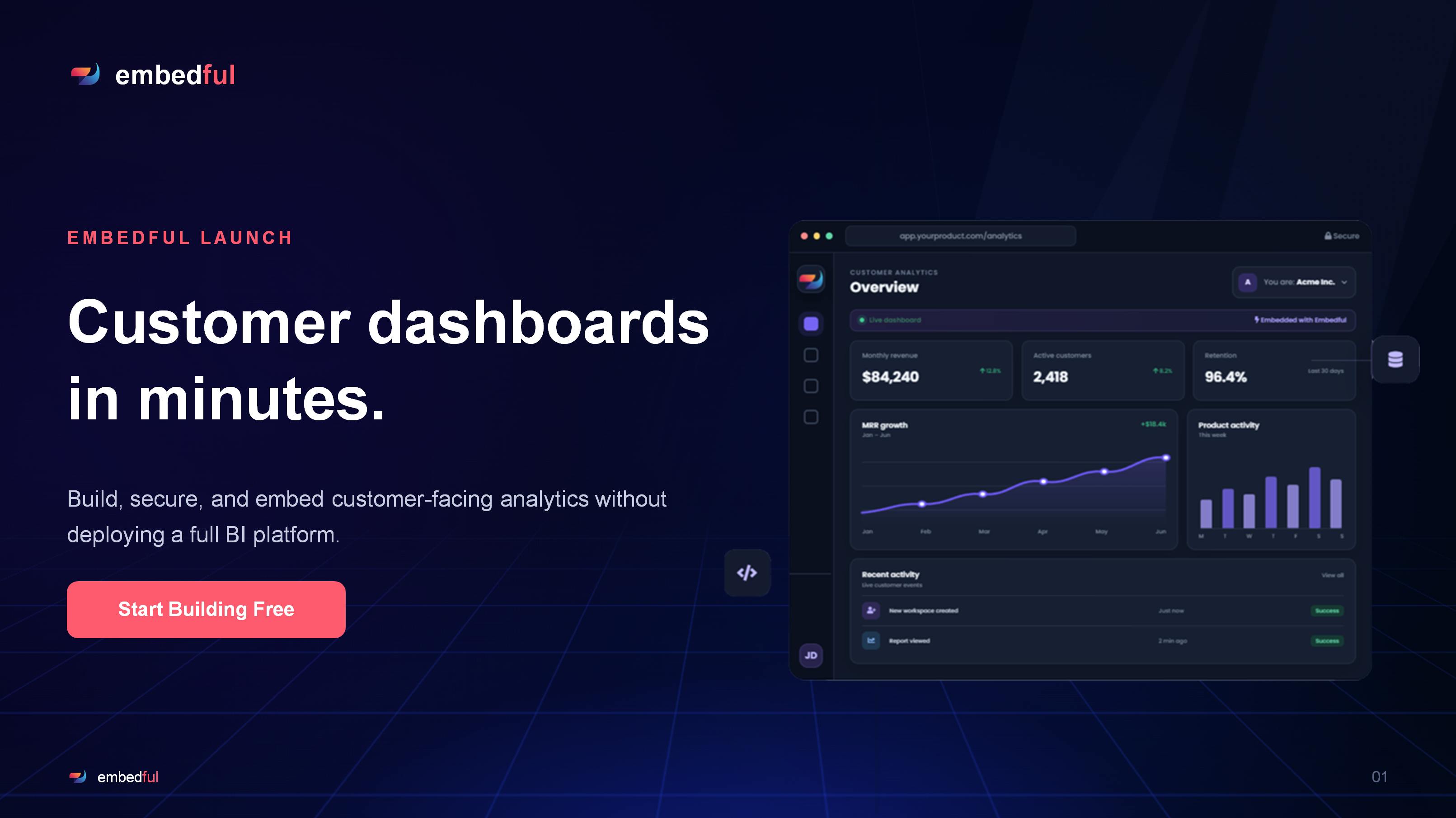
Embedful is an embedded analytics tool for SaaS teams, designed to solve the high-cost, low-core-value engineering challenge of delivering data analytics to customers. Its workflow has three steps: connect existing data sources, create tenant-isolated customer dashboards, and embed personalized analytics into your product. Compared to building in-house, Embedful compresses delivery from weeks to minutes. It recently launched on Product Hunt with 71 upvotes, targeting small-to-mid-sized SaaS teams without dedicated data staff. Pricing, security compliance, and real-world performance in complex scenarios remain to be validated.
The Old Problem with Embedded Analytics: High Build Costs
For most SaaS teams, delivering data analytics capabilities to customers is practically a necessity. Users want to see their own operational metrics, usage trends, and business reports directly inside the product — not export a pile of CSVs and figure it out themselves. The problem is that building this kind of "customer-facing analytics" properly is no small task. It requires standing up data pipelines, designing permission isolation, developing visualization components, and maintaining the entire dashboard infrastructure long-term.
This work tends to consume significant engineering resources while contributing little to the product's core competitive edge. Embedful targets exactly this pain point: it lets SaaS teams skip the complexity of building an analytics platform from scratch and get an embeddable customer dashboard live in minutes. The product recently launched on Product Hunt, earning 71 upvotes and ranking 11th for the day, across the SaaS, Developer Tools, and Analytics categories.
What Embedful Actually Solves
According to the official description, Embedful's workflow breaks down into three steps: connect your existing data sources, create secure customer-facing dashboards, and embed personalized analytics directly into your own product. The core value proposition is "no need to build and maintain complex analytics platforms or dashboard infrastructure yourself."
Connect Your Existing Data
Embedful emphasizes working with data your team already has, rather than requiring you to restructure a new data warehouse. This lowers the barrier to entry — for SaaS products that already have a business database, how quickly you can get connected directly determines whether a tool like this is worth using.
Secure Isolation for Customer-Facing Dashboards
"Customer-facing" is the key phrase here. Unlike internal BI tools, customer dashboards must guarantee that Customer A cannot see Customer B's data. This kind of multi-tenant data isolation and access control is precisely the part that's most prone to mistakes — and most time-consuming — when building in-house. Embedful leads with "secure customer-facing dashboards" as its flagship feature, indicating that tenant isolation is a default capability in its design.
In practice, multi-tenant data isolation is typically implemented through one of three approaches: Row-Level Security (RLS), separate database instances, or application-layer filtering. RLS is the most common — it tags each record with a tenant identifier at the database query layer, ensuring query results naturally return only the current tenant's data. PostgreSQL and BigQuery both support this natively. Application-layer filtering relies on code logic to append WHERE clauses to SQL queries; it's cheaper to implement but carries higher risk, since any logic flaw can lead to unauthorized data access. For embedded analytics specifically, a common pattern is the "Signed Token" mechanism: generate short-lived tokens carrying a tenant ID for each customer, pass them to the analytics service when the frontend loads a dashboard, and let the server automatically scope the data — all transparently to the end user. The design complexity of this kind of security architecture is exactly the engineering cost most often underestimated in custom-built solutions.
Embeddable and Personalized
Dashboards aren't standalone websites — they're components that can be embedded inside your product and support per-customer personalization. For SaaS products, this means analytics can appear seamlessly within your own interface, maintaining brand consistency and a unified experience, rather than redirecting users to a third-party page.
Why This Category of Tool Deserves Attention
Embedded analytics isn't a new concept — there are already several mature vendors in the space. Embedful's differentiation lies more in its "fast time-to-value" positioning, describing delivery in "minutes" rather than "weeks." It targets small-to-mid-sized SaaS companies that don't have a dedicated data team but want to quickly deliver analytics value to their customers.
For founding teams and small engineering teams, this "buy vs. build" choice is increasingly common. The marginal maintenance cost of data infrastructure is high. Rather than dedicating multiple engineers to maintaining a homegrown dashboard system long-term, it often makes more sense to outsource that capability to a specialized tool and focus engineering effort on the core product. This is the underlying logic behind the continued momentum in the developer tools space.
The major players in the embedded analytics market include Metabase (open-source, supports iframe embedding), Looker Embedded, Sigma Computing, and tools positioned closer to Embedful like Cumul.io and Omni. Pricing across this category tends to skew high and enterprise-focused, with monthly costs typically starting in the hundreds to thousands of dollars, often requiring longer onboarding cycles and dedicated technical support. By contrast, Embedful's "minutes to launch" positioning signals that its target customers are startups and small-to-mid-sized SaaS companies, with an emphasis on self-serve onboarding rather than sales-led adoption. The broader trend in this space is "analytics democratization" — what was once the exclusive domain of large enterprises is becoming a standard feature expectation for any SaaS product — driving a wave of lightweight embedded analytics tools into the market.
Things to Watch Out For
Publicly available information is still fairly limited. The Product Hunt page has only 3 comments, which means the community feedback sample is too small to draw reliable conclusions. Real-world usage experience, pricing model, and data sync performance all need further validation. For any scenario where you're handing customer data to a third-party platform, security compliance, data residency, and vendor lock-in risk are all factors that must be evaluated before committing.
Additionally, "live in minutes" typically applies to standard use cases. Once you introduce complex custom visualizations, deep data transformations, or unusual permission logic, the actual time investment may far exceed what the marketing suggests. Teams interested in Embedful would be well-advised to run a small-scale pilot with a real data source before deciding on a full rollout.
Summary
Embedful turns "customer-facing embedded analytics" — something that has long been a headache for engineering teams — into an out-of-the-box service. For SaaS teams that want to move fast without taking on the burden of maintaining analytics infrastructure, it offers an option worth trying. Whether it's the right fit, of course, depends on your data scale, security requirements, and budget.
Related articles

In the AI Era, a Developer's Core Value Is No Longer Writing Code
AI coding assistants make code generation easier than ever, but a developer's core value is shifting from writing code to understanding requirements and making the right trade-offs. This article explores how developers can stay irreplaceable in the AI era.

Hands-On with PhotoCraft: An Open-Source Photo Editor You Can Actually Tinker With
Hands-on review of PhotoCraft, an open-source photo editor with 58K GitHub stars: self-hosting, local inference, zero API costs, plus installation steps and use cases.

photocraft Open-Source Image Editor Hands-On Review: A Free Self-Hosted Alternative for Photo Editing
photocraft is an open-source image editor supporting self-hosting and privacy protection, with over 57K GitHub stars. This article shares hands-on experience, analyzing its performance, onboarding, and comparison with paid tools to help you decide if it's worth trying.