EMNLP 2026 Launches AI Reviewing Experiment: A Transformation in Academic Peer Review

EMNLP 2026 experiments with AI-generated reviews in its peer review process, sparking debate on quality and fairness.
EMNLP 2026 has introduced AI-generated reviews into the ACL Rolling Review system as an experimental auxiliary reviewer, marking the first time a top NLP conference has integrated LLM-based reviewing into a live evaluation process. Driven by severe reviewer shortages and exponential submission growth, the experiment aims to alleviate reviewing pressure while raising significant concerns about hallucinations, fairness biases, and the potential for adversarial gaming between AI authors and AI reviewers.
AI Enters Top Conference Reviewing: EMNLP 2026 Takes a Critical Step
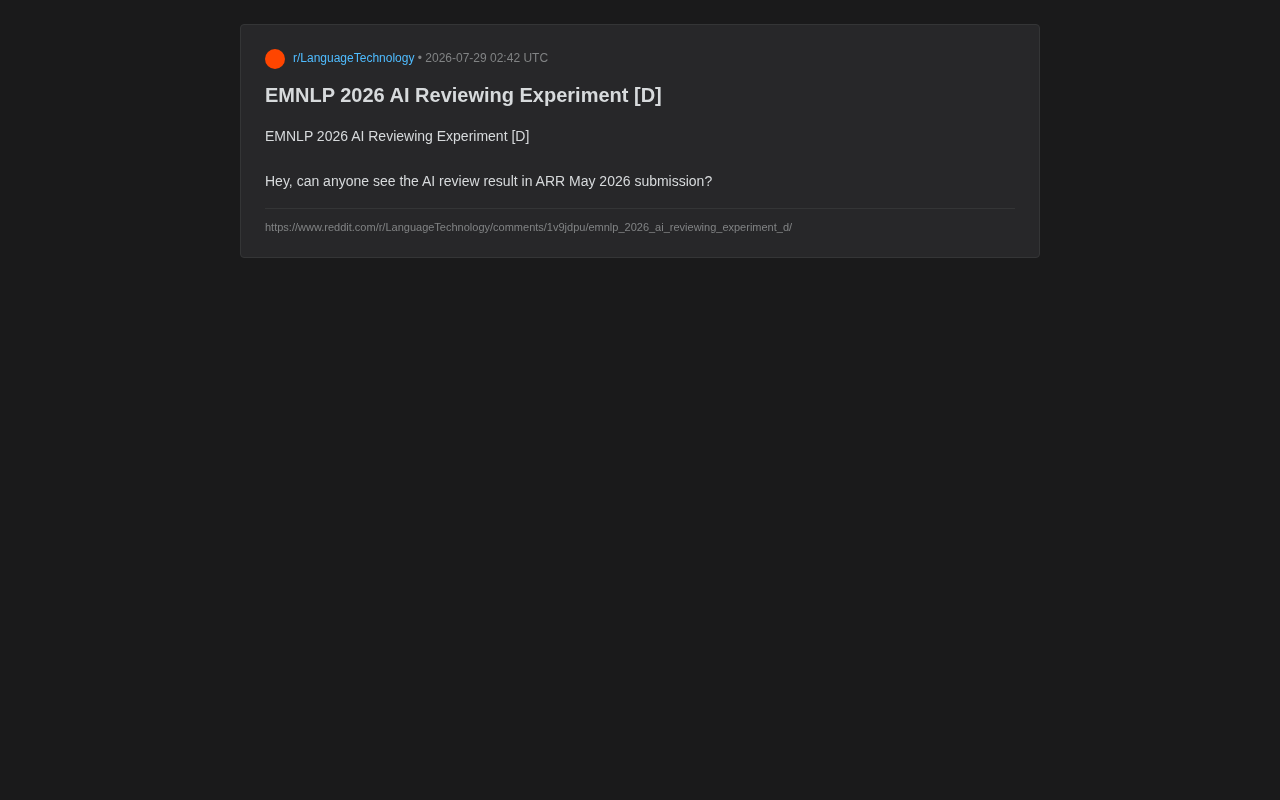
Recently, a post titled "EMNLP 2026 AI Reviewing Experiment" appeared on Reddit's machine learning community (r/MachineLearning), sparking widespread discussion. Researchers noticed an unprecedented change in the ACL Rolling Review (ARR) May 2026 cycle submission system—AI-generated reviews began appearing among the review results.
This development signals that EMNLP, a top-tier conference in natural language processing (NLP), has officially begun experimenting with large language models (LLMs) in the academic peer review process. For an AI research community long plagued by reviewer shortages and inconsistent review quality, this represents both a bold attempt and a highly controversial experiment.
The ARR Mechanism and the Reviewing Crisis: The Real-World Context
What is ACL Rolling Review?
ACL Rolling Review (ARR) is a rolling paper review system shared by multiple top conferences (including ACL, EMNLP, NAACL, etc.) under the Association for Computational Linguistics (ACL). Researchers submit papers to ARR, receive unified review feedback, and can then "commit" those reviews to specific conferences.
The original intent of this mechanism was to reduce redundant reviewing and improve review reuse. ARR officially launched in 2021 as a fundamental reform of the traditional conference review model. Under the traditional model, each conference organized reviews independently—rejected papers had to be resubmitted and re-reviewed, creating massive duplication of effort. ARR adopted a journal-like rolling review model with submission windows every month (later adjusted to every two months). After receiving reviews, authors can choose to commit to any conference that accepts ARR results, or revise and resubmit in the next cycle. The entire system uses the OpenReview platform as its technical infrastructure, with all review processes conducted on that platform. However, with the explosive growth in submissions, the ARR system has also come under enormous pressure.
The Increasingly Severe Reviewer Shortage
In recent years, paper submissions in NLP and machine learning have grown exponentially. Top conferences like EMNLP and ACL routinely receive thousands or even tens of thousands of submissions per cycle.
The growth in submission volumes is staggering. Taking ACL-series conferences as an example, ACL 2019's main conference received approximately 2,900 submissions; by 2024, a single ARR cycle exceeded 4,000 submissions, with the total papers processed through ARR annually surpassing 10,000. Meanwhile, AAAI 2025 received over 12,000 submissions, and NeurIPS 2024 received approximately 15,000. Some estimates suggest that with 3 reviewers needed per paper and each reviewer handling 3-6 papers, top conferences require thousands of qualified reviewers per cycle. The growth rate of researchers willing and able to take on reviewing duties falls far short of submission growth, creating a structural supply-demand imbalance.
This has directly led to:
- Severe reviewer shortages: The number of qualified senior reviewers cannot keep pace with submission growth;
- Declining review quality: Overburdened reviewers produce perfunctory, brief, and unconstructive reviews;
- Extended review cycles: Authors often wait months for feedback.
It is against this backdrop that the idea of introducing AI into the review process has gradually shifted from "wishful thinking" to "something we have to try."
Core Content and Operation of the AI Reviewing Experiment
Experiment Format: AI as an Auxiliary Reviewer
According to community discussions, EMNLP 2026 added AI-generated reviews for some or all submissions in the ARR May 2026 cycle. These AI reviews are displayed alongside human reviewer opinions for reference by authors and Area Chairs (ACs).
Interestingly, based on currently available information, AI reviewing is more likely positioned as an auxiliary, experimental presence rather than a final arbiter that directly determines a paper's fate. Its role is similar to that of a "Reviewer N," intended to supplement perspectives that human reviewers might miss or to provide cross-validation of review quality.
The Technical Foundation of AI Reviewing
Using LLMs for academic review is not a sudden inspiration. Since 2023, multiple studies have explored this direction. For example, a Stanford University research team used GPT-4 to conduct simulated reviews of ICLR and NeurIPS papers, finding moderate agreement between AI and human reviews on certain dimensions. Additionally, tools like ReviewerGPT and MARG (Multi-Agent Review Generation) have been developed for review assistance. These systems typically use Retrieval-Augmented Generation (RAG) architectures, combining paper content with related literature databases to generate review opinions. However, these tools remain notably weaker than senior human reviewers at identifying genuine academic novelty and detecting implicit flaws in experimental design. The EMNLP 2026 experiment likely builds on these prior studies, representing the first time AI reviewing has moved from the laboratory into a real review process.
Potential Application Value of AI Reviewing
If AI reviewing can operate effectively, it could theoretically deliver the following benefits:
- Relieving reviewer pressure: AI can handle preliminary screening, format checking, related work surveys, and other repetitive tasks;
- Improving feedback timeliness: AI can generate preliminary feedback nearly in real-time;
- Ensuring baseline quality: Even if human review quality is poor, AI can provide a structured baseline review;
- Assisting Area Chair decisions: Providing ACs with additional dimensions for judgment.
Controversies and Concerns: Challenges Facing AI Reviewing
Despite the appealing prospects, the AI reviewing experiment has also triggered widespread skepticism and concern in the academic community.
Questionable Review Quality and Reliability
While current LLMs excel at text understanding and generation, they still have obvious shortcomings in deep technical judgment. Academic paper reviewing requires reviewers to have deep understanding of the specific subfield, the ability to identify methodological novelty, experimental rigor, and reliability of conclusions. AI can easily produce reviews that "seem reasonable but are actually hollow," or even contain factual errors (hallucinations).
The "hallucination" problem of LLMs is particularly dangerous in academic review scenarios. Hallucination refers to the model generating content that appears fluent and credible but is actually incorrect or fabricated. In review scenarios, this might manifest as: AI fabricating a non-existent related work and criticizing the authors for not citing it; incorrectly claiming that the paper's mathematical derivation has problems (when the derivation is actually correct); or making inaccurate summaries of experimental setups and then providing erroneous evaluations based on those summaries. If these hallucinatory errors are trusted by Area Chairs, they could directly lead to the rejection of quality papers—consequences more severe than AI errors in general scenarios, as they directly impact knowledge dissemination and researchers' career development.
Fairness Issues Cannot Be Ignored
If AI review opinions are given excessive weight, they may systematically favor certain writing styles or research paradigms, creating implicit discrimination against non-native speakers, niche research directions, or non-mainstream methodologies. LLMs are primarily trained on English data and are more exposed to texts from mainstream research paradigms, meaning they may develop comprehension biases against non-standard expressions, interdisciplinary innovative methods, or work from researchers in under-resourced regions. Furthermore, AI reviews may give inflated scores to papers that are "formally perfect but offer limited substantive contribution" while undervaluing work that is less polished in expression but contains genuine innovation.
Academic Integrity and the "AI vs. AI" Dilemma
A rather ironic concern is that when reviewing is conducted by AI, authors may also use AI to write and optimize their papers, or even deliberately "cater to" AI reviewer preferences. This could evolve into a game between AIs, deviating from the essence of academic review. If the evaluation preferences of AI reviewing systems are reverse-engineered, authors might learn to insert specific keywords, structures, or claims into papers to "trick" the AI into giving higher scores—similar to a variant of search engine optimization (SEO) in academia. This "review optimization" could lead to homogenization of paper writing, suppressing genuine academic diversity.
Deeper Significance: Academic Review Moving Toward Human-AI Collaboration
The significance of this experiment extends far beyond "using AI to write a few review comments." It reflects how the entire AI research community is being disrupted and reshaped by the very technology it creates—the surge in submissions is a direct result of widespread AI tools, and the response must once again turn to AI.
From a broader perspective, EMNLP 2026's attempt may be a milestone in the academic publishing process moving toward "human-AI collaboration." EMNLP is not the only academic venue exploring AI-assisted review. Nature journals already use AI tools for manuscript pre-screening, detecting statistical errors and image manipulation. Elsevier developed the UNSILO system for automatically matching reviewers with papers. IEEE is also experimenting with AI tools to detect plagiarism and AI-generated content in papers. In computer science, ICML 2024 discussed policies on introducing AI-assisted reviewing, ultimately deciding not to adopt it but encouraging related research. By comparison, the EMNLP 2026 experiment is more radical—it goes beyond backend assistance to directly present AI review opinions to authors and decision-makers, a first in top conference practice.
The future review system may evolve into:
- AI handles preliminary screening, format review, and basic evaluation;
- Human reviewers focus on higher-order judgments of novelty and value;
- Area Chairs make final decisions based on a synthesis of both perspectives.
If reasonable standards and oversight mechanisms can be established for this division of labor, it may effectively alleviate the current reviewing crisis while maintaining quality.
Conclusion: The Future Direction of the AI Reviewing Experiment
The EMNLP 2026 AI reviewing experiment is still in its early stages, and community discussions have mostly centered on observational questions like "can we see the AI review results." It's foreseeable that as more authors receive their reviews, discussions around AI review quality, fairness, and ethics will intensify further.
Regardless of the ultimate outcome, this experiment provides a valuable real-world sample for academic review reform in the AI era. It reminds us that when AI deeply intervenes in knowledge production and evaluation systems, how to strike a balance between efficiency and quality, innovation and fairness, will be a long-term challenge that the entire academic community must face together.
Related articles

Using ChatGPT to Win Arguments with Your Partner? The Risks and Boundaries of AI in Intimate Relationships
More couples are turning to ChatGPT during arguments, but can AI truly improve relationships? This article analyzes the risks of AI sycophancy, emotional proxy effects, and provides healthy guidelines.

Perplexity Pro Massively Downgraded: From 500 Responses to 6, Paying Users Flee En Masse
Perplexity Pro users expose severe service cuts: advanced model responses drop from 500 to 6, image/video quotas nearly eliminated, accounts vanish for two weeks without response. Analysis of the AI subscription trust crisis.

Why Self-Hosted Email Continues to Decline: Reputation Mechanisms and the Centralization Trap
Analysis of why self-hosted email keeps declining: anti-spam reputation systems, IP blacklists, major providers monopolizing deliverability, and practical strategies.