Emochi: Explore Your Emotional World with Voice Journaling and Generative Art

Emochi turns emotional journaling into visual interaction with voice notes and a generative character.
Emochi is an iOS voice journaling app that received 105 votes on Product Hunt. Users speak, the app transcribes and detects emotional patterns, then transforms the text into a generative character called Mochi that evolves with their emotions. Built by a doctor, a designer, and two AI engineers, it is positioned as a private, non-clinical self-reflection tool rather than a therapy or diagnostic product. Voice input lowers the journaling barrier, and the generative character offers more emotional resonance than charts; success hinges on transcription accuracy, emotion recognition granularity, sustained engagement with Mochi, and privacy trust.
From Voice Notes to Emotional Avatar: The Creative Origin of Emochi
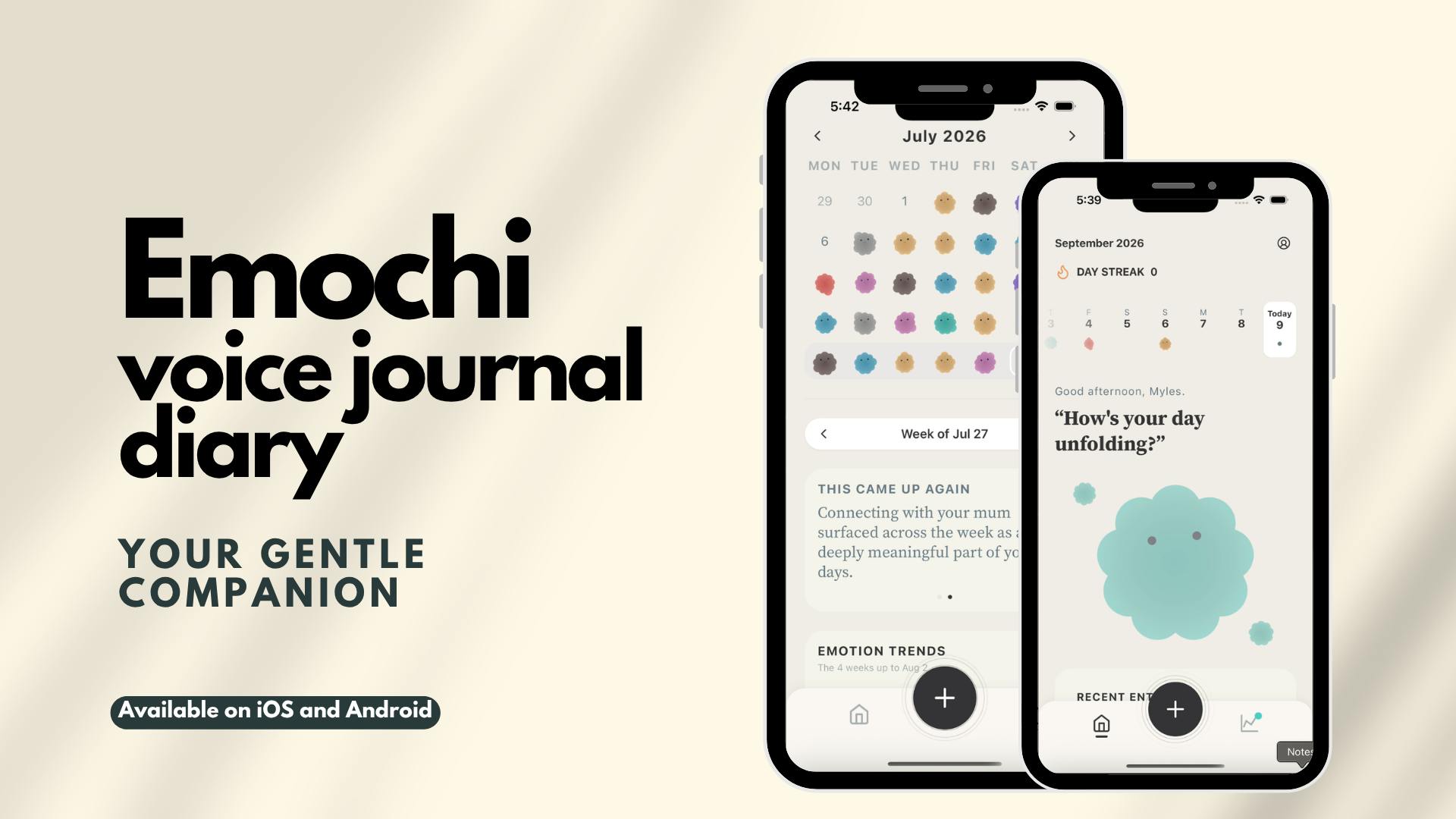
Ranked third on Product Hunt with 105 votes on its launch day, Emochi describes itself as "a voice journal for understanding yourself through art and science." Its core interaction is straightforward: you speak a few words into your phone—venting about your day, sorting through a thought, or simply recording how you feel right now. Emochi instantly transcribes your speech into text and detects patterns in your emotional fluctuations.
But what truly sets it apart from an ordinary voice memo is the next step: that text is transformed into a "living, generative character"—your Mochi. This character evolves as your emotional state changes, becoming a visual mirror of your inner world.
Art Meets Science: How Affective Computing Lands in Practice
Emochi's team composition is worth noting: a doctor, a designer, and two AI engineers. This mix is directly reflected in the product's positioning—it explicitly defines itself as a "private, non-clinical self-reflection tool," not a psychotherapy or diagnostic product.
From a technical standpoint, Emochi combines at least three layers of capability:
- Speech transcription: Converts spoken content into text in real time, lowering the barrier to journaling;
- Emotional pattern recognition: Analyzes emotional trajectories from text, helping users notice recurring patterns in their feelings;
- Generative visual feedback: Presents emotional states through a dynamic character, making abstract feelings tangible.
This "art + science" approach essentially packages research from affective computing into a lightweight, approachable consumer experience. The medical background brings a cautious attitude toward emotional health, the designer ensures the interaction doesn't feel cold, and the AI engineers keep the technical pipeline running smoothly.
Affective computing was introduced by Rosalind Picard of the MIT Media Lab in 1995, referring to research and technology that enables computers to recognize, understand, express, and even regulate human emotions. Typical technical approaches include extracting features from speech prosody, pitch, and speaking rate; performing sentiment polarity classification or fine-grained emotion recognition on text; and inferring emotions through facial expressions and physiological signals (heart rate, skin conductance). In recent years, the rise of large language models has made semantic context-based emotion attribution mainstream—compared to earlier dictionary- and rule-based methods, it better captures irony, mixed emotions, and emotional shifts. Emochi's text-based emotional pattern recognition belongs to this lineage of text sentiment analysis.
It's important to note that "emotion recognition" in consumer products is largely based on statistically correlated heuristics rather than clinical psychological assessment. Accuracy is heavily influenced by individual expression habits, language style, and cultural context. This is one of the technical reasons many similar apps deliberately maintain a "non-diagnostic" positioning.
Why "Voice Journaling" Is a Smart Entry Point
The pain point of journaling lies in the "writing"—high activation cost, hard to sustain. Voice input drops the barrier to nearly zero; users just need to speak. Emochi layers instant transcription and pattern analysis on top, turning fragmented spoken words into traceable emotional data.
Even more clever is the generative character design. Traditional mood-tracking apps typically present data through charts, ratings, or tags—rational but lacking emotional resonance. A character that changes with your emotions offers a more intuitive form of feedback—you don't need to interpret a line chart to "feel" your recent state. This design transforms self-reflection from a task into an interaction.
Speech-to-text (ASR) is the technical foundation of such products. Modern on-device/cloud hybrid solutions typically use streaming acoustic models with language model rescoring, achieving relatively high character accuracy for Mandarin Chinese in quiet environments—but errors still occur with accents, dialects, fast speech, or utterances mixed with English or proper nouns. Since journaling scenarios involve emotional, colloquial, and loosely structured expression, transcription errors directly contaminate downstream emotion analysis results, creating an error cascade. Therefore, transcription quality and fault-tolerance design (e.g., allowing lightweight user edits, flagging low-confidence segments) are key indicators for evaluating whether such apps are reliable—and explain why the article lists "transcription accuracy" as the primary variable determining whether it can gain traction.
Privacy and Non-Clinical Positioning: Boundaries Matter
Emochi deliberately emphasizes "private" and "non-clinical" in its description—this is no accident. Emotional data is highly sensitive personal information, and users' trust threshold for such apps is far higher than for ordinary tools. Clearly drawing the line between itself and medical diagnosis is both an honest definition of the product's capabilities and a reduction of users' psychological burden—you're interacting with a character, not undergoing an assessment.
For readers interested in AI application deployment, Emochi's value lies in demonstrating a product approach: rather than pursuing generic "emotional companionship," it focuses on the specific loop of "record—awareness—feedback," using generative art as its differentiator. Whether it can establish itself in the health and fitness category depends on transcription accuracy, the granularity of emotion recognition, and whether the Mochi character can genuinely sustain users' willingness to keep interacting.
Currently, Emochi is available only on iOS. For users looking to try voice journaling or mood-tracking tools, it offers a very low-barrier option with visual appeal.
"Non-clinical" is not purely marketing language in a regulatory context. In the United States, consumer health apps that claim to diagnose, treat, or prevent disease may fall under the FDA's definition of medical devices; in China, services providing psychological assessment or intervention must comply with mental health and internet healthcare regulations. Explicitly stating that a product does not provide diagnosis or treatment is a common compliance buffer strategy for consumer emotion apps.
Accompanying this are privacy practices: emotional voice recordings are sensitive personal information, involving audio storage, transcribed text retention, and use of data for model training. Common practices include prioritizing on-device processing, not using data for model training by default, providing export and complete deletion options, and following data minimization principles under frameworks such as GDPR and CCPA. When evaluating such tools, users would do well to check the specific clauses in the privacy policy regarding "whether data is used for training," "retention periods," and "third-party sharing."
One-line Summary
Emochi combines voice journaling with a generative character to turn emotional recording into visual interaction.
Paragraph Summary
Emochi is an iOS voice journaling app that received 105 votes on Product Hunt. Its core flow: users speak, the app instantly transcribes to text and identifies emotional patterns, then transforms that text into a generative character called Mochi that evolves with emotions—serving as a visual mirror of the inner world. The team comprises a doctor, a designer, and two AI engineers, and the product is explicitly positioned as a private, non-clinical self-reflection tool rather than a psychotherapy or diagnostic product. The article argues that voice input dramatically lowers the barrier to journaling, and the generative character offers more emotional resonance than charts or ratings, turning self-reflection from a task into an interaction. However, its success depends on transcription accuracy, the granularity of emotion recognition, and users' willingness to keep interacting with Mochi—privacy protection and clear boundaries are the foundation of trust.
Related articles

Gemini 4 Argon Hands-On: AI Builds Board Games, Constructs Temples, and Trains Robots Autonomously
Gemini 4 Argon hands-on roundup: AI autonomously builds a desk racetrack and temple in Blender, writes a ray tracing engine, trains a humanoid robot to sink 7 shots, plus API pricing and developer access.

The Magic Octagonal Coin: Why Only 9% of People Can Predict Its Flip?
Only 9% of people can correctly predict the Magic Octagon coin flip. This article explains its spatial rotation mechanism, common cognitive pitfalls, and a new hypothesis based on Relevance Theory, exploring the limits of human spatial reasoning.

Sam Altman: AI Is Entering the Era of Scientific Discovery — Math Breakthroughs Will Replicate in Biology and Energy
Sam Altman says AI is entering the era of scientific discovery — math breakthroughs will replicate in biology, materials science, and energy to help develop new drugs and energy sources.