EMODE: A Dynamic Expert Architecture That Brings Emotional Awareness to Speech LLMs

EMODE explicitly decouples semantic and emotional features via dynamic expert routing to improve Speech LLM emotional awareness.
Existing speech LLMs suffer from entangled acoustic representations that capture what is said but miss how it is said. EMODE addresses this with a Dynamic Para-Semantic Experts (DPSE) architecture that explicitly separates speech features into semantic and paralinguistic pathways, fused via dynamic routing. Three-stage curriculum training — semantic warm-up, paralinguistic activation, and joint refinement — backed by OEG, SAA, and GDR mechanisms ensures genuine functional specialization. Validated on SER, empathic response generation, and a new bilingual MEPA benchmark, EMODE better balances lexical fidelity with emotional sensitivity. Its core principle: emotion should be explicitly modeled, not passively recovered as a semantic byproduct.
The Emotional Blind Spot in Speech LLMs
Large speech language models (Speech LLMs) have demonstrated impressive capabilities in cross-modal understanding and generation in recent years, handling tasks ranging from speech-to-text to text-to-speech within a unified framework. Yet on one critical dimension, these systems have consistently fallen short — the preservation of paralinguistic cues, and especially emotional information.
The root cause lies in a widespread reliance on "entangled" acoustic representations. These representations mix semantic content with acoustic-prosodic features, causing the underlying language model to over-rely on recovered lexical content rather than grounding its judgments in actual acoustic-prosodic evidence. In plain terms: the model understands what was said, but fails to grasp how it was said. For interaction scenarios that demand empathy and emotional understanding, this is a fundamental limitation.
Paralinguistic cues refer to all non-semantic information conveyed through sound beyond the linguistic content itself — including intonation, pitch, speech rate, volume variation, pauses, rhythm, and voice quality (such as trembling or hoarseness). These cues play a crucial role in human communication: the same sentence spoken in a different tone can convey a completely opposite emotional meaning. Traditional automatic speech recognition (ASR) systems focus primarily on accurately transcribing lexical content, so paralinguistic information is typically discarded or ignored in the processing pipeline. When speech LLMs operate on ASR-generated text, these emotional cues are already unrecoverable. Even end-to-end speech models, if trained with semantic reconstruction as the primary objective, will systematically suppress paralinguistic signals at the representation level — giving rise to the so-called "entangled representation" problem.
EMODE's Core Design: Dynamic Para-Semantic Experts
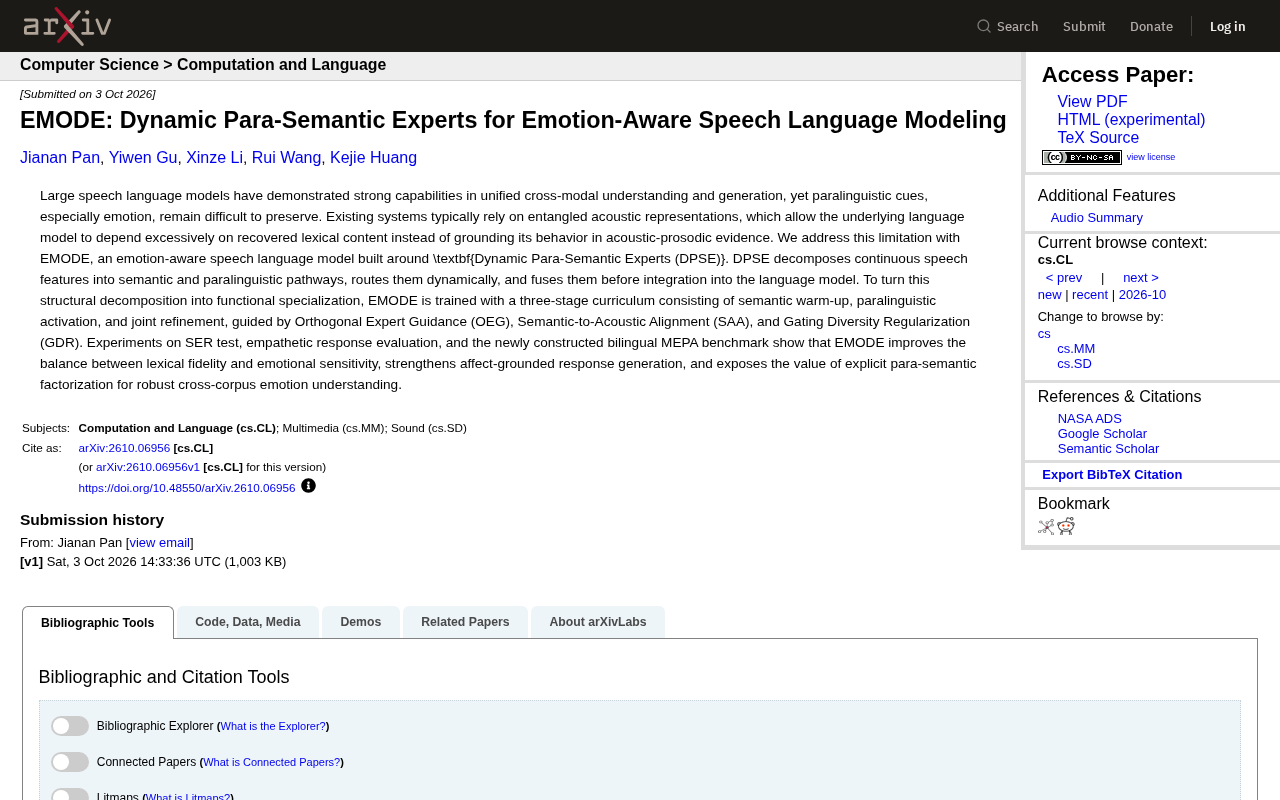
This research from arXiv introduces EMODE, an emotion-aware speech language model built around Dynamic Para-Semantic Experts (DPSE).
The core idea behind DPSE is to explicitly decompose continuous speech features into two distinct pathways:
- Semantic pathway: carries lexical and linguistic content
- Paralinguistic pathway: captures emotional, prosodic, and other acoustic cues
These two pathways are merged through dynamic routing before being integrated into the language model. The significance of this structural decoupling is that semantic content no longer "crowds out" emotional information. Instead, paralinguistic features are given an independent, protected processing channel.
From Structural Decoupling to Functional Specialization
Structural separation alone is not enough — the key is ensuring each pathway truly specializes in its respective role. To this end, EMODE employs a three-stage curriculum training approach:
- Semantic warm-up: establishes a solid foundation in language understanding
- Paralinguistic activation: awakens and reinforces the expressive capacity of the emotion pathway
- Joint refinement: coordinates optimization of both pathways together
This curriculum is supported by three regularization and guidance mechanisms: Orthogonal Expert Guidance (OEG) ensures the two expert types learn non-overlapping features; Semantic-to-Acoustic Alignment (SAA) maintains cross-modal consistency; and Gating Diversity Regularization (GDR) prevents the dynamic routing from collapsing into a single pathway. Together, these mechanisms translate "structural decoupling" into genuine "functional specialization."
The core idea behind OEG comes from the concept of orthogonality in linear algebra — two orthogonal vectors are completely uncorrelated in feature space. Applying this constraint to the representations of semantic and paralinguistic experts mathematically guarantees that the two expert types learn complementary, non-redundant features. Such orthogonality constraints are widely used in multi-task learning and Mixture of Experts (MoE) models, essentially penalizing cosine similarity or inner products between the two groups of feature vectors through a regularization loss term. GDR, meanwhile, addresses the common "expert collapse" problem in MoE architectures — without additional constraints, dynamic routing tends to converge on always activating the same pathway, rendering the multi-expert design ineffective. GDR encourages the gating weight distribution to maximize entropy, forcing different input samples to activate different expert combinations and thereby preserving the architectural diversity benefits.
Experimental Validation and a New Benchmark
The research team evaluated EMODE across multiple tasks, including speech emotion recognition (SER) tests, empathic response evaluation, and the newly constructed bilingual MEPA benchmark.
The results demonstrate improvements in several areas:
- Better balance between lexical fidelity and emotional sensitivity, without sacrificing one for the other
- Enhanced emotion-grounded response generation, making model outputs more aligned with the speaker's emotional state
- Evidence of the value of explicit para-semantic factorization for cross-corpus emotion understanding robustness
Notably, the introduction of the bilingual MEPA benchmark deserves attention. Cross-corpus, cross-lingual emotion understanding has long been a pain point in the field. Acoustic patterns of emotional expression vary across languages, and a dedicated bilingual evaluation set enables fairer assessment of a model's generalization ability.
Cross-corpus speech emotion recognition (SER) is a long-standing challenge in the field: models trained on one dataset often suffer dramatic performance drops when applied to another. The reason is that acoustic patterns of emotional expression vary significantly across languages, cultural backgrounds, and even recording environments — for example, the pitch contour shapes for expressing anger differ between Mandarin and English. Existing English-centric benchmarks cannot fully assess a model's ability to generalize across multilingual scenarios. The construction of the MEPA bilingual benchmark fills this gap, enabling researchers to distinguish whether a model has truly learned cross-lingual universal emotional acoustic features or has simply overfit to a single language's data distribution. This has direct implications for evaluating the reliability of emotion AI systems in real-world multilingual deployment environments.
Implications for Voice Interaction
EMODE's value goes beyond metric improvements. More importantly, it puts forward an insightful design principle: emotional information deserves to be explicitly modeled, not passively recovered as a byproduct of semantics.
As voice assistants, emotional companionship applications, customer service systems, and other interactive scenarios place increasingly higher demands on "emotional intelligence," the ability to genuinely perceive tone, emotion, and attitude is becoming the next frontier of competition for speech LLMs. The DPSE architecture — which explicitly decouples semantic and paralinguistic features before dynamically fusing them — offers a technically viable path forward for future research.
It should be noted that this article is based on the abstract of a single arXiv preprint (arXiv:2610.06956v1). Specific network scale, experimental data details, and comparison metrics against other baseline models require reference to the full paper. The method's performance in real-world deployment environments also awaits further validation.
Related articles

Gemini 4 Argon Hands-On: AI Builds Board Games, Constructs Temples, and Trains Robots Autonomously
Gemini 4 Argon hands-on roundup: AI autonomously builds a desk racetrack and temple in Blender, writes a ray tracing engine, trains a humanoid robot to sink 7 shots, plus API pricing and developer access.

The Magic Octagonal Coin: Why Only 9% of People Can Predict Its Flip?
Only 9% of people can correctly predict the Magic Octagon coin flip. This article explains its spatial rotation mechanism, common cognitive pitfalls, and a new hypothesis based on Relevance Theory, exploring the limits of human spatial reasoning.

Sam Altman: AI Is Entering the Era of Scientific Discovery — Math Breakthroughs Will Replicate in Biology and Energy
Sam Altman says AI is entering the era of scientific discovery — math breakthroughs will replicate in biology, materials science, and energy to help develop new drugs and energy sources.