End-Grain Cutting Board Tutorial: A Hit in the Hacker News Tech Community

A Hacker News post about making end-grain cutting boards reflects the tech crowd's enduring interest in physical building and Maker culture.
Starting from a Hacker News post about end-grain cutting boards with only 4 upvotes and 0 comments, the article explains why a handcraft woodworking topic unrelated to AI appears in a tech community. End-grain cutting boards rotate wood strips 90 degrees so the knife edge contacts end-grain fibers rather than side fibers, achieving knife protection and a "self-healing" property—essentially a material structure optimization problem, similar to layered design and fault-tolerance in software architecture. The article then breaks down three core steps—material selection and cutting, assembly and gluing, and surface treatment—emphasizing moisture content, assembly precision, and food-grade glue and wax, with a comparison table showing engineering trade-offs between end-grain and regular cutting boards. Finally, the author attributes this to Maker culture—tech people using tangible handcraft projects to balance long hours facing screens and abstract code.
In the Hacker News tech community, a post titled "How to Make End-Grain Cutting Boards" sparked a small but focused discussion. Despite having only 4 upvotes and 0 comments, this handcrafted woodworking topic—seemingly unrelated to AI—unexpectedly reflects the tech crowd's enduring interest in "building in the physical world."
Why Would a Tech Community Care About a Cutting Board?
Hacker News' user base consists mainly of programmers, founders, and tech enthusiasts. Making an end-grain cutting board is essentially a "material structure optimization" problem: by cutting wood into small strips, rotating them 90 degrees, and gluing them together, the knife edge contacts the end-grain fibers of the wood rather than the side fibers. This structure causes less damage to the knife edge and gives the board a "self-healing" property—the fibers naturally spring back and close after the blade passes through.
From an engineering perspective, this is remarkably similar to layered design and fault-tolerance mechanisms in software architecture. The tech crowd is naturally sensitive to cases of "solving functional problems through structural design."
The difference between end-grain and side-grain fibers is the key to understanding end-grain cutting boards. Wood is composed of long tubular fibers arranged along the trunk direction. When a blade cuts perpendicularly into the side of the wood (the way a normal cutting board bears force), the blade cuts across the fibers laterally—high resistance and easy to leave knife marks. The end grain, however, is the "cross-section" of the fibers. The blade cuts along the fiber direction, like splitting a bundle of chopsticks from the top—the fibers are compressed by the blade edge rather than severed. After the knife leaves, the compressed fibers recover elastically and close back up—this is the so-called "self-healing" effect. The trade-off is that end grain absorbs water far more readily than side grain, so it relies more heavily on maintenance oil and wax, and is more prone to warping from humidity changes.
Core Steps for Making an End-Grain Cutting Board
The making process can be broken down into several key stages, each involving precise dimensional control and material understanding.
1. Material Selection and Cutting
Hardwoods such as maple, walnut, or cherry are typically used. The wood must be dried to a moisture content of 6%–8%, otherwise the finished product is prone to cracking. After cutting the wood into uniform-length strips, rotate them 90 degrees so the growth rings face upward, then glue them into a large panel with woodworking glue.
The technical challenge here: cutting precision directly determines the quality of the glue lines. An error exceeding 0.5mm will cause gaps in the glued surface, affecting structural strength.
Moisture content of 6%–8% refers to the percentage of water weight in the wood relative to the weight of completely dry wood, typically measured with a pin-type or induction-type moisture meter. This range is close to the equilibrium moisture content (EMC) of most indoor environments, meaning the wood essentially reaches moisture equilibrium with its usage environment after forming, minimizing subsequent expansion and contraction. If moisture content is too high, the wood continues to dry and shrink after gluing, pulling the joints apart; if too low, the wood absorbs moisture and swells, potentially cracking the panel. Hardwoods (such as maple and walnut) are preferred because of their high density, thick fiber walls, good end-grain resilience, wear resistance, resistance to fuzzing, and more reliable food safety.
2. Assembly and Gluing
During assembly, even pressure must be applied, typically using woodworking clamps. For glue, choose food-safe waterproof woodworking adhesives like Titebond III. After waiting 24 hours for curing, proceed with surface flattening.
Titebond III is a common PVA-type (polyvinyl acetate) woodworking glue, distinguished from ordinary white glue by its ANSI/HPVA Type I waterproof rating. Once dried, its glue film is considered safe for food contact (chemically stable after full curing). The reason for choosing waterproof glue is that cutting boards need frequent washing, and ordinary glue will soften and debond after prolonged soaking in water. Woodworking clamps provide even and sufficient clamping force; typically about 30–40 kg of pressure per 25mm of glue line length is recommended. Insufficient pressure leaves glue gaps; excessive pressure squeezes out too much glue, causing "glue starvation" that actually weakens strength.
3. Surface Treatment and Maintenance
Sanding should progress gradually from 80 grit to 220 grit or higher. For surface treatment, do not use ordinary varnish—instead, use a mixture of food-grade mineral oil and beeswax to ensure safety and allow penetration to protect the fibers.
End-Grain vs. Regular Cutting Boards: Technical Differences and Trade-offs
| Feature | End-Grain Board | Regular Side-Cut Board |
|---|---|---|
| Knife edge protection | Excellent (fiber rebound) | Average (blade cuts into fibers) |
| Difficulty of making | High (requires precise assembly) | Low |
| Maintenance requirements | High (regular oiling) | Low |
| Weight | Heavier | Lighter |
| Cost | High | Low |
This comparison is essentially an engineering trade-off: greater manufacturing complexity in exchange for better user experience and longevity.
Where Does the Tech Community's Craft Enthusiasm Come From?
Occasionally, non-programming handcraft, woodworking, and mechanical topics appear on Hacker News. This reflects an extension of "Maker culture"—the pursuit of tangible, verifiable results. The abstract nature of writing code and the concreteness of woodworking complement each other. Many developers use handcrafting to balance long hours in front of screens.
Making end-grain cutting boards is particularly suited to this psychology: it's a project requiring patience, precision, and material knowledge, and the finished product is a practical item used every day. This "slow work produces fine results" rhythm stands in sharp contrast to the rapid iteration of software development.
Maker culture originated in the mid-2000s DIY and open-source hardware movement, emphasizing individuals combining digital tools (3D printing, laser cutting, Arduino, etc.) with traditional craftsmanship to design and build physical objects themselves. Its overlap with the tech community lies in shared values: hands-on verification, iterative improvement, and open sharing. For many programmers, the output of programming is entirely abstract bits, while the output of woodworking, metalworking, and electronics is tangible, measurable, carryable atoms. This switch from bits to atoms brings psychological balance and a sense of accomplishment, and also explains why handcraft topics continually appear on tech sites like Hacker News.
If You Want to Try It Too
For beginners, start with a smaller size (e.g., 30cm × 20cm) and use cheaper wood species to practice assembly precision. Core tools include a table saw, woodworking clamps, a random orbital sander, and food-grade wood wax oil. On safety, the operational risks of woodworking machinery should not be ignored—safety goggles and a dust mask are basic equipment.
For those accustomed to building worlds with code, making an end-grain cutting board by hand might be an interesting "full-stack" experience.
One-line Summary
A post about making end-grain cutting boards on Hacker News reflects the tech crowd's enduring interest in physical building and Maker culture.
Paragraph Summary
The article uses a Hacker News post about end-grain cutting boards—with only 4 upvotes and 0 comments—as a starting point to explain why a handcraft woodworking topic unrelated to AI would appear in a tech community. The author points out that end-grain cutting boards, made by rotating wood strips 90 degrees and gluing them together, let the knife edge contact end-grain fibers rather than side fibers, achieving knife protection and a "self-healing" property. It is essentially a material structure optimization problem, remarkably similar to layered design and fault-tolerance mechanisms in software architecture. The article then breaks down three core steps—material selection and cutting, assembly and gluing, and surface treatment—emphasizing the key roles of moisture content, assembly precision, and food-grade glue and wax, and presents an engineering trade-off comparison table between end-grain and regular cutting boards in terms of knife protection, difficulty, maintenance, and cost. Finally, the author attributes this phenomenon to Maker culture—tech people using tangible handcraft projects to balance long hours facing screens and abstract code.
Related articles

VERS: Editing Activation Explanations to Halve Reasoning Model Tokens
VERS guides reasoning models by editing activation explanations, cutting 45.8% of tokens on GSM8K with only a 0.82 pp accuracy drop and transferring to larger models, but losing accuracy on competition problems.

Finding Errors Is Not Enough: Selective Model Escalation for Entity-Targeted Sentiment Analysis
This study explores selective model escalation for entity-targeted sentiment analysis, comparing data collection ordering, uncertainty-driven re-examination, and model routing—finding that minority-class priority only helps at very small data volumes, the oracle upper bound far exceeds actual gains, and escalation must be tailored to each dataset.
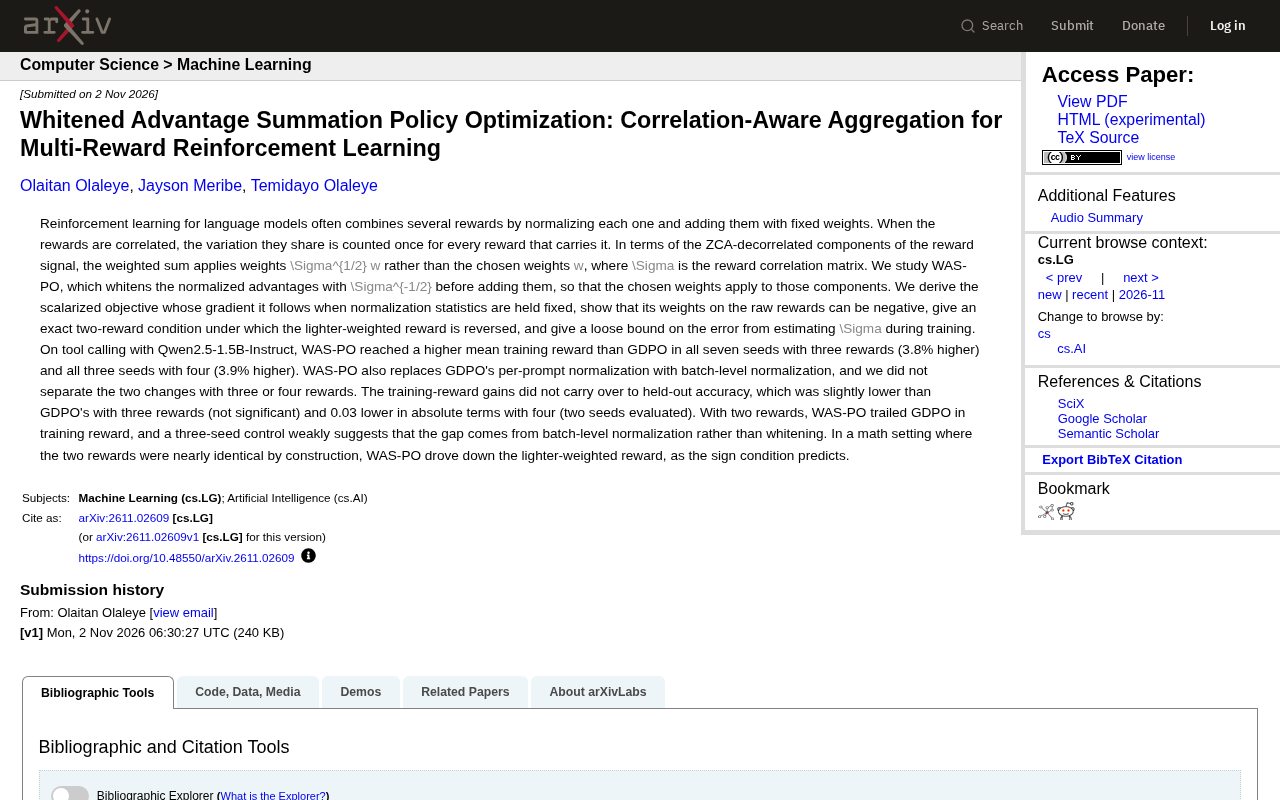
WAS-PO: Using Whitened Advantages to Solve the Correlation Trap in Multi-Reward Reinforcement Learning
WAS-PO paper proposes whitening advantages to correct correlation bias in multi-reward RL: when rewards are correlated, naive weighted summation effectively applies Σ^{1/2}w instead of w. Experiments show training reward improves steadily, but held-out accuracy does not improve in sync, and under two rewards it actually falls behind.