Engineering AI Agents for Production: Four Key Challenges and a 12-Week Implementation Roadmap

A systematic engineering methodology for taking AI Agents from demo to production
About 90% of AI Agent projects stall at the demo stage, fundamentally due to three engineering shortcomings: unstable performance, unpredictable costs, and no quality feedback loop. This article presents a four-layer architecture (perception, reasoning, action, memory), three operational mode options (Workflow, Agent, Multi-Agent), tool orchestration validation mechanisms, and six elements of context engineering to systematically solve the challenges of moving Agents from prototype to production.
About 90% of AI Agent projects never make it past the demo stage — not because the models aren't powerful enough or the ideas aren't good enough, but because the engineering capabilities can't keep up. Based on hands-on experience from frontline teams, this article systematically covers the complete methodology for taking AI Agents from prototype to production, spanning four core dimensions: architecture design, context engineering, evaluation systems, and observability.
90% of AI Agent Projects Die at the Demo Stage — What's Really Going Wrong?
In conversations with numerous teams, one painful truth keeps surfacing: the vast majority of Agent projects never leave the lab. The root cause points to three engineering barriers:
Unstable performance: When multi-step reasoning compounds, 5%–10% variance at each step amplifies level by level. Overall success rates plummet, and P95 latency easily multiplies by 5 to 10x.
Unpredictable costs: For the same task under different context lengths, single-request token consumption can fluctuate 5 to 50x. Long-tail tasks are especially prone to devouring budgets.
No quality feedback loop: When something fails, it's often unclear whether the issue is the model, the prompt, or the data. Without regression testing, every prompt change feels like a gamble.
These three barriers share one thing in common: "switching to a stronger model" won't solve them — they require systematic engineering approaches.
AI Agent Standard Architecture: A Four-Layer Model
Agent systems can be decomposed into four clear layers, each with its own engineering challenges and each independently refinable and replaceable:
- Perception Layer: Handles input parsing, multimodal fusion, and context window management
- Reasoning Layer: Manages decision-making paradigms like Plan, ReAct, Tree of Thought, and Reflection
- Action Layer: Translates model decisions into tool calls, function execution, and API orchestration
- Memory Layer: Encompasses short-term context, long-term vector stores, and task-level caching
Background on Reasoning Paradigms: The various paradigms in the reasoning layer each have distinct focuses. ReAct (Reasoning + Acting), proposed by Google's research team in 2022, interleaves chain-of-thought reasoning with external tool calls, allowing the model to both "think" and "act" at each step — it's currently the most mainstream single-step decision paradigm. Tree of Thought (ToT) allows the model to explore multiple reasoning paths simultaneously, similar to how humans engage in divergent thinking during complex decisions, making it suitable for scenarios requiring global search. The Reflection mechanism enables the Agent to self-evaluate results after taking action, forming an "act → reflect → correct" loop that effectively reduces the cumulative impact of single-step decision errors. These paradigms aren't mutually exclusive — in production, they're often mixed based on task complexity.
The core value of the four-layer architecture lies in separation of concerns — when one layer has issues, you can precisely locate and independently optimize it without cascading effects. After understanding the architecture, the next step is choosing the right operational mode.
Three Agent Mode Options: Workflow, Agent, and Multi-Agent
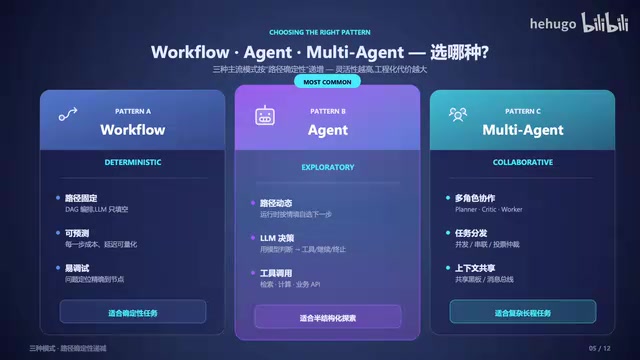
In actual production, Agent operational modes fall roughly into three categories, each suited to different scenarios:
Workflow Mode: Fixed paths where the LLM only "fills in the blanks." Predictable and easy to debug, suitable for deterministic tasks like templated document generation and form processing.
Agent Mode: Dynamic paths where the model decides the next step at runtime. This is the mode most projects are actually implementing, suitable for semi-structured exploratory tasks.
Multi-Agent Mode: Splits Planner, Critic, and Worker into concurrent collaborators. Maximum flexibility but also maximum complexity — use only in scenarios that genuinely require long-horizon task decomposition.
A pragmatic recommendation: For the vast majority of production scenarios, starting with Agent mode is sufficient. Don't prematurely introduce Multi-Agent complexity. Wait until single-Agent capability boundaries have been thoroughly validated before considering decomposition.
Tool Orchestration: The Most Common Failure Point Is Step Four
A stable tool-calling pipeline generally follows six steps: parse task → select tool → execute call → validate response → retry/fallback → aggregate results.
Here's a key insight: The most common failure point isn't step one — it's step four: validating the response. Many teams take the tool's return value and feed it directly to the model, skipping schema validation and business rule checks. This is where hallucinations leak in — the model might fabricate tools, fabricate results, or even pretend a call succeeded.
Background on Hallucination and Grounding: Hallucination is one of the most intractable inherent flaws of large language models: models generate content with high confidence that sounds plausible but is actually incorrect or fabricated — including inventing nonexistent tool names, faking API responses, or claiming to have successfully executed operations that never occurred. Grounding is the core engineering approach to combating hallucination. Its essence is binding every critical model output to a verifiable real data source — for example, requiring tool call results to pass schema validation before entering the next reasoning step, or requiring the model to cite specific retrieved passages when generating answers. Grounding cannot eliminate hallucination, but it can confine its impact to a detectable, interceptable range.
Specifically, response validation should do at least three things:
- Schema validation: Are field types and required fields complete?
- Business rule validation: Are return values within reasonable ranges?
- Consistency validation: Are the returned results logically coherent with the request parameters?
Every step must be observable, and every step must have a fallback — this is the iron rule of tool orchestration.
Context Engineering: The Core Capability That Determines an AI Agent's Fate

Models iterate daily, and prompts get adjusted daily, but what truly determines whether an Agent works well is what it sees at each step — that's context engineering.
Around this core principle, at least six things must be done well:
- Retrieval must be reliable: RAG's recall quality directly determines Agent decision quality. Retrieval failure means all subsequent reasoning is built on a faulty foundation.
- Reranking must be accurate: The ordering of retrieval results directly affects the model's attention allocation. A good Reranker can boost accuracy by a full tier.
- Truncation requires tradeoffs: Context windows are limited. You must learn to discard low-value information and retain what's most critical to the current decision.
- Memory must be split into short-term and long-term: Manage short-term conversation memory and long-term knowledge bases separately to avoid information mixing that causes decision drift.
- Tool descriptions must be specific enough: Vague tool descriptions lead to wrong tool selection. Each tool's inputs, outputs, and applicable scenarios must be clearly documented.
- System prompts must be comprehensive: Persona, output format, safety rules, and boundary conditions must all be clearly specified in the system prompt.
Background on RAG and Reranker Technology: RAG (Retrieval-Augmented Generation) is the current mainstream approach for injecting external knowledge: knowledge base documents are chunked and encoded into vectors, stored in a vector database; at query time, Top-K relevant passages are retrieved via semantic similarity and concatenated into the context for the model to generate answers. However, vector retrieval is essentially approximate matching, and the ordering of recalled results isn't always arranged by "most useful to the model."
Related articles
 Tutorials
ChatGPT Plus Subscription Guide: Are GPT-5.5, image-2, and Codex Worth the Upgrade?
A detailed look at ChatGPT Plus features — GPT-5.5, image-2, and Codex — with a Plus vs Pro comparison and a complete step-by-step subscription guide for users outside the US.
 Tutorials
Harness AI Engineering in Practice: Using Claude Code to Master Enterprise-Level E-Commerce Development
Deep dive into Harness AI Engineering: master enterprise e-commerce development with Claude Code using the Rules, Skills, Wiki, and Changes framework.
 Tutorials
Cursor + Codex Dual-IDE Collaboration: A Practical Methodology for Open-Source Project Customization
A complete methodology for open-source project customization based on real-world experience, detailing the Cursor+Codex dual-IDE workflow, seven-stage process, MVP validation, and AI source code reading techniques.