Enterprise AI Agents in Practice: A Developer's Guide to Hermes Agent
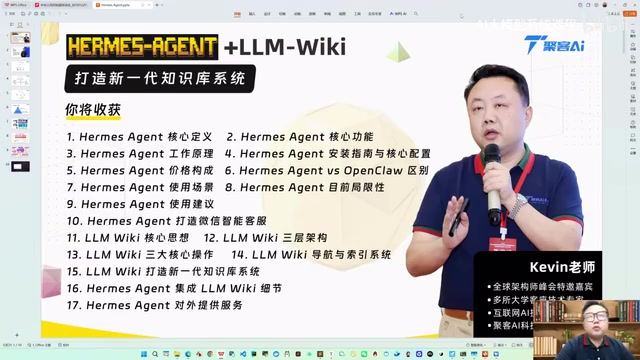
Why mastering AI agents matters more than which agent framework you choose.
This article explores enterprise AI agent development through a comparison of Hermes Agent and OpenCloud, backed by real deployment cases in telecom, finance, and e-commerce. The core argument: tool quality rarely limits success — systematic knowledge of generative models, RAG architecture, and business scenario mapping is what separates effective deployments from failed ones.
In the Agent Era, the Ability to Master the Tools Is the True Competitive Edge
As generative AI technology continues to evolve, building enterprise-grade AI agents has become a top priority for developers and organizations alike. Recently, a technical instructor focused on AI product development and graduate-level research training shared a complete hands-on guide — covering how to build an enterprise AI agent from scratch by combining the latest large model capabilities with mainstream Agent frameworks.
This article is based on that session. It covers a comparative analysis of Hermes Agent versus OpenCloud and other mainstream Agent paradigms, real-world enterprise deployment experiences, and the fundamental reason why "mastering the tools" — not choosing them — determines whether an Agent project succeeds or fails.
What is an AI Agent? An AI Agent is an AI system capable of perceiving its environment, autonomously planning, and executing multi-step tasks — fundamentally different from traditional single-turn conversation models. While conventional large models operate on a basic "input prompt → output response" paradigm, Agents introduce three core modules: Tool Use, Memory Management, and Planning. An Agent can call external APIs, query databases, execute code, browse the web, and even coordinate other sub-agents to form a closed loop of multi-step reasoning and action. Popular Agent frameworks include LangChain, AutoGPT, CrewAI, and Microsoft's AutoGen, all of which provide standardized tool-chain integration and task orchestration logic. Building enterprise-grade Agents is far more complex than simply calling a model API, as it involves state management, error recovery, task decomposition, and other challenging engineering problems — which is precisely why "mastery" matters so much.
Hermes Agent vs OpenCloud: The Tools Are Fine — It's Mastery That Makes the Difference
Before diving into Hermes Agent, many developers may have already encountered another Agent tool — OpenCloud, jokingly nicknamed "the crawfish" in Chinese developer circles. Recently, the internet has been flooded with negative reviews claiming OpenCloud is "hard to use" and "full of problems."
However, the instructor offered a critical observation: the problem is usually not the tool itself, but the user's ability to wield it.
"It's not that OpenCloud or the Hermes Agent we're discussing today is bad — they're actually very capable implementations of the current mainstream Agent paradigm."
Whether it's OpenCloud or Hermes Agent, both are solid realizations of today's leading AI Agent approaches. How well a tool works depends largely on whether the developer has a systematic understanding of the underlying technology. Many users still think of generative models as simple "question-and-answer chatbots" — and that shallow mental model is the real reason tools seem to "not work."
Why Is Hermes Agent Generally Preferred for Enterprise Development?
From a developer's perspective, Hermes Agent demonstrates stronger overall capabilities for enterprise-grade development scenarios. OpenCloud, on the other hand, stands out for cost efficiency — its subscription-based pricing requires only a few dozen RMB per month, which is sufficient for most vertical automation use cases.
Breaking Down Enterprise Agent Cost Structures: Current Agent tools in the market use two main billing models. The first is token-based billing (e.g., directly calling OpenAI, Claude, or similar APIs), where cost scales with usage — ideal for scenarios with highly variable traffic. The second is subscription-based plans (like OpenCloud's model), which offer a fixed monthly fee in exchange for a set volume of automated task executions — better suited for enterprises with stable, predictable workloads. For standardized scenarios like financial customer service or telecom ticket processing, subscription plans can reduce monthly AI operating costs to the tens-of-RMB range, an overwhelming advantage over human labor costs. However, lower-cost plans typically come with limited underlying model capabilities, and complex reasoning tasks or multi-turn context tracking may be unstable — so "matching the tool to the scenario" is a common strategy in mature enterprise AI deployments.
Both tools have their strengths. The right choice depends on your specific business scenario and technical requirements — it's not a simple matter of one being better than the other.

Real Enterprise Use Cases: How AI Agents Are Deployed in Practice
The instructor shared hands-on deployment experience across multiple industries, including:
- Telecom intelligent customer service systems
- Financial industry intelligent customer service
- Cross-border e-commerce customer service systems
These cases validate the viability of Agent technology in real commercial environments and provide a practical reference for enterprise deployment.
Case Study: Fully Automated VIP Student Access Management
One compelling example is the automation of VIP student onboarding. After a student completes enrollment, OpenCloud handles the entire backend access process automatically:
"After a VIP student enrolls in a course, all the onboarding steps — granting various permissions, customer service handoff — are fully automated. We no longer need any human involvement; the crawfish handles all the customer service coordination."
This case highlights two core values of deploying Agent technology:
- Controllable costs: Subscription billing keeps monthly expenses to just a few dozen RMB
- Complete elimination of manual work: Repetitive tasks like permission provisioning and customer service routing run fully automatically
Offloading standardized, process-driven business operations to an intelligent agent — freeing up human staff to focus on higher-value work — is precisely the core motivation behind enterprise AI Agent adoption.

Systematic Knowledge: The Real Barrier to Successful Enterprise Agent Deployment
The central argument running through the entire session is: the ability to master an Agent matters far more than which Agent you choose.
Both OpenCloud and Hermes Agent are mature enough as tools. What truly separates successful deployments from failed ones is the developer's depth of systematic knowledge across three dimensions.
1. Deep Understanding of Generative Model Capabilities and Limits
Many developers rush into Agent development without a solid grasp of how models fundamentally work, which often leads to frustration and wasted effort. Understanding core characteristics like context mechanisms, training cutoff constraints, and reasoning capability boundaries is a prerequisite for building reliable AI Agents.
Context Windows and Capability Limits Explained: The context window is one of the most critical constraints in large language models — it determines how much information the model can "see" in a single inference pass. Early GPT-3.5 had a context of only 4K tokens, while today's mainstream models have expanded to 128K or even 1 million tokens (e.g., Gemini 1.5 Pro). However, a larger context window does not mean unlimited capability. The "Lost in the Middle" effect shows that models' ability to retrieve information from the middle of very long contexts degrades significantly. Models also have a "training cutoff" limitation — they cannot be aware of events that occurred after their training data was collected. For Agent developers, recognizing these boundaries is essential to designing sound task decomposition strategies, memory management mechanisms, and knowledge injection approaches — and to avoiding the systemic failures that result from assigning tasks beyond the model's actual capabilities directly to an Agent.
2. Methodology for Combining Knowledge Bases with Large Models
A knowledge base is the key mechanism for giving a general-purpose large model domain-specific expertise — and it's the core dividing line between enterprise-grade Agents and toy demos. How you design the knowledge base structure, optimize retrieval strategies, and control injection quality directly determines the Agent's real-world performance.
How RAG Works: The core technical approach for combining knowledge bases with large models is RAG (Retrieval-Augmented Generation). RAG works as follows: enterprise documents, product manuals, FAQs, and other private data are chunked into segments, then converted into high-dimensional vectors via an Embedding model and stored in a vector database (such as Pinecone, Milvus, or Chroma). When a user asks a question, the system first retrieves the semantically closest document chunks from the vector database, then injects those chunks as context into the model's prompt, guiding it to generate accurate answers grounded in private knowledge. RAG effectively addresses two major pain points of large models: the knowledge cutoff limitation and hallucinations. In enterprise Agent scenarios, the quality of the knowledge base directly determines usability — document chunking granularity, the choice of Embedding model, retrieval strategy (dense vs. sparse retrieval), and reranking mechanisms all require careful tuning for each specific business scenario. Simply "uploading files" is not enough.
3. Scenario-Driven Deployment Thinking
Technology cannot be divorced from business context. From telecom customer service to cross-border e-commerce, every scenario has its own unique requirements and process logic. Successful AI Agent deployment requires developers to have the ability to precisely map technical capabilities onto specific business workflows.
Conclusion: Build Your Knowledge, Not Just Your Toolkit
As AI technology evolves at a rapid pace, Agents have moved from proof-of-concept to enterprise-scale deployment. The practical experience shared in this article offers several key takeaways:
- Evaluate tool criticism rationally: "The tool doesn't work" is often a misattribution that masks insufficient user capability
- Match tools to scenarios: OpenCloud is cost-effective for standardized processes; Hermes Agent offers stronger capabilities for complex enterprise development
- Systematic knowledge is the true competitive edge: Without a deep understanding of model mechanisms and business scenarios, even the most powerful tool will fail to deliver value
For teams looking to enter enterprise AI Agent development, rather than endlessly debating tool selection, the better investment is building a systematic knowledge framework around generative AI — including Agent architecture principles, RAG knowledge base design, and model capability boundary assessment. That is the genuine shortcut to avoiding pitfalls and delivering business value quickly.
Note: This article is based on a single creator's live stream session. The comparative views on Hermes Agent and OpenCloud represent the presenter's personal technical judgment. Readers are encouraged to validate these perspectives against their own business scenarios.
Key Takeaways
Related articles

Disaster and Glory of the Apollo Program: The History We Must Revisit Before Returning to the Moon
From the fatal Apollo 1 fire to Apollo 8's daring lunar orbit to Apollo 11's successful landing—revisiting the disasters, fears, and compromises of the Apollo program and their lessons for today's return to the Moon.

Netflix Trust Exercise Turns Into Firing Trap: Where Are the Boundaries of Corporate Trust?
A Netflix employee was fired after sharing private info in a trust exercise. We analyze the risks of corporate trust exercises and how employees can protect themselves.

AMD CDNA5 Architecture Deep Dive: Technical Evolution and the AI Computing Competition Landscape
Deep analysis of AMD's CDNA5 architecture covering Chiplet packaging upgrades, HBM memory evolution, and low-precision compute optimization, examining how AMD challenges NVIDIA's AI chip dominance.