Enterprise Brains That Only Answer Questions Never Improve at Decision-Making — How Can They Evolve?

Moody's argues enterprise AI should shift from Q&A retrieval to training specialized models on its own decision experience to improve decision quality.
Based on a sharing by Alehav1, GM and Head of Applied AI at Moody's, at the Fireworks Forge event, the article notes that today's enterprise "company brain" is essentially a knowledge retrieval system that optimizes information access but does not record or analyze the decision process, so it cannot improve decision quality. Moody's approach separates knowledge bases from decision records and uses the latter to train specialized models that learn the organization's decision preferences, risk logic, and historical experience. The article argues enterprise AI is moving from knowledge management to decision assistance, which requires structured decision records, an outcome feedback loop, and scenario-specific fine-tuning — an area where large institutions with rich decision histories hold a data advantage.
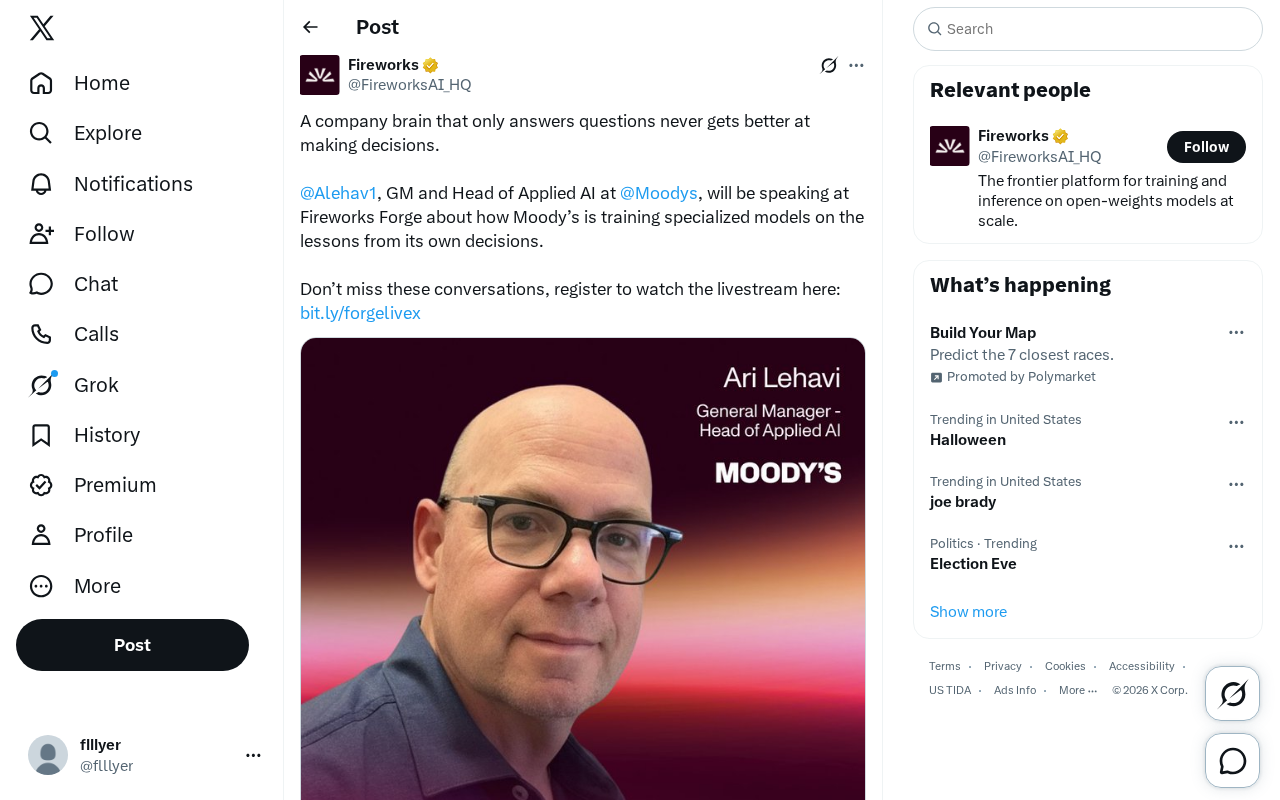
Enterprise AI assistants that stay at the Q&A level will never truly improve decision quality. Alehav1, GM and Head of Applied AI at Moody's, shared a key insight at the Fireworks Forge event: enterprises need to train specialized models that learn from their own historical decision-making experience.
The Limits of the Enterprise Brain: The Ceiling of Q&A-Style AI
The "company brain" deployed by most enterprises is essentially a knowledge retrieval system — employees ask questions, and the AI finds answers from a document library. This model solves the efficiency problem of information access, but Alehav1 points out a fundamental flaw: a system that only answers questions will never get better at making decisions.
The optimization goal of Q&A-style AI is to "find the right information," not to "make better judgments." It does not record the decision process, does not analyze decision outcomes, and does not distill patterns from successes and failures. Enterprises accumulate a large amount of decision data but rarely turn it into signals that a model can learn from.
According to Alehav1's sharing on Twitter, Moody's is exploring a different path: letting AI systems learn from the company's own decision experience, rather than merely retrieving knowledge.
Moody's Solution: Training Specialized Models on Decision Experience
Alehav1 is the GM and Head of Applied AI at Moody's, and he will explain in detail at the Fireworks Forge event how Moody's trains specialized models to learn from the "lessons" of its own decisions.
The core of this approach lies in distinguishing two types of data: one is the enterprise's knowledge base (documents, policies, processes), and the other is the enterprise's decision records (what choices were made under what circumstances, and what the results were). The former is suitable for retrieval; the latter is suitable for training.
The key difference between a specialized model and a general-purpose large model is that it learns the decision preferences, risk judgment logic, and historical experience of a specific organization. As a globally recognized credit rating and risk analysis institution, Moody's decision data inherently carries a strong risk assessment character, which gives it a natural advantage in training specialized models.
"A company brain that only answers questions never gets better at making decisions." — Alehav1
Specialized model fine-tuning refers to retraining model parameters on top of a pretrained large model using labeled data from a specific domain, so that the model adapts to a certain type of task or the specific needs of an organization. Unlike prompt engineering or retrieval-augmented generation (RAG), fine-tuning actually changes the model weights, thereby "internalizing" domain knowledge into the model. In enterprise decision-making scenarios, fine-tuning data typically includes historical decision cases, decision rationale, outcome labels, and so on. The advantage of this approach is that the model can learn the organization's unique judgment logic and risk preferences rather than relying on statistical patterns in general corpora; the cost is that it requires high-quality labeled data and a certain amount of compute investment, and the model update cycle is relatively long.
From "Knowing" to "Judging": The Next Stop for Enterprise AI
This view points to a watershed in enterprise AI adoption. Most enterprise AI projects currently remain at the "knowledge management" level, with metrics such as retrieval accuracy and response speed. The competitive focus of the next stage is "decision assistance" — whether a model can, based on historical experience, provide well-grounded judgment recommendations for new business situations.
Achieving this leap requires three prerequisites: structured decision records, an outcome feedback loop, and model fine-tuning for specific decision scenarios. Moody's practice shows that large institutions with rich decision histories have a data advantage in training specialized decision models.
Interestingly, Alehav1's sharing focuses on "training specialized models" rather than directly using general-purpose large models, which hints at a pragmatic technical path: in high-stakes scenarios such as enterprise decision-making, the generalization ability of general models is not necessarily superior to specialized models fine-tuned on the organization's own experience.
Outcome feedback loop refers to the mechanism by which the actual results after a decision is executed are systematically collected, labeled, and fed back into the model training process. In decision assistance scenarios, this means recording not only "what decision was made" but also "what consequences the decision brought," and using the latter as a supervisory signal for model iteration. Without a feedback loop, the model can only learn the surface patterns of decisions and cannot distinguish between successful and failed decision paths. The key challenges in building the loop lie in outcome attribution (distinguishing the decision itself from the influence of external factors), feedback delay (some decision effects only become apparent after months), and the cost of data labeling.
High-stakes scenarios refer to application contexts where the consequences of decisions are significant and the cost of errors is extremely high, such as credit rating, medical diagnosis, and financial risk control. In such scenarios, the requirements for model interpretability, reliability, and domain adaptation are far higher than in general applications. Although general-purpose large models have strong generalization ability, their outputs are based on statistical associations in broad corpora and may not reflect the professional judgment standards of a specific institution. Therefore, in high-stakes scenarios, specialized models fine-tuned on the organization's own experience are often preferred — their behavioral boundaries are more controllable, and their judgment basis is closer to the organization's historical practice and compliance requirements.
Event Information and How to Participate
The Fireworks Forge event will bring together multiple enterprise AI practitioners, and Alehav1's sharing is one of the sessions. Readers interested in how Moody's builds a decision-learning system can register to watch the livestream via the original link.
The value of enterprise AI should not stop at "answering questions." Only when systems begin to learn from decisions does the enterprise brain truly gain the ability to evolve.
One-line Summary
Moody's argues that enterprise AI should shift from Q&A retrieval to training specialized models on its own decision experience to improve decision quality.
Paragraph Summary
Based on a sharing by Alehav1, GM and Head of Applied AI at Moody's, at the Fireworks Forge event, the article points out that the current enterprise "company brain" is essentially a knowledge retrieval system that only optimizes information access efficiency and does not record or analyze the decision process, and therefore cannot improve decision quality. Moody's solution is to distinguish two types of data — knowledge bases and decision records — and use the latter to train specialized models, enabling AI to learn the organization's own decision preferences, risk judgment logic, and historical experience. The article argues that enterprise AI is shifting from knowledge management to decision assistance, and that achieving this leap requires structured decision records, an outcome feedback loop, and model fine-tuning for specific scenarios, while large institutions with rich decision histories have a data advantage.
Related articles

VERS: Editing Activation Explanations to Halve Reasoning Model Tokens
VERS guides reasoning models by editing activation explanations, cutting 45.8% of tokens on GSM8K with only a 0.82 pp accuracy drop and transferring to larger models, but losing accuracy on competition problems.

Finding Errors Is Not Enough: Selective Model Escalation for Entity-Targeted Sentiment Analysis
This study explores selective model escalation for entity-targeted sentiment analysis, comparing data collection ordering, uncertainty-driven re-examination, and model routing—finding that minority-class priority only helps at very small data volumes, the oracle upper bound far exceeds actual gains, and escalation must be tailored to each dataset.

WAS-PO: Using Whitened Advantages to Solve the Correlation Trap in Multi-Reward Reinforcement Learning
WAS-PO paper proposes whitening advantages to correct correlation bias in multi-reward RL: when rewards are correlated, naive weighted summation effectively applies Σ^{1/2}w instead of w. Experiments show training reward improves steadily, but held-out accuracy does not improve in sync, and under two rewards it actually falls behind.