Enterprise-Level Vibe Coding in Practice: Claude Code + Codex Engineering Development

From Vibe Coding to engineering: a hands-on breakdown of the enterprise-level progression path and tool selection for AI programming.
The article documents a hands-on course by Bilibili creator Mr. Zhu, exploring how AI programming tools can bridge the gap from "vibe coding" to enterprise-level engineering. The author notes that Vibe Coding suits product managers building quick demos, but when facing complex businesses such as distributed systems, microservices, and high concurrency, the generated code is hard to maintain and bug fixing easily falls into endless loops. The course designs a three-tier progressive path: pure Vibe Coding, Plan Mode, and engineering-driven development based on Claude Code's Super Power plugin covering the full workflow from requirements to deployment. The article also compares Claude Code and Codex in capability and availability, discusses the priority of model selection, uses an OpenRouter-like model aggregation platform to illustrate the business logic of wrapper services, and finally mentions the progress of Alibaba's internal AI engineering system.
Why Vibe Coding Can't Handle Enterprise Projects
Vibe Coding originated overseas, and its core logic is "you describe an idea, AI generates code." For product managers or creators without a technical background, this genuinely lowers the barrier to development. Early on, many bloggers used this approach to build tools like fill lights, pomodoro timers, and small cross-border websites, with some even claiming that "programmers are about to be replaced."
But Mr. Zhu points out that such projects have extremely simple functionality—often fully describable in two sentences. Once the project scales up and business logic becomes more complex, problems surface: the generated code is hard to maintain, and when bugs appear in production, a non-technical person directing the work can't effectively guide the AI to fix them. The project easily falls into an endless loop until it stalls.
Enterprise-level projects are by nature complex in both business and technology—distributed systems, microservice architectures, high-concurrency scenarios. None of these can be handled correctly by the AI in one shot just from a simple requirement description. Vibe Coding can rapidly produce demos, but it's still a long way from a maintainable, iterable enterprise-grade system.
The term Vibe Coding was coined by AI researcher Andrej Karpathy in early 2025, referring to a development approach where developers fully go along with AI code generation, don't review line by line, and push forward based on "feel." Its typical workflow is: natural language description → AI generates → run directly → describe again on error. What distinguishes it from AI-assisted coding is the degree of human involvement: the latter requires developers to understand and review the generated code, while the former delegates review responsibility to the tool itself. This is precisely the fundamental reason it's highly efficient for small projects but quickly fails in complex systems—without human oversight of architecture and contracts, code quality cannot converge as scale grows.
A Three-Tier Progressive Hands-On Path
The course is designed along a path from easy to hard, corresponding to three development modes:
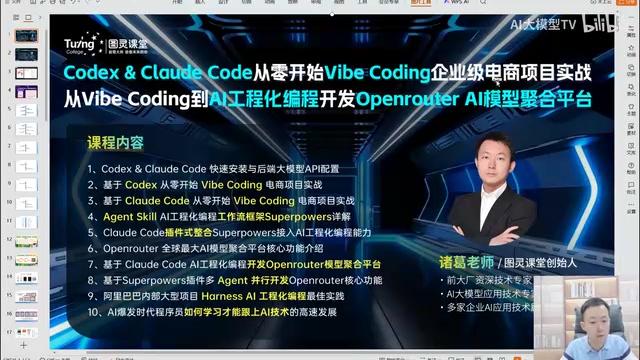
Tier 1: Pure Vibe Coding. Use Claude Code and Codex to each create an e-commerce project folder, give a few sentences of requirements, and let the AI start writing directly. Within minutes you can see a runnable page, which is suitable for understanding the basic capability boundaries of the tools.
Tier 2: Plan Mode. Both Claude Code and Codex offer a plan mode, where the AI first breaks down requirements and plans the steps before writing code. Compared with direct generation, this approach is more controllable for slightly more complex projects.
Tier 3: Engineering-driven programming. This is the core of the course. Based on Claude Code's Super Power plugin, a Skill system covering the entire workflow—requirements analysis, development, testing, and deployment—is used to build a真正的 enterprise-level e-commerce project. Super Power contains dozens of Skills, essentially encapsulating the AI engineering standards used inside big tech companies into a reusable development pipeline.
Plan Mode is an interaction paradigm in current mainstream AI programming tools: before writing code, the model outputs a structured implementation plan (which files are involved, order of changes, dependencies, verification methods), which the user confirms or modifies before execution. It is equivalent to making the "requirements analysis—solution design" step explicit, reducing the model's drift from the goal in long tasks. Common accompanying practices include rule files (such as CLAUDE.md and AGENTS.md) and context management, replacing one-off prompts with persistent project constraints—a key transition from "conversation" to "pipeline."
A Real Capability Comparison of Claude Code and Codex
Mr. Zhu's assessment of the two tools is quite direct: Claude Code is the most used among professional developers and is the most capable, with a very mature internal AI engineering system and extensive optimization for professional programming. But the problem is that Anthropic's CEO is "very anti-China," the latest models are restricted to the United States, and account bans are frequent and troublesome to recover from—so he himself uses it less and less now.
Codex was far inferior to Claude Code early on, but after the latest GPT release its capabilities improved markedly, and with fewer usage restrictions, he now uses it more often. As for domestic tools, Codebody, Trae, and Cursor are all decent, but the core factor remains the underlying model capability—model first, tool second.
For backend model selection, he has tried mainstream domestic models such as Zhipu GLM, Xiaomi MiMo, and DeepSeekAd, and believes GLM is currently the best in the top tier, DeepSeek offers the best value for money, and MiniMax, Kimi, and Tencent Hunyuan are all within the realm of options.
The statement in the article that "model first, tool second" points to the layered structure of AI programming tools: at the bottom is model capability (reasoning, long context, code generation, and tool calling), in the middle is the agent framework (file reading/writing, command execution, multi-turn planning, sub-agent scheduling), and only at the top is the IDE or CLI interaction form. When the same model is connected to different tools, the differences in results mainly come from context organization and tool-calling strategy; while different models under the same tool often differ even more significantly. Therefore, when evaluating tools, one should distinguish "model ceiling" from "engineering encapsulation"—the former determines the upper limit, and the latter determines stability and reproducibility.
Why OpenRouter-Like Wrapper Sites Make So Much Money
The second project in the course is to develop an AI model aggregation platform similar to OpenRouter. OpenRouter is the world's largest AI large-model aggregation platform, integrating almost all mainstream models on the market, some of which are available for free or at low cost.
Here Mr. Zhu offers a counterintuitive judgment: the most profitable areas in AI right now are not consumer-facing AI applications—Doubao and Tencent Yuanbao are all losing money—but rather those selling compute power, selling tokens, and running token-wrapper aggregation sites. He has friends who run this kind of overseas wrapper site, and a team of a dozen or so people reached annual revenue of one to two hundred million.
The teaching value of this project lies in the fact that it is both a project type with real commercial value and a way for students to understand common architectural patterns in enterprise-level development such as API aggregation, multi-model routing, and billing systems.
The core mechanism of a model aggregation platform is a unified API gateway: externally it provides an interface protocol compatible with OpenAI, internally it connects to model endpoints from multiple vendors, makes trade-offs among price, latency, and availability through routing strategies, and automatically falls back to backup models on failure. Its business model is usually reselling upstream tokens at a markup over wholesale prices, or offering prepaid credits and usage statistics. The technical difficulty of such projects lies not in the models themselves, but in the accuracy of billing reconciliation, key and quota management, multi-tenant isolation, and the stability of streaming response passthrough—these are precisely typical topics in enterprise-level backend engineering.
How Big Tech Is Doing AI Engineering
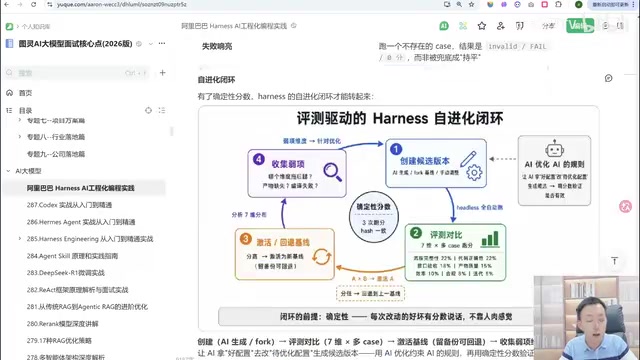
The course also covers AI programming practices at leading domestic big tech companies. According to Mr. Zhu, Alibaba is internally promoting a complete AI engineering programming system, including full-process standards from requirements to launch. He has an internal document and will explain its overall thinking in the course (because there is too much practical content, only the general framework will be covered).
The value of this part is to show students that AI programming is not as simple as "open a chat box and let the AI write code." Big tech companies are already turning it into a manageable, auditable, and collaborative engineering process. Plugins like Super Power are, to some extent, an open-source encapsulation of this kind of process.
What Developers Should Take Away
This lesson has a high information density, but what is truly worth paying attention to is not the specific operating steps of particular tools—those can be learned by reading the docs—but two structural judgments:
First, the boundary of Vibe Coding is clear. It can help you quickly validate ideas and build prototypes, but the complexity of enterprise-level projects means it must be supplemented by engineering standards. Equating AI programming with "you can build systems without understanding technology" is a misreading of tool capabilities.
Second, tool selection is shifting from "which IDE is easy to use" to "which model + which engineering workflow works best." The combination of VS Code + Claude Code plugin, the Codex desktop app, and the CLI represents a new paradigm of "lightweight editor + strong AI agent." Traditional heavy IDEs that don't transform will find themselves in an increasingly awkward position.
For developers who want to keep up with this wave of change, Mr. Zhu's advice is simple: this is a profession that requires lifelong learning. AI will not eliminate everyone, but it will eliminate those who stop learning.
Related articles

The Information-Geometric Blind Spot of Conformal Test Martingales: Why Distribution Drift Goes Undetected
This article explains the information-geometric blind spot of conformal test martingales (CTMs): drifts preserving the conformal score pushforward are undetectable. It formalizes A-equivalence classes and A-secret I-projections, gives explicit KL-nearest densities and Pythagorean decompositions, and empirically constructs the blind spot on EMNIST/MNIST image data. Implications for e-value design and drift detection are discussed.

Bilibili AI Agent Development Tutorial: A Practical Guide to LangChain and MCP
Bilibili's latest AI Agent development tutorial: zero-foundation LangChain and MCP practice, a four-day camp covering core tools and career guidance, with free resume templates and interview guides to quickly get started with large model application development.

DP-μP: A New Framework for Zero-Shot Hyperparameter Transfer in Differentially Private Training
The DP-μP framework fixes μP's failure under differential privacy, using SNR conditions and spectral scaling to derive learning-rate scaling rules for DP-SGD, DP-Adam, and DP-Muon, enabling zero-shot transfer across model widths.