Enterprise Private Deployment Costs Hundreds of Thousands? Panel AI Gets It Done in 30 Minutes with One Click

Panel AI challenges expensive big-tech private deployment with 30-minute one-click deployment and autonomous code delivery.
The article compares big-tech private deployment with Panel AI. Big-tech solutions use on-site customization, take three to six months, cost hundreds of thousands or more, and lock in their own models without code delivery—unaffordable for SMEs. Panel AI offers visual one-click deployment within 30 minutes, free switching and combination of open-source models, containerized code delivery with independent maintenance, elastic scaling and distributed node management, physical data isolation, and monetization of idle compute. The article notes the information comes mainly from a single source, and performance and stability still require POC validation, making it better suited for cost-sensitive SMEs with some technical capability.
Enterprise Private Deployment Costs Hundreds of Thousands? Panel AI Gets It Done in 30 Minutes with One Click
Recently, I've been talking with a lot of small and medium business owners about AI implementation. Whenever private deployment comes up, their first reaction is usually: "The big companies have already built this—why not just use Alibaba, Tencent, Baidu, or Huawei's solutions?" This is indeed a common mindset. But are big-tech private deployment solutions really suitable for SMEs? Bilibili creator Xiong Ge shared in a video his observations on the pain points of private deployment, along with the solution his team came up with—Panel AI.
Why SMEs Can't Afford Big-Tech Private Deployment
Big-tech private deployment typically uses an on-site custom development model, requiring professional engineers to be present, with deployment cycles of three to six months. High communication costs and long development cycles mean that for SMEs eager to validate AI's value, time itself is the biggest cost.
More critically, there's the cost threshold. According to Xiong Ge in the video, big-tech private deployment costs run into hundreds of thousands or even millions, which SMEs struggle to bear. And it's not a one-time deal—annual maintenance fees may double, and each feature change may incur additional charges.
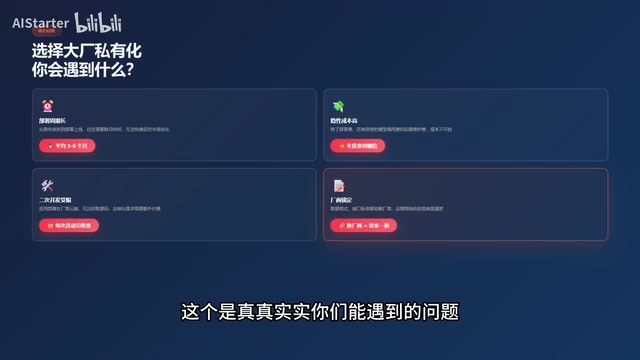
Another hidden risk is model lock-in. Big-tech solutions often bind you to their own models, preventing enterprises from flexibly switching or combining open-source models. At the delivery level, the underlying code and tech stack are usually not in the enterprise's hands, so switching vendors later means buying everything again. This "vendor lock-in" puts enterprises in a passive position for long-term iteration.
Redefining Private Deployment: Five Differentiators of Panel AI
The Panel AI solution proposed by Xiong Ge's team attempts to redefine private deployment standards across dimensions such as deployment method, model selection, and delivery completeness.
One-Click Deployment: From Zero to Production in 30 Minutes
Traditional deployment requires manually installing the Python environment, CUDA drivers, and GPU startup items—and installing one application after another may cause conflicts. Panel AI's approach is visual page operations with front-end/back-end separation: operations staff can deploy open-source projects with a click on the back end, automatically checking the environment and configuring the database, cache, message queue, and HTTPS. From zero to production in under 30 minutes—a clear efficiency gain compared to traditional customized deployment that takes three to seven days.
The reason traditional AI project deployment is so cumbersome lies in the complexity of dependencies. A typical deep learning application requires a specific version of the Python interpreter, a CUDA toolchain matched to the GPU driver, cuDNN acceleration libraries, and middleware such as databases, caches (e.g., Redis), and message queues. These components have a strict version compatibility matrix, and manual installation easily leads to dependency conflicts where "installing A breaks B." Containerization technologies (such as Docker) alleviate this to some extent by packaging applications and their dependencies into standardized images, but orchestrating multiple containers and configuring networking and persistent storage still require expertise. What Panel AI does is essentially encapsulate the above steps—environment checks, dependency installation, middleware configuration, and HTTPS certificate issuance—into a visual workflow, with the system automatically completing version matching and sequencing, compressing work that would take a senior ops engineer days into minutes.
Free Model Combination Without Lock-In
Panel AI supports freely switching and combining open-source models. Enterprises can choose different models based on business scenarios instead of being bound to a single vendor's model ecosystem. This is especially important for scenarios requiring multi-model collaboration.
Model lock-in means that after an enterprise selects a vendor, the inference interface, fine-tuning toolchain, and data formats are all bound to a single vendor's model system, requiring extensive rewriting of calling code and re-validation of results when migrating. The open-source model ecosystem offers another path: enterprises can deploy models of different parameter sizes and capability focuses on the same infrastructure—for example, using smaller models for high-concurrency simple tasks and larger models for complex reasoning, then distributing requests by type through a unified routing layer. This "model combination" strategy controls inference costs and enables quick replacement when a model is updated or discontinued, avoiding business interruption. However, coexisting multiple models also brings additional complexity in GPU memory scheduling, version management, and performance evaluation, requiring a supporting scheduling system.
Complete Delivery: The Code Is in Your Hands
Deployed project code runs in containers, and enterprises can modify it directly. All documentation is provided, allowing independent modification and maintenance. Xiong Ge emphasized in the video: "All the data keys are yours—if we want to maintain it, we still need you to give us a key to open it." This delivery approach gives enterprises true control.
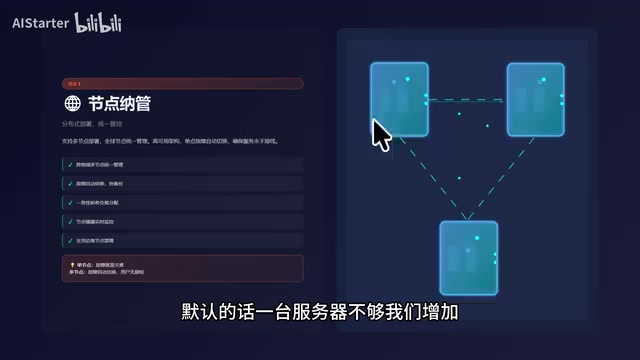
Elastic Scaling and Node Management
When one server's compute power is insufficient, enterprises can buy another server and connect it directly to the system to expand scheduling resources. Panel AI has a built-in scheduling system that automatically determines resource requirements based on project usage. Node management supports unified management after distributed deployment.
Physical Data Isolation and Compute Monetization
Data is deployed on the enterprise's own servers—whether inside the company or anywhere else—and used internally over the network, inaccessible to others. Xiong Ge specifically mentioned compute tokenization: if deployed compute power exceeds internal needs, it can be sold externally, and applications can be listed for sale directly in the back end, creating new revenue streams.
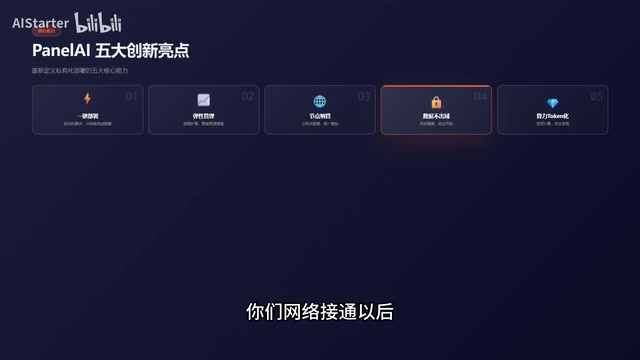
Compute tokenization means metering GPU inference capability by call volume or duration and selling it externally like utilities. Its technical prerequisite is a scheduling system capable of isolating, metering, and billing multi-tenant compute usage, typically involving container resource quotas, GPU time-sharing, and request-level billing. For enterprises, self-built private clusters often have low GPU utilization during idle periods; selling surplus compute can amortize hardware costs. But this also requires reliable tenant isolation mechanisms to prevent data or model cross-contamination between users, along with clear service-level agreements and settlement methods. Whether this model can run stably at small and medium scale still depends on scheduling precision and isolation strength.
Who Is This Suitable For?
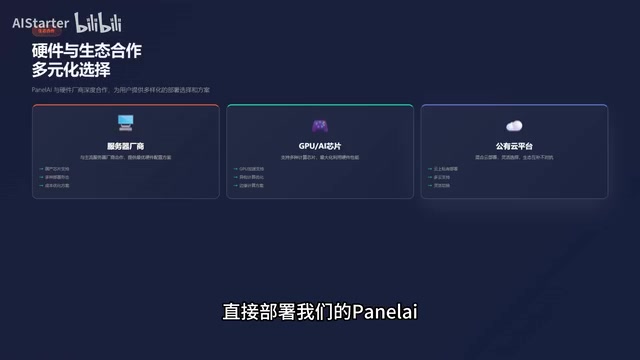
Panel AI targets SMEs that need private deployment but have limited budgets. It supports x86 and ARM architectures, can be deployed on public cloud platforms, and supports various AI chips. Xiong Ge revealed that hardware vendors are currently in talks, hoping to pre-install Panel AI on servers at the factory to enhance product competitiveness.
If you're technical, you can deploy and install it yourself; if not, Xiong Ge's team also provides workflow-building services, including integration of open-source projects for data cleaning, OCR recognition, and knowledge bases.
A Rational View: Areas Still Needing Validation
A note: the above information mainly comes from Xiong Ge's one-sided sharing. The video does not show specific performance test data, details of the multi-tenant isolation scheme, or stability under large-scale nodes. For SMEs considering private deployment, it's advisable to require vendors to provide POC validation during selection, focusing on model inference performance, data isolation mechanisms, and fault recovery capabilities. Big-tech solutions still have advantages in compliance, service systems, and ecosystem completeness; lightweight solutions like Panel AI are better suited for cost-sensitive teams with reasonable technical capability.
At the end of the video, Xiong Ge mentioned an interesting detail: this PPT was written with AI's help. "You're already using AI—why not use AI to do it?" This may also reflect a pragmatic attitude for SMEs embracing AI today—tools are neither big nor small; a solution that solves the problem is a good one.
One-line Summary
Panel AI challenges expensive big-tech private deployment with 30-minute one-click deployment and autonomous code delivery.
Paragraph Summary
The article compares big-tech private deployment with the Panel AI solution. Big-tech solutions use on-site customization, take three to six months, cost hundreds of thousands or more, and lock in their own models without delivering code—unaffordable for SMEs. Panel AI focuses on visual one-click deployment, completing environment checks, database, and HTTPS configuration within 30 minutes; supports free switching and combination of open-source models; delivers containerized code that enterprises can modify and maintain independently; supports elastic scaling and distributed node management; provides physical data isolation and lets idle compute be tokenized and sold externally. The article also notes that the information comes mainly from a single source, and performance and stability still require POC validation, making it better suited for cost-sensitive SMEs with some technical capability.
Related articles

A Single Prompt Triggers a Global PHP Security Storm: Is AI a Savior or a Hidden Risk?
A single AI prompt triggered a global PHP security crisis affecting Wikipedia and the Internet Archive. This article reviews the incident, analyzes the OpenAI-Amazon controversy, and explores the security paradox of lowered vulnerability discovery barriers in the AI era and developer response strategies.

When AI Is Taken Away: How Reliance on Shortcuts Undermines Your Problem-Solving Resilience
A study of 1,222 people found that after using AI to answer questions, once AI was removed, people gave up on more problems than a control group that never used AI. The article analyzes the impact of AI reliance on learning resilience and metacognition, and explores design implications for AI learning tools.

Carta and NewView Partner to Let Startup Employees Cash Out Equity Early
Carta and NewView Capital partner to simplify startup tender offers, helping employees sell equity early. Analysis of the mechanism, liquidity pain points, and impact.