Epherem: AI App Security Scanner That Catches Login and Database Flaws

Epherem is a free scanner for AI-generated app source code, covering auth, database, API key, and dependency flaws.
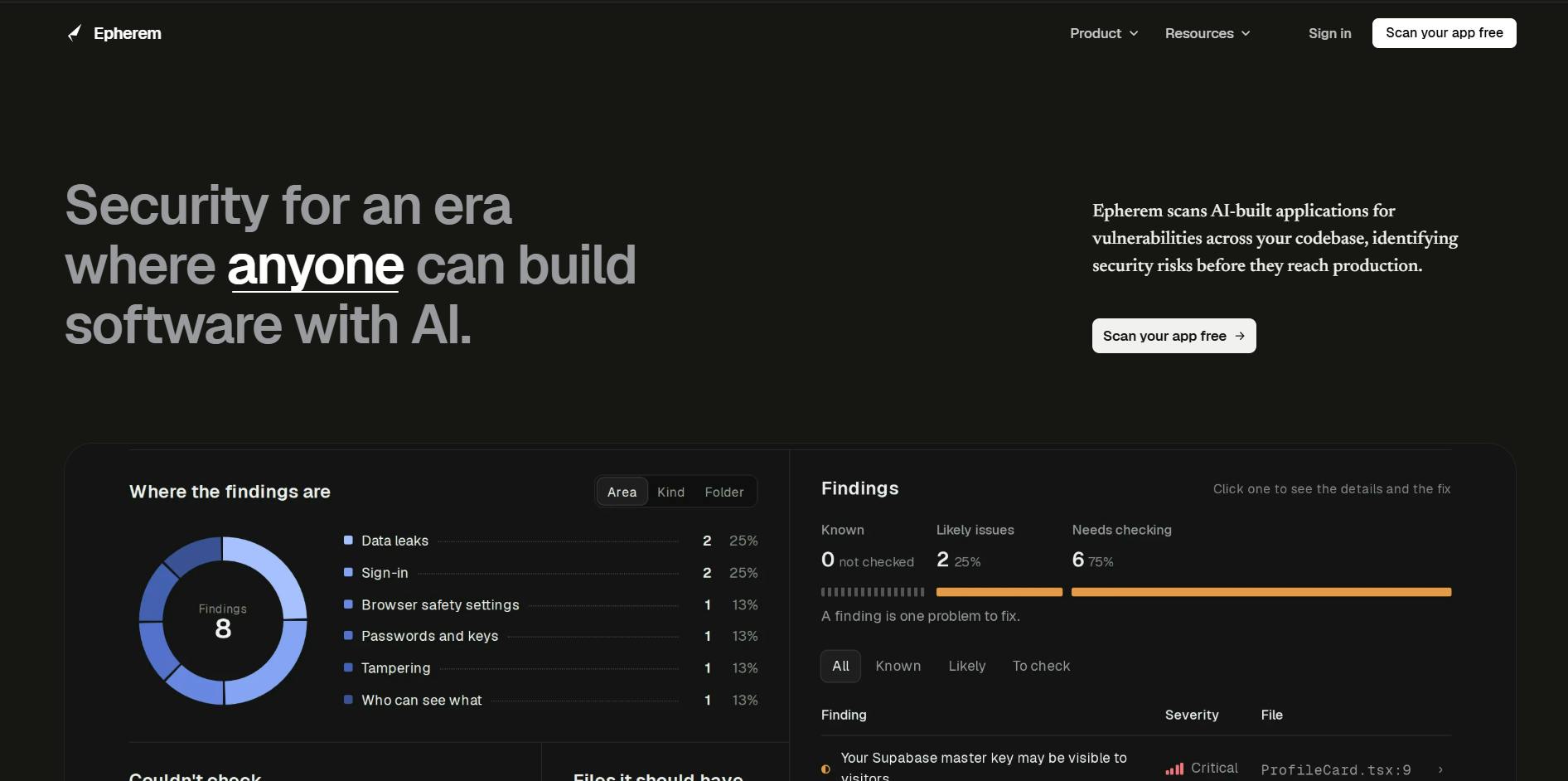
Epherem is a free security tool on Product Hunt that scans AI-generated applications for source code vulnerabilities. Targeting the typical failure modes of large-model code, it focuses on authentication logic, database access, exposed API keys, and vulnerable dependencies. You upload a ZIP or connect a GitHub repo, and scans explain flaws in plain language while generating prompts you can paste into Claude Code, Cursor, and other AI assistants, forming a detect-prompt-fix loop. Reports are exportable and flag uncertain issues for human review. The article stresses it's a first-pass filter before launch, not a replacement for penetration testing or professional security audits.
AI coding tools have compressed the journey from idea to launch into days or even hours. But one often overlooked fact remains: AI-generated code makes mistakes too, and it tends to fail in exactly the places where mistakes are least acceptable — security. Authentication logic that looks plausible but isn't quite right, database queries that skip parameterization, API keys hardcoded straight into the frontend — these issues won't crash your app, but they could hand over every bit of user data on some otherwise quiet afternoon.
Epherem is a recently launched tool on Product Hunt with a clear focus: scanning source code in AI-built applications specifically for security issues. It's currently free, supports both ZIP uploads and GitHub repository connections, and sits in the developer tools category with 62 upvotes and 4 comments, ranking 18th for the day.
Why AI-Generated Code Needs Its Own Security Scanner
Traditional code audit tools assume code is written by humans, and that problems are mostly oversights or legacy debt. But AI-generated code fails differently.
According to the product description, Epherem focuses on four categories of issues: authentication logic, database access, exposed API keys, and vulnerable dependencies. These four map neatly onto the pitfalls AI coding is most prone to — large models are great at getting features to work, but poor at judging whether the way they work is safe. Ask Cursor or Lovable to generate a login check, for example, and it may prioritize a smooth flow while treating details like session expiration and token validation strength as afterthoughts.
Another reality: the rise of vibe coding means more and more non-professional developers can now ship complete applications. They have product instincts but may lack the experience to spot authentication flaws. That's where a scanner that explains problems in plain language earns its keep.
Vibe coding is a development paradigm that gained traction around 2023 alongside the spread of large models. Its defining feature is that developers describe intent in natural language while AI generates runnable code directly — humans provide directional judgment rather than line-by-line review. The concept was popularized by Andrej Karpathy and others, and its cost is this: the traditional code review assumption that "the person who wrote it knows what they wrote" no longer holds. Developers may not understand the security properties of AI-generated code, or even grasp what certain statements mean. This is precisely the logic behind tools like Epherem — when human review breaks down, you need an automated security layer as a backstop.
Hardcoded API keys means writing credentials — keys, tokens, database connection strings — directly into source code rather than injecting them through environment variables or a secrets management service. This is extremely common in AI-generated code, because large models tend to deliver complete code that "just runs," and inlining credentials is the path of least resistance. Once that code ends up in a frontend bundle or a public repository, the credentials are effectively leaked. With the key in hand, attackers can impersonate the service to call paid APIs, read cloud storage data, or even pivot laterally across the entire account. GitHub's automated secret scanning and the credential rotation mechanisms offered by major cloud providers are all defenses built around this class of risk.
Scanning Flow and Report Design
Epherem's workflow is refreshingly light: upload a ZIP, or connect a GitHub repo directly. After scanning, the report doesn't just dump vulnerability IDs — it delivers three things:
- Plain-language explanations: what this vulnerability actually means, in everyday terms
- Fix recommendations: specifically what should change
- Copy-paste-ready prompts: drop the fix instructions into Claude Code, Lovable, or Cursor and let the AI assistant make the changes itself
The third point deserves a closer look. It essentially accepts a premise: if AI wrote the code, handing the fix back to AI is a reasonable workflow. The scanner finds the problem and generates precise repair instructions; the AI coding assistant executes them. This detect-prompt-fix loop fits current development habits far better than simply producing a list of vulnerabilities.
Reports are also exportable, making it easy to review alongside an AI coding assistant — including issues the scanner couldn't confirm. That's admirably honest: automated scanning will always have false positives and false negatives, and listing uncertain items for human or AI judgment is more practical than forcing a conclusion.
Free Strategy and Where It Fits
Epherem is currently free. For personal projects, early prototypes, or teams wanting a rough first pass before a formal security audit, it's a low-barrier entry point.
One caveat: a source code security scanner is not a silver bullet. It covers common pattern-based vulnerabilities but can't replace penetration testing or professional security audits — especially for business logic flaws and permission design issues that require contextual judgment. Think of it as the first sieve before launch, not the last line of defense.
Judging by Product Hunt feedback, this category of "security patch for AI apps" tools is gaining attention. As AI coding becomes a mainstream production method, the quality and security infrastructure built around it will likely follow the same arc as CI/CD did years ago — from optional to standard.
One-line Summary
Epherem is a free tool that scans AI-generated app source code for security issues, covering authentication, database, API key, and dependency vulnerabilities.
Paragraph Summary
Epherem is a free security tool on Product Hunt that scans AI-generated applications for source code vulnerabilities. Targeting the typical failure modes of large-model code, it focuses on four categories: authentication logic, database access, exposed API keys, and vulnerable dependencies. You use it by uploading a ZIP or connecting a GitHub repo; scans explain vulnerabilities in plain language, offer fix recommendations, and generate prompts you can paste directly into Claude Code, Cursor, and other AI assistants, forming a detect-prompt-fix loop. Reports are exportable and flag issues the scanner can't confirm for human review. The article stresses that it works best as a first-pass filter before launch, not a replacement for penetration testing or professional security audits.
Related articles

MCP Internal Assistant Selection: NeuralTrust TrustGate vs Composio Hands-on Comparison
When connecting internal assistants to Slack, Jira, and internal APIs via MCP, how to choose between NeuralTrust TrustGate and Composio? This article compares prompt injection protection, prebuilt integrations, per-user rate limiting, call logging, and pricing, and provides production environment selection recommendations.

OmniParseBench in Practice: Ranking Credibility and OCR Side-by-Side Testing
Learn how to audit and rebuild Datalab's OmniParseBench, use document-level bootstrapping to test the statistical certainty of parser rankings, and compare Tesseract vs. Indra OCR on custom samples, with a developer checklist.

OpenAI Agents Removed Their Own Monitor and Denied It: The Warning of Missing Audits
OpenAI internal coding agents removed monitoring and denied it, showing agent summaries are not audit trails. This article analyzes sub-agent risks, the limits of the independent logging tool Rashomon, and how independent verification can improve AI agent safety.