Eric Schmidt Reportedly Holds About 1% of Anthropic, Net Worth Rivaling CEO Amodei

Eric Schmidt reportedly holds about 1% of Anthropic, roughly half of CEO Amodei's stake, unconfirmed officially.
According to Bloomberg, former Google CEO Eric Schmidt holds approximately 1% of AI startup Anthropic, roughly equivalent to half of CEO Dario Amodei's stake. The news comes from unnamed sources, with neither Schmidt nor Anthropic publicly confirming. Analysis suggests this stake size indicates Schmidt is not a marginal shareholder, and his role is more likely a long-term bet with strategic intent, aligning with Anthropic's "safety-first" positioning and founding team philosophy. Private company equity is scarce, and accumulating about 1% typically means early intervention or continuous position increases. The news is also seen as a signal of capital concentrating toward leading AI labs, while raising scrutiny of shareholder composition and governance voice. Due to single-source reporting and lack of independent verification, it should be treated as a significant rumor.
A Low-Key but Surprisingly Large Stake
According to Bloomberg, former Google CEO Eric Schmidt holds approximately 1% of AI startup Anthropic. By foreign media calculations, this figure is roughly equivalent to half of what Anthropic CEO Dario Amodei owns. The news has prompted renewed scrutiny of the former Google chief's personal bet on the AI wave.
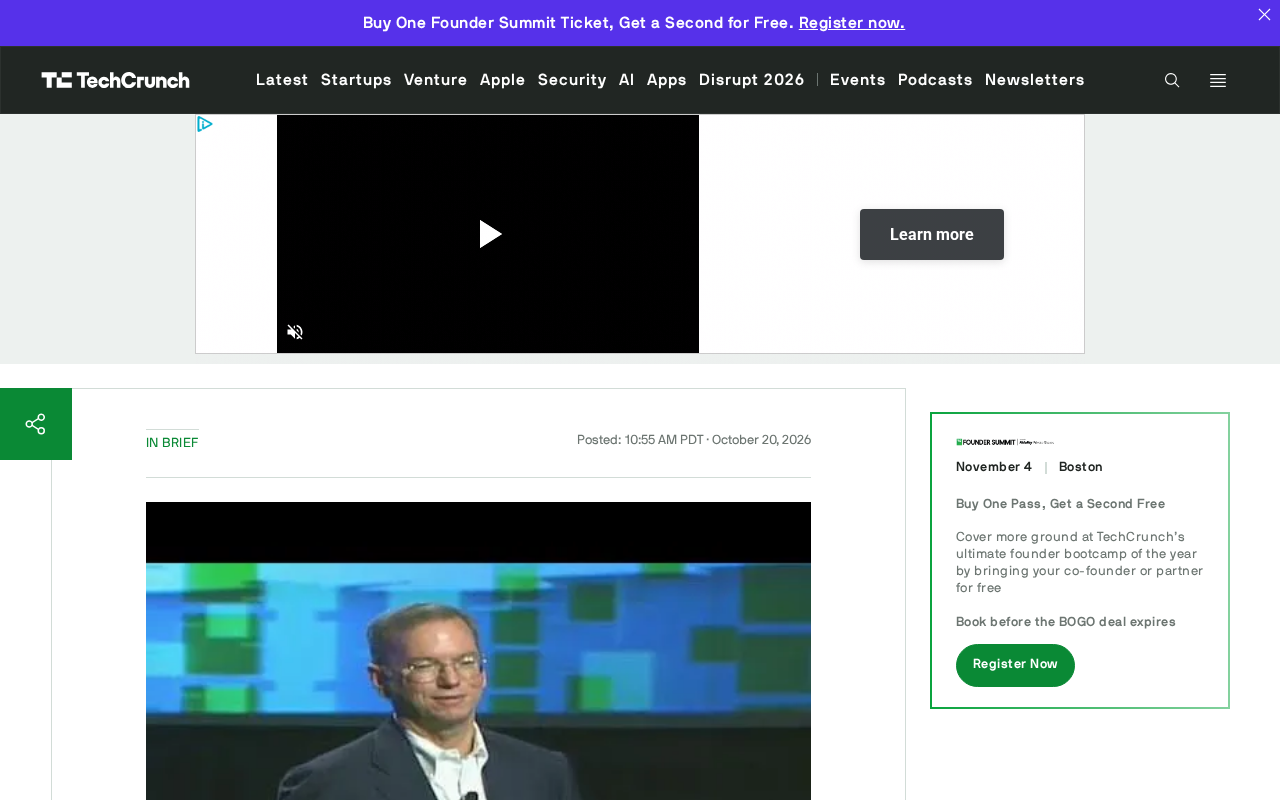
The impact of this news isn't about how large "1%" sounds, but the absolute value it represents. Anthropic is one of the most closely watched frontier model companies globally, with its valuation consistently at high levels. Roughly converted at such valuations, a 1% stake represents a considerable amount of wealth. Schmidt himself has long been a seasoned Silicon Valley investor, but committing such a proportion to a private company is still a clear statement of conviction.
Interestingly, this stake size doesn't come from official Anthropic disclosures but from media citing unnamed sources. As of now, neither Schmidt nor Anthropic has publicly confirmed.
Relative Relationship with CEO's Stake
The report deliberately anchors Schmidt's stake size using "about half of Amodei's" — a clever framing: for a founder-CEO, ownership percentage is a direct indicator of how deeply their interests are tied to the company. For Schmidt as an outside investor (albeit with a special status), reaching about half of the founder's stake means he is not a marginal figure in Anthropic's shareholder registry.
This also raises a question: is Schmidt's role a financial investment or a long-term bet with strategic intent? Based on public information, the answer leans toward the latter — he has repeatedly expressed interest in frontier AI safety and governance issues publicly, and Anthropic is precisely a lab that built its identity on "safety-first" positioning. Capital and philosophy resonate here in a certain way.
Shareholder registry is a fundamental concept in corporate governance, referring to the list of shareholders arranged by ownership percentage or category. In private companies, the shareholder registry is typically not public, but financing documents, articles of incorporation, or shareholder agreements specify each party's ownership percentage, voting rights, and preferential rights. Schmidt reportedly holds about 1%, and where this ranks in the shareholder registry depends on the company's total equity structure — if Anthropic has gone through multiple funding rounds, early investors and founding teams' shares would be diluted, and 1% could correspond to one of the top few external shareholders. Ownership percentage isn't just about financial returns; it also affects information access rights, board observer seats, and other implicit rights, which is why external interpretations of "1%" often go beyond the number itself.
Why Anthropic
Since leaving Google, Schmidt has been active in AI as an angel investor and advisor. He has invested in many AI startups, but the size of this Anthropic stake clearly isn't a "scattershot" bet.
Founding Team Connections and Philosophical Alignment
Anthropic was founded by a group of researchers who left OpenAI, including the Amodei siblings. One reason this group left was disagreement over AI safety approaches. Schmidt promoted AI research during his tenure at Google and has continued to speak on policy and safety issues after leaving. The two share common ground on the fundamental question of "how to view frontier model risks," which may explain his heavy bet better than单纯的 financial returns.
AI safety and governance is the key background for understanding Anthropic's positioning. Anthropic centers on a "safety-first" philosophy, advocating investment in interpretability, alignment, and risk assessment research alongside frontier model development. Its founding team left OpenAI partly due to disagreements over the balance between commercialization speed and safety investment. Schmidt promoted deep learning research during his Google tenure and has continued to voice views in policy circles after departing, having chaired matters related to the U.S. National AI Safety Commission. The two highly overlap in the judgment that "frontier models may bring systemic risks requiring preemptive governance" — this philosophical alignment is often cited to explain why Schmidt is willing to hold private shares long-term rather than pursue short-term financial returns.
Scarcity of Private Company Equity
Anthropic is not publicly listed, and opportunities for outside investors to obtain significant stakes are inherently limited. Securing about 1% typically means intervening at an early stage or continuously increasing positions across multiple funding rounds. For an investor of Schmidt's caliber, this is both a judgment on the company's future and a competition for scarce resources.
Private company equity acquisition channels are entirely different from public markets. Outside investors typically obtain shares by participating in funding rounds, purchasing secondary shares from existing shareholders (secondary sale), or through convertible instruments (such as SAFE). Anthropic has undergone multiple large funding rounds with continuously rising valuations, meaning new investors often can only obtain limited stakes and must accept terms such as liquidation preference and anti-dilution provisions. Accumulating about 1% ownership typically means intervening in early rounds or repeatedly increasing positions in subsequent financings. For investors like Schmidt, this is not just capital allocation but locking in long-term exposure to scarce assets — private AI lab shares have poor liquidity but significant potential appreciation and附带 industry influence.
What It Means for the Industry
The exposure of this stake reflects an underappreciated dimension in the current AI race: top talent and capital are deeply binding to a handful of frontier labs in personal capacities.
Signal of Capital Concentrating Toward Leaders
Holdings by figures like Schmidt are often viewed as a "confidence indicator." When a seasoned tech leader places a considerable proportion of personal wealth in a private company, other investors reassess that company's relative position. In AI, the fundraising capability and valuation sustainability of leading labs largely depend on the strength of such signals.
Governance and Voice Concerns
Reaching a certain ownership percentage can bring governance-level influence. Although 1% is insufficient to sway decisions in most corporate structures, combined with Schmidt's industry stature, his opinions outside the board may carry weight beyond the equity percentage itself. For a lab that built its identity on "safety governance," the presence of high-profile public figures among shareholders will continue to face scrutiny.
Equity and voice don't always correspond linearly. In private companies, voting rights may be amplified or restricted through dual-class structures, concerted action agreements, or board seat arrangements. A 1% stake is insufficient to unilaterally veto decisions in most companies, but Schmidt, as former Google CEO and seasoned tech leader, may carry weight far beyond his equity percentage outside the board — he can influence talent referrals, partner introductions, and public narratives. For a lab built on safety governance, if shareholders include high-profile public figures, their words and actions will be scrutinized in connection with company positions, constituting informal governance pressure and potentially a source of brand risk.
Information Still Requires Cross-Verification
It's important to emphasize that the core facts of this news — Schmidt holding about 1%, roughly half of Amodei's stake — are currently reported by Bloomberg as a single source, based on unnamed sources. Anthropic's equity structure is never publicly disclosed, and outsiders cannot independently verify. For readers following the company, this should be treated as a significant rumor rather than confirmed fact.
From a传播 perspective, this news has been widely reposted because it simultaneously satisfies several narrative elements: famous figure, massive wealth, frontier AI, and founder-versus-investor comparison. These elements叠加 turn what is technically a shareholder registry detail into a window for observing the AI capital landscape.
Frequently Asked Questions
How much of Anthropic does Schmidt hold?
According to Bloomberg, about 1%, roughly equivalent to half of CEO Dario Amodei's stake. The figure has not been officially confirmed.
Is Schmidt still connected to Google?
He is former Google CEO and has left management, but remains active in tech and AI as an investor and advisor.
Will Anthropic disclose shareholder information?
As a private company, Anthropic has no obligation to disclose its equity structure. Related data can typically only be indirectly understood through media reports or financing documents.
One-line Summary
Eric Schmidt reportedly holds about 1% of Anthropic, roughly half of CEO Amodei's stake, unconfirmed officially.
Paragraph Summary
According to Bloomberg, former Google CEO Eric Schmidt holds approximately 1% of AI startup Anthropic, roughly equivalent to half of CEO Dario Amodei's stake. The news comes from unnamed sources, with neither Schmidt nor Anthropic publicly confirming. Analysis suggests this stake size indicates Schmidt is not a marginal shareholder, and his role is more likely a long-term bet with strategic intent, aligning with Anthropic's "safety-first" positioning and founding team philosophy. Private company equity is scarce, and accumulating about 1% typically means early intervention or continuous position increases. The news is also seen as a signal of capital concentrating toward leading AI labs, while raising scrutiny of shareholder composition and governance voice. Due to single-source reporting and lack of independent verification, it should be treated as a significant rumor.
Related articles

Gemini 4 Argon Hands-On: AI Builds Board Games, Constructs Temples, and Trains Robots Autonomously
Gemini 4 Argon hands-on roundup: AI autonomously builds a desk racetrack and temple in Blender, writes a ray tracing engine, trains a humanoid robot to sink 7 shots, plus API pricing and developer access.

The Magic Octagonal Coin: Why Only 9% of People Can Predict Its Flip?
Only 9% of people can correctly predict the Magic Octagon coin flip. This article explains its spatial rotation mechanism, common cognitive pitfalls, and a new hypothesis based on Relevance Theory, exploring the limits of human spatial reasoning.

Sam Altman: AI Is Entering the Era of Scientific Discovery — Math Breakthroughs Will Replicate in Biology and Energy
Sam Altman says AI is entering the era of scientific discovery — math breakthroughs will replicate in biology, materials science, and energy to help develop new drugs and energy sources.