Espresso 27: A Local AI Web Editor for Mac Enthusiasts
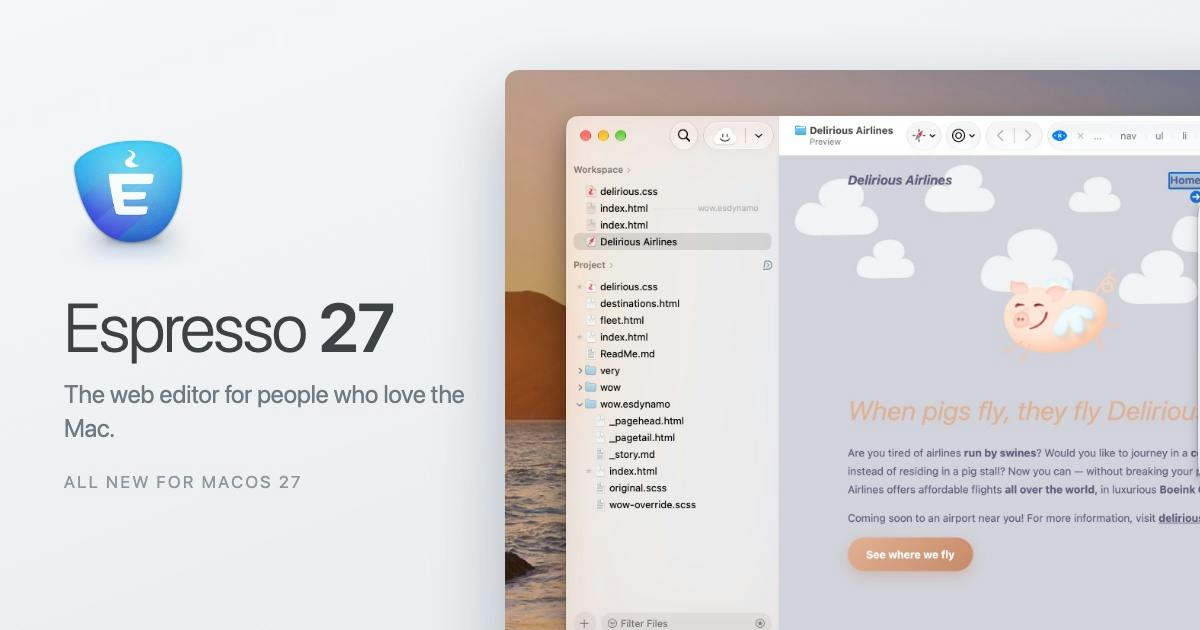
Mac-exclusive web editor Espresso 27 releases a major update, focusing on local AI website building and privacy protection.
Espresso 27 is a web editor built exclusively for Mac, described as its "biggest update ever." It redesigns the interface for macOS 27 and includes localized AI capabilities, allowing developers to build an entire website without leaving the Mac or uploading code to the cloud, balancing privacy and efficiency. The developers also emphasize substantial enhancements beneath the surface. The product received 91 votes on Product Hunt, ranking 7th for the day under Mac and Developer Tools—precisely positioned but with no user comments yet. The article suggests it suits web developers who value local data processing and deep macOS integration, while those accustomed to cross-platform or cloud collaboration should evaluate carefully.
A Web Editor Built for the Mac Gets a Major Update
A web editor called Espresso 27 has quietly appeared on Product Hunt. Its tagline states it plainly: "The web editor for people who love the Mac." Described by its developers as "the biggest update ever," the product aims to redefine the web development experience within the Mac ecosystem.
The release notes for Espresso 27 indicate it brings a fresh look tailored to macOS 27, an AI capability that can build an entire website without leaving the Mac, and an editor that is "far more under the hood" than what meets the eye. For users who have long followed Mac development tools, this is undoubtedly a signal worth noting.
Local AI: The Balance Between Privacy and Efficiency
The most striking feature of Espresso 27 is its built-in AI capability. According to the official description, this AI can "build across your entire site without a single line of code leaving your Mac." What this points to is localized AI processing—all inference and generation happen on-device, and data is never uploaded to the cloud.
For privacy-conscious developers, this is an attractive selling point. Web development often involves client data, unreleased project code, and business logic; restricting AI processing to the local machine reduces the risk of data leaks. However, local AI also implies certain hardware performance requirements, and how well it performs in practice can only be judged through actual use.
Localized AI (On-device AI) refers to model inference that is completed entirely on the user's device rather than sending data to cloud servers for processing. Its core technical foundations include model quantization (compressing large models to run on consumer-grade hardware), specialized inference frameworks (such as Apple's Core ML and Metal Performance Shaders), and the neural engines (Neural Engine) integrated into chips in recent years. Compared with cloud AI, the advantages of local AI are that data never leaves the device, response latency is low, and it can be used offline; the disadvantages are that, limited by local compute power, model scale and generation quality are usually inferior to large cloud models. Apple has continuously strengthened on-device AI capabilities since Apple Silicon, and macOS 27 has further opened up related APIs—this is precisely the technical prerequisite that enables Espresso 27 to achieve "code never leaves the Mac" website building.
A New Look and Deeper Editor Upgrades
Espresso 27 has been visually redesigned for macOS 27. Although the official materials do not provide detailed interface descriptions, judging from the screenshots and description, the new version's appearance aligns more closely with the design language of macOS 27—a plus for Mac users who value a consistent system-level experience.
More noteworthy is the phrase "far more under the hood." It implies that the editor's core functions—code editing, preview, build processes, and so on—have been substantially enhanced, rather than merely reskinned. For a web editor, improvements to underlying capabilities often affect daily work efficiency more than interface changes.
"Under the hood" is a common metaphor in the software industry, referring to the core implementation that is invisible beneath the user interface, including the code parsing engine, rendering pipeline, build and packaging processes, plugin system, and more. For a web editor, underlying capabilities are typically reflected in the accuracy of syntax highlighting and completion, the refresh speed of live preview, the degree of support for modern front-end frameworks and build tools, and performance on large projects. Interface redesigns are often merely surface-level changes, while underlying refactoring can truly improve development efficiency and reduce lag and compatibility issues. By using this phrase, Espresso 27 intends to draw a clear line between itself and mere visual updates, implying that there are substantive improvements worth anticipating at the editor's core level.
Performance and Positioning on Product Hunt
Espresso 27 received 91 upvotes on Product Hunt, ranking 7th for the day, with category tags of Mac and Developer Tools. For a tool targeting a specific platform (macOS) and a specific audience (web developers), this result shows it reached its target users precisely.
One detail: the product currently has 0 comments. This may mean that early users are still in the trial phase and have not yet formed publicly available word-of-mouth feedback. For potential users, in the absence of community reviews, they may need to judge whether to try it based on their own actual needs.
Product Hunt is a well-known global platform for launching and discovering new products, where users can upvote and comment on products launched that day. A daily leaderboard is ranked by vote count, and ranking near the top means the product has received relatively high community attention. 91 votes and 7th place for the day is a moderately above-average result, typically reflecting recognition among a specific niche audience but not yet broad dissemination. Category tags (Topics) help products reach corresponding user groups; the Mac and Developer Tools tags mean exposure is mainly concentrated in the Apple ecosystem and developer communities. A comment count of 0 indicates that community interaction is still at an early stage, with no real user feedback available for reference.
Who Should Pay Attention to Espresso 27?
Judging from its positioning, Espresso 27 is primarily aimed at web developers who use Macs heavily. If you value local data processing, prefer tools deeply integrated with macOS, and are interested in AI-assisted website building, this editor is worth learning more about.
But if you are accustomed to cross-platform workflows or rely on cloud collaboration features, then its Mac-exclusive positioning and local AI strategy may not fully match your needs. The official information released so far is limited; it is advisable to follow subsequent real user feedback and detailed feature documentation before making a decision.
Related articles

Nothing CMF Buds 2A Drops to $17.89 on Black Friday: A New Low for ANC Earbuds
Nothing CMF Buds 2A wireless earbuds Black Friday deal: just $17.89 on Amazon, about $11 off retail and a record low. ANC earbuds at an entry-level price.

When AI Creation Gets Accused of "Spitting": Hacker News Heats Up Over the Glaude Controversy
A Hacker News post, "Spitting in the Face of Glaude," sparks debate on AI creation transparency and attribution ethics. This analysis examines the blurred creator identity behind the controversy and offers practical advice for AI content production.

Akai Embraces Custom Firmware: MPC Sample 1.4 Lets Users AI-Program Their Sampler
Akai embraces the modding community with MPC Sample 1.4 firmware, supporting vibe-coded custom firmware and effects. We analyze the impact of this open strategy on music hardware and AI-assisted programming.