Even Americans Who Use AI Every Day Are Worried About It

Daily AI users in the US are still worried — familiarity doesn't equal trust.
A new report challenges the tech industry's assumption that more exposure to AI leads to greater comfort: even heavy daily users remain deeply concerned and continue to support AI regulation. The report finds that greater exposure neither alleviates unease nor weakens demand for oversight. Frequent users experience AI's limitations and risks firsthand, meaning their concerns stem from knowledge, not ignorance. This has major implications for both tech companies — who need real investment in safety and transparency, not just awareness campaigns — and for policymakers navigating an increasingly mature public appetite for AI governance.
Core Finding: Familiarity Doesn't Mean Reassurance
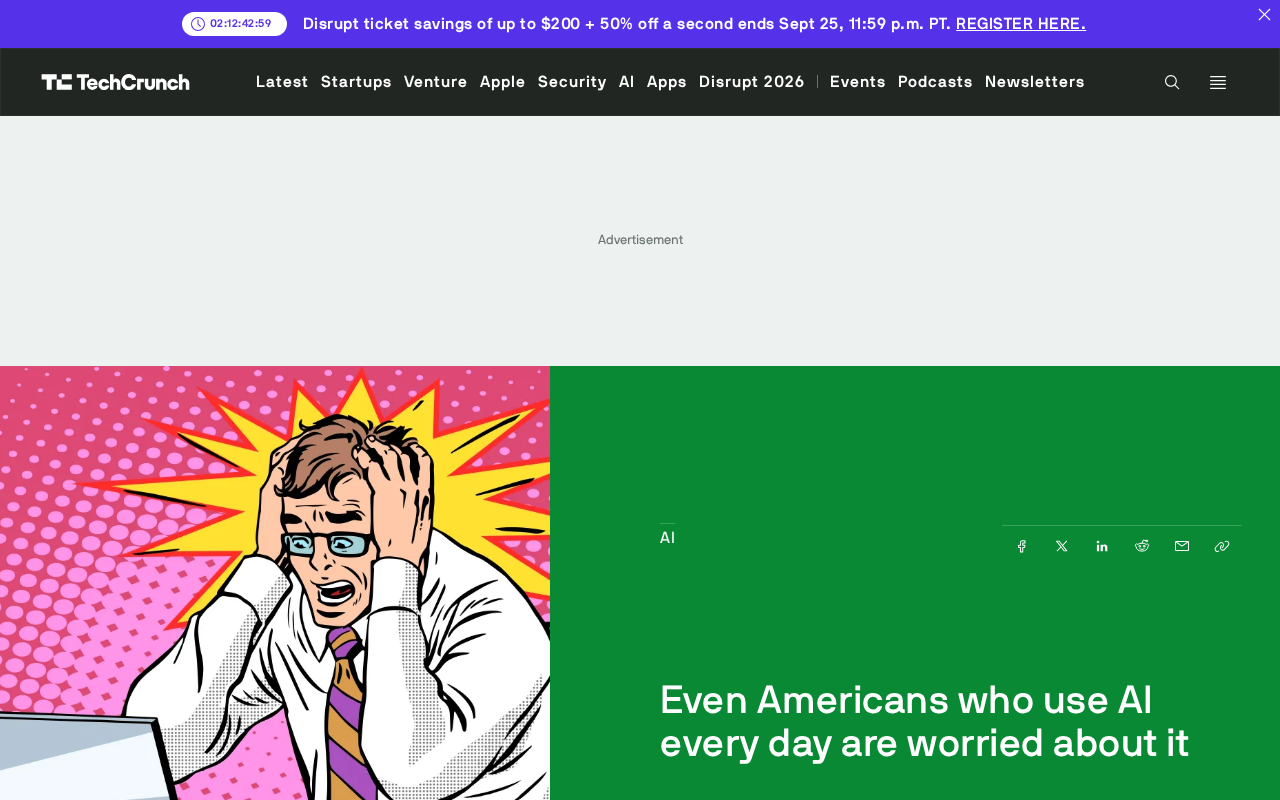
A new report has surfaced a counterintuitive conclusion — even Americans who use AI tools every day remain deeply concerned about the technology. This challenges a long-standing assumption in the tech industry: that greater exposure and familiarity with AI would naturally dissolve public skepticism.
The report makes clear that greater exposure neither alleviates public unease about AI nor weakens support for regulating it. In other words, the logic of "the more you use it, the more comfortable you'll feel" simply doesn't hold up against real-world data.
Why "Familiarity Breeds Confidence" Falls Apart
Tech companies have generally believed that user resistance to new technology stems from unfamiliarity and misunderstanding — and that as products become more widespread and people gain more experience with them, acceptance naturally rises. That pattern has held for many consumer technologies. But AI appears to be taking a different path.
The fact that daily AI users are often among the most concerned isn't hard to explain. Frequent use means they experience firsthand the limits of AI's capabilities and its potential risks — from content authenticity and data privacy to employment disruption and decision-making transparency. Heavy users tend to understand better than casual observers what this technology "can do" and what can "go wrong."
This suggests that concern doesn't stem from ignorance — it may stem precisely from understanding. That's a significant challenge to the industry's communication strategy: education and awareness campaigns alone may not be enough to build trust.
There's a relevant concept from behavioral science here — the "Curse of Knowledge": once you've acquired certain knowledge, it becomes difficult to see things from the perspective of someone who doesn't have it. Heavy AI users are in exactly this position: they have firsthand experience with specific flaws like hallucinations, model bias, and prompt injection, and that first-person knowledge continuously reinforces rather than dissolves their concerns. Technology diffusion research also identifies a corresponding "technology backlash" phenomenon — when a technology penetrates high-stakes domains like healthcare, criminal justice, or hiring, users' tolerance for errors drops sharply because the cost of mistakes becomes more concrete and tangible. This aligns closely with AI's current trajectory of expansion.
Implications for Regulatory Attitudes
Another key finding in the report is that increased exposure has not reduced public support for AI regulation. This has direct practical implications for both policymakers and tech companies.
For a long time, some argued that calls for regulation came primarily from people who didn't understand the technology, and that as AI became integrated into daily life, those calls would gradually fade. But the data shows that even heavy users broadly believe AI needs to be governed and constrained. This provides a broader popular mandate for regulatory legislation and undermines the argument that "overregulation would go against users' wishes."
For tech companies hoping to strike a balance between self-regulation and government oversight, this is a signal that deserves serious attention.
It's worth noting that the United States currently lacks unified federal AI legislation. Existing rules rely primarily on executive orders (such as the Biden administration's 2023 AI executive order) and fragmented state-level legislation (such as California's various AI-related bills). Against this backdrop of regulatory vacuum, sustained public support for oversight is especially noteworthy — it suggests that even without a clear legislative framework, demand for regulation at the public opinion level is already quite mature. By contrast, the EU AI Act, which has officially entered into force, represents an alternative policy approach based on risk-tiered regulation. As U.S. policymakers design domestic regulatory frameworks, this public opinion data may provide a critical indicator of political feasibility.
Takeaways for the Industry
The value of this report lies in prompting us to reexamine the relationship between technology adoption and public trust. The two are not simply correlated.
For tech companies, earning trust may require not more aggressive promotion, but substantive investment in safety, transparency, and accountability mechanisms. User concerns are rational feedback — not obstacles to be eliminated through "education." On the policy side, sustained public support for regulation means the conversation around AI governance is unlikely to fade as the technology becomes more widespread; if anything, it may persist for the long term.
It should be noted that this article is based on summary information from a single source. The specific research sample, methodology, and detailed data breakdowns of the report were not fully presented in the original material, and readers should apply appropriate caution when interpreting these findings.
Related articles

Kimi K3.1 Pro Open-Sourced: 2.8 Trillion Parameters Close In on Opus
Moonshot releases the open-source MoE model Kimi K3.1 Pro, with 2.8T total parameters and 104B activated, trailing Opus 5.5 by under 1 point on Terminal Bench 4.0.

Costco Tech Price Guessing: Are Monitors, Keyboards, Mice, and Bose Speakers Worth It?
A YouTube blogger guesses prices of Costco tech products: 2K 180Hz monitor, Logitech keyboard and mouse, Bose speaker, and CyberPower UPS, revealing warehouse-store selection and brand premium.

AT&T Partners with OpenAI to Build AI Legal Workflow: An Intelligent Transformation of 150 Years of Experience
AT&T and OpenAI launch Legal Edge to rebuild legal services with AI: a shared knowledge layer, natural language intake, and decision-making kept with lawyers.