Eventually Ticketing: A Detailed Look at Squarespace's Commission-Free Ticketing Solution

A commission-free Squarespace ticketing tool using flat monthly subscriptions for event-based sellers.
Eventually Ticketing is a new tool that runs natively on Squarespace websites, offering event-based sellers a commission-free alternative to traditional ticketing platforms. Using a flat monthly subscription instead of per-ticket fees, it helps workshops, fitness studios, and community organizers sell tickets while maintaining brand consistency and retaining complete guest data ownership.
A Ticketing Tool Built for Calendar-Based Sellers
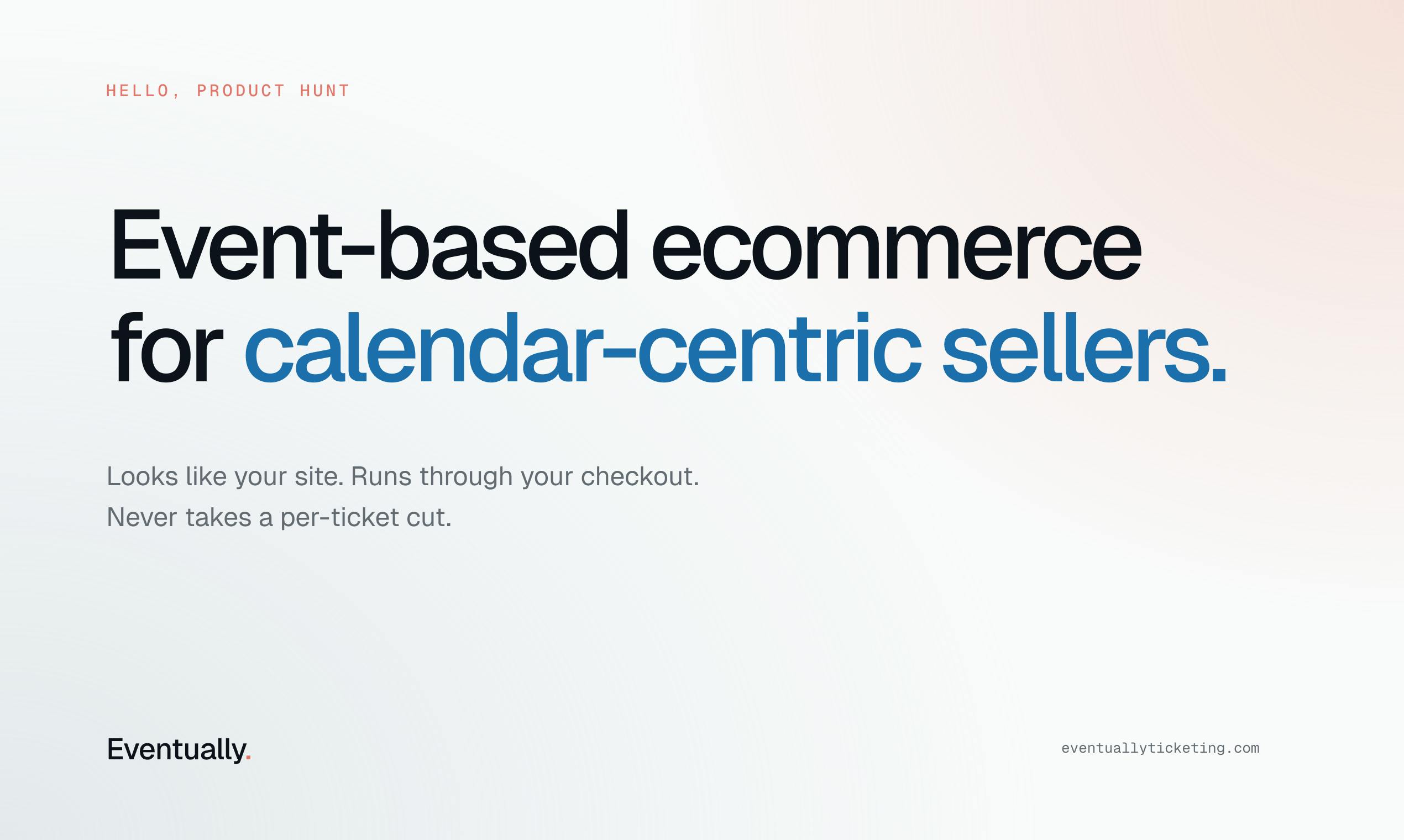
As the event economy continues to heat up, a product called Eventually Ticketing has launched on Product Hunt, positioning itself as providing "event-based e-commerce capabilities for calendar-centric sellers." Its core value proposition is clear: help businesses that rely on scheduling, appointments, and events to handle ticketing and registration on their own websites, without depending on third-party ticketing platforms.
The Event Economy refers to the commercial ecosystem formed around offline or online events, encompassing workshops, performances, classes, community gatherings, and more. According to Allied Market Research, the global event management software market is projected to reach $18.4 billion by 2028. "Calendar-based sellers" are businesses whose core logic revolves around time-based scheduling—their products aren't physical goods but experiences or services within specific time slots. The operational complexity for these businesses lies in the fact that each "product" has time attributes, capacity limits, and dynamic inventory—something traditional e-commerce tools struggle to natively support.
Unlike traditional ticketing platforms, Eventually runs directly on Squarespace websites. Squarespace is an all-in-one website building platform designed for creatives and small businesses, powering millions of active websites worldwide. Known for its drag-and-drop design, beautiful templates, and integrated e-commerce features, it allows users to build professional websites without writing code. According to its 2023 IPO filing, Squarespace serves over 4 million paying subscribers with annual revenue exceeding $900 million. Its user profile is heavily concentrated among creative professionals, freelancers, and small studios—precisely the demographic that overlaps with event-based sellers. Squarespace offers an Extensions ecosystem that allows third-party developers to embed functional modules within the native environment, and Eventually operates through this mechanism. This extension architecture is similar to browser plugins or mobile app stores—third-party functionality runs seamlessly within the host platform, giving users enhanced capabilities without leaving their existing environment.
This means sellers don't need to redirect users to external platforms or tolerate a ticket-purchasing experience that clashes with their brand. The ticketing interface's fonts, colors, and layout all remain consistent with the merchant's website, rather than popping up an external window with a completely different style. For small businesses that rely on brand image and user trust, this is particularly crucial. Research shows that user drop-off rates during cross-domain redirects can reach 20%-40%, and a consistent visual experience can significantly reduce cognitive friction in purchasing decisions.
Eventually's Commission-Free Subscription Model: The Core Difference from Traditional Ticketing Platforms
The most striking aspect of Eventually Ticketing is its pricing logic. It uses a flat monthly subscription fee rather than charging per-ticket commissions (no per-ticket fees).
This stands in stark contrast to mainstream ticketing platforms. Traditional ticketing platforms typically structure their commissions as a fixed processing fee plus a percentage cut. Take industry leader Eventbrite as an example—its standard rate is 2% plus $0.79 per ticket (US market), with potential additional payment processing fees for high-priced events. Another common choice, Ticket Tailor, charges starting at $0.26 per ticket, while Universe (acquired by Live Nation) charges 2.5% plus $0.99. This means for a 100-person event with $50 tickets, Eventbrite platform fees alone could exceed $179. For high-frequency sellers hosting multiple events monthly, annualized commission costs can easily surpass several thousand dollars. A more hidden cost is that many platforms also charge buyers an additional "service fee," inflating the end price and indirectly affecting merchants' pricing competitiveness and consumer satisfaction.
Eventually's flat subscription model allows merchants to accurately forecast costs, making it especially suitable for operators with high event frequency and stable ticket volumes. Once transaction volume exceeds a certain break-even point, every additional ticket sold is pure profit without platform commissions eating into margins—this is the fundamental reason why the flat monthly fee model holds such strong appeal for specific user segments. In SaaS pricing theory, this model is called "Flat-rate Pricing." Its advantage lies in reducing decision complexity and psychological costs for customers; its disadvantage is that revenue growth for the provider isn't linearly tied to customer success.
Which Businesses Are Best Suited for Eventually Ticketing?
Based on the product's positioning, the following types of sellers are Eventually's typical target users:
- Workshop and course creators: Education-focused sellers who run regular sessions and charge per event;
- Fitness and yoga studios: Scenarios requiring appointment scheduling and member registration;
- Small venue performers and salon organizers: Independent creators who host frequent events and prioritize brand consistency;
- Community event operators: Organizers who need to collect complete guest information.
For these businesses whose core logic revolves around "calendar scheduling," integrating ticketing, registration, and their existing website can significantly reduce operational fragmentation. Operational fragmentation refers to businesses needing to simultaneously manage multiple disconnected tools—one platform for website building, another for ticketing, yet another for email marketing—with data unable to flow automatically between systems, requiring manual synchronization that consumes enormous effort and is error-prone. Eventually's value lies in bringing the critical ticketing component back into the merchant's core operating environment.
The Dual Value of Brand Consistency and Guest Data Sovereignty
Eventually emphasizes two core capabilities: matches your brand and captures every guest.
Brand consistency may seem like a detail, but it directly impacts conversion rates. When users complete the entire journey from browsing to purchasing tickets within the same visual system, both redirect friction and trust costs are reduced. By contrast, jumping to a third-party ticketing platform often means user drop-off and experience disruption. In user experience design, this is called "Cognitive Continuity"—users maintaining a sense of familiarity and control over their environment during interactions. Once the interface style abruptly changes or the URL redirects to an unfamiliar domain, the user's brain needs to reassess safety and credibility. This "micro-pause" becomes an invisible drop-off point in the conversion funnel.
"Captures every guest" points to the issue of data sovereignty. Data Sovereignty in the events industry refers to merchants' complete control over participant information. Under the traditional ticketing platform model, buyers' names, emails, purchase preferences, and other information are often stored in the platform's database, with merchants only able to access partial data through limited interfaces provided by the platform. This creates several practical problems: merchants cannot independently send marketing emails for repeat purchase activation; they cannot build complete customer lifecycle profiles; and when merchants decide to switch platforms, historical customer relationships may face disruption. A deeper issue is that some ticketing platforms use merchants' customer data to recommend competitors' events to their buyers—something that has sparked widespread controversy in Eventbrite's user community.
In an era of continuously rising customer acquisition costs (CAC)—according to ProfitWell, the average CAC in the SaaS industry has risen approximately 55% over the past five years—merchants who own first-party data can achieve higher customer lifetime value (LTV) through precise email marketing, community operations, and personalized recommendations. First-party data refers to data collected directly from user interactions, as opposed to third-party data obtained through third-party cookies or data brokers. With Apple's ATT policy and Google's gradual phase-out of third-party cookies, the strategic value of first-party data is being reassessed. Eventually allows sellers to fully retain guest information, which holds long-term value for repeat purchase marketing, community building, and customer relationship management—particularly crucial for event-based businesses that depend on returning customers.
An Objective Assessment: Limitations of Eventually Ticketing
It should be objectively noted that based on Product Hunt data, Eventually is still in its early stages—it launched with 0 votes, only 4 comments, and ranked 12th. This indicates it has not yet achieved broad market validation. As the world's largest new product discovery platform, products ranking in the top 5 on Product Hunt typically receive hundreds or even thousands of votes daily; ranking 12th means the product didn't generate significant attention on its launch day. However, it's worth noting that Product Hunt performance doesn't always accurately predict a product's long-term market success—many excellent vertical tools perform modestly because their target users aren't part of the platform's community.
Additionally, its deep integration with the Squarespace platform is a double-edged sword. For businesses already operating on Squarespace, it's a seamless advantage; but for sellers using Shopify, WordPress, or other website builders, they cannot currently benefit. Notably, WordPress dominates with over 40% global website market share, while Shopify has millions of merchants in the e-commerce space—meaning Eventually's current addressable user pool is only a subset of the total market.
Eventually's choice to deeply bind to a single platform rather than pursuing multi-platform compatibility from the start is known as a "Wedge Strategy" in SaaS product development. The logic is: build an exceptional experience within a single ecosystem to establish reputation and competitive moats, then expand horizontally once the product matures. Historically, many successful tool products have followed similar paths—Mailchimp initially served only small e-commerce users (it was even free early on), accumulating sufficient user base and product maturity before expanding into a full-featured marketing platform; Calendly initially focused solely on one-on-one scheduling before gradually expanding to team scheduling and enterprise solutions; Notion started as just a note-taking tool, polishing its product within niche communities before expanding to the broader collaboration market. The risk of this strategy is that if the target platform itself slows in growth or users migrate away, the product's ceiling becomes limited. Squarespace has faced competitive pressure from emerging website builders like Wix and Framer in recent years, with its growth rate slowing somewhat. But for early-stage teams, concentrating limited resources on a user group with higher certainty is often easier for achieving Product-Market Fit than spreading development across multiple platforms. The concept of Product-Market Fit, proposed by Marc Andreessen in 2007, refers to a product satisfying a strong demand in a sufficiently large market, typically measured by metrics including natural retention rate, referral rate, and paid conversion rate.
The Boundaries of the Flat Monthly Fee Model
The flat monthly fee model isn't cost-effective for everyone. For sellers with low event frequency who only occasionally host one or two events, per-ticket commission platforms might actually be more economical. Here's a simplified calculation: assuming Eventually's monthly fee is $30, while Eventbrite charges approximately 2% + $0.79 per ticket. If an event only sells 20 tickets at $30 each, Eventbrite's fees would be approximately $27.80—less than the flat monthly fee. But if a second event of the same scale is held in the same month, cumulative commissions reach $55.60, and the flat fee advantage immediately becomes apparent. Therefore, Eventually's cost-effectiveness is highly dependent on the merchant's event density and ticket volume—the commission-free advantage only truly manifests when enough transactions are generated each month.
Conclusion: Is Eventually Ticketing Worth Trying?
Eventually Ticketing addresses a real pain point: small and medium event sellers want both an independent brand experience and data sovereignty, without bearing high per-ticket commissions. Through the combination of "running on your own website + flat subscription + no commissions," it provides a clear alternative for a specific audience.
This product's emergence also reflects a broader industry trend: the Creator Economy and small businesses are shifting from dependence on large platforms toward building owned channels. From Substack letting writers own subscriber relationships, to Teachable letting course creators own student data, to Eventually letting event organizers own guest information—"disintermediation" is becoming a common narrative among vertical SaaS tools.
For sellers who heavily rely on event scheduling and are already within the Squarespace ecosystem, Eventually is worth watching and trying. Whether it can move beyond its early stage and expand to more platforms will require time and further market validation.
Related articles

Bunzee 3.0 Review: Using MCP Protocol to Bridge the Full Pipeline from Idea to Code
Deep dive into how Bunzee 3.0 uses MCP protocol to inject complete context into AI coding tools — from market analysis and PRDs to wireframes and designs — solving the context gap problem.

AI Video Generation Makes 'Interdimensional Cable' Real: When a Sci-Fi Gag Becomes Reality
AI video generation technology turns Rick and Morty's Interdimensional Cable into reality. Explore how absurd AI content reshapes the creative industry and redefines value in the free content era.

Replayable A2A Jury: How to Trace Multi-AI Agent Decision Influence Chains
Deep dive into the Replayable A2A Jury project, exploring decision tracing and influence attribution in multi-agent collaboration systems, covering explainability, influence tracking, and debugging.