EverClaw Deep Dive: A Decentralized Platform for Earning Permanent AI Inference by Staking MOR Tokens
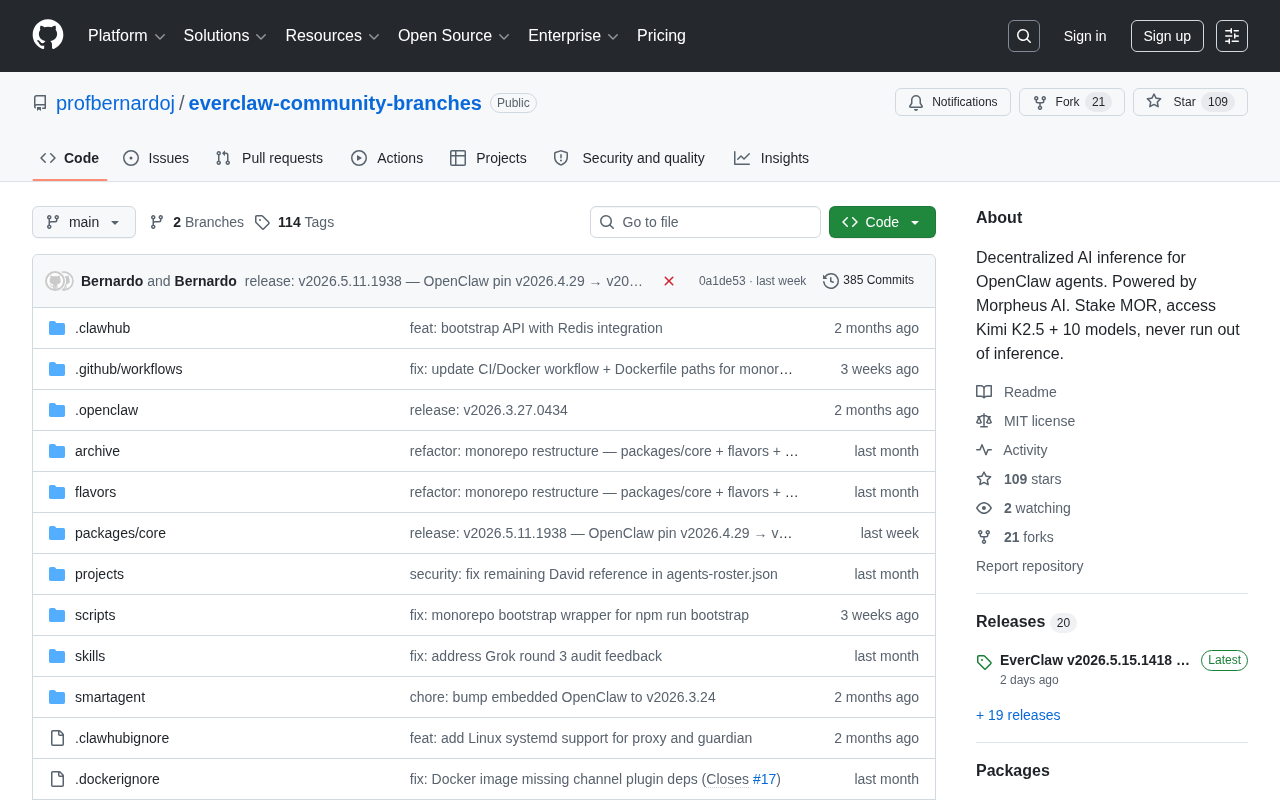
EverClaw enables decentralized AI inference via MOR token staking, providing agents with continuous multi-model access.
EverClaw is a decentralized AI inference platform built on the Morpheus AI protocol, where users stake MOR tokens to gain inference access to over 10 AI models including Kimi K2.5, replacing traditional pay-per-use models. The project aims to solve the high costs of frequent inference calls by AI agents, transforming inference from an on-demand service into an infrastructure layer. However, decentralized inference still faces challenges in latency, quality verification, economic sustainability, and scalability.
EverClaw Project Overview: A New Paradigm for Decentralized AI Inference
EverClaw Community Branches is a decentralized AI inference platform built on Morpheus AI, specifically designed to provide inference services for OpenClawAd intelligent agents. Through MOR token staking, the project enables users to access over 10 AI models including Kimi K2.5, with the promise of "never running out of inference credits."
The project has already earned 108 stars on GitHub, is developed in JavaScript, and has 21 forks — indicating growing community interest in decentralized AI inference solutions.
Core Mechanism Analysis: Architecture, Economic Model & Multi-Model Support
Decentralized Inference Architecture
Traditional AI inference services rely on centralized API providers (such as OpenAI and Anthropic), where users pay per API call or token count. EverClaw takes a fundamentally different approach — distributing inference tasks through a decentralized network, leveraging the Morpheus AI protocol as its underlying infrastructure.
Morpheus AI is a decentralized AI agent protocol aimed at building an open intelligent agent network. Its design draws inspiration from Decentralized Physical Infrastructure Networks (DePIN), attempting to deliver AI inference capabilities through distributed node networks — much like decentralized storage (e.g., Filecoin) or decentralized compute (e.g., Akash Network). Within the Morpheus architecture, there are four core participant types: code contributors, capital providers, compute providers, and community builders, each earning MOR token incentives through different mechanisms. This four-party game-theoretic design enables the network to operate in a self-organizing manner, and EverClaw builds its application layer precisely at the intersection of compute provision and inference consumption, achieving decentralization at the inference layer so that OpenClaw agents can obtain continuous inference capabilities without depending on any single service provider.
MOR Token Staking Economic Model
The project's economic model revolves around the MOR token. Users stake MOR tokens to gain inference access rights, rather than following the traditional pay-per-use model.
Staking, as a crypto-economic mechanism, was first widely adopted in Proof of Stake consensus systems. Its core logic involves locking assets in exchange for network rights. In the AI inference context, the staking model's economic principles resemble a "membership system" — users lock tokens once, effectively prepaying future inference costs, while the network uses yields generated from staked assets (such as DeFi returns or inflation rewards) to cover actual compute expenses. The key assumption of this model is that the time value of staked assets can continuously cover the marginal cost of inference. If inference demand surges while staking yields fail to cover GPU compute costs, the model may face economic imbalance risks.
This design offers the following advantages:
- Continuous access: Once staked, users can continuously use inference services without repeatedly topping up
- Incentive alignment: Stakers' interests are aligned with the long-term health of the network
- Censorship resistance: The decentralized architecture reduces the risk of single points of failure and service interruptions
Multi-Model Support: Kimi K2.5 and More
EverClaw supports Kimi K2.5 along with 10 other models. Kimi K2.5 was developed by Chinese AI company Moonshot AI, founded by Tsinghua University alumnus Yang Zhilin, known for its long context window processing capabilities — its early product Kimi Chat was among the first to support ultra-long text inputs of 200,000 characters. The K2.5 version shows significant improvements in mathematical reasoning, code generation, and multimodal understanding, approaching GPT-4o levels on certain benchmarks.
Integrating multiple heterogeneous models into a decentralized inference network poses non-trivial technical challenges: different models use varying inference frameworks (such as vLLM, TensorRT-LLM, GGML, etc.), have different VRAM requirements and quantization strategies, and require a unified scheduling layer to manage model routing, load balancing, and standardized inference output. However, this also provides agents with more flexible model selection capabilities — developers can dynamically switch to the most suitable model based on task requirements, for example using lightweight models for simple classification tasks and heavyweight models for complex reasoning tasks.
Technical Significance & Industry Trend Analysis
Inference Infrastructure Demands of AI Agents
As the AI agent ecosystem rapidly evolves, inference infrastructure has become a critical bottleneck. AI agents differ fundamentally from traditional chatbots: agents need to autonomously plan, invoke tools, and execute multi-step tasks, meaning a single task may require dozens or even hundreds of LLM inference calls. For example, an autonomous trading agent executing a single investment decision might need to first call a model to analyze market data, then call a model to generate a trading strategy, and finally call a model to evaluate risk — each step consuming inference credits. At OpenAI GPT-4o pricing, an active agent's monthly inference costs could reach hundreds or even thousands of dollars.
This is precisely the core pain point that decentralized inference networks aim to solve: transforming inference from expensive on-demand consumption into predictable infrastructure costs. An autonomously running AI agent needs stable, continuous, low-cost inference capabilities, and decentralized inference networks are designed exactly for this purpose — attempting to transform inference from an "on-demand service" into an "infrastructure layer."
Challenges Facing Decentralized AI Inference
Despite the appealing vision, decentralized AI inference still faces numerous real-world challenges:
-
Latency issues: The routing and consensus mechanisms of decentralized networks may introduce additional latency. Centralized APIs (like OpenAI) typically achieve Time to First Token (TTFT) of 200-500 milliseconds, while decentralized networks must additionally undergo node discovery, task routing, and potentially on-chain verification steps, which could push latency to the multi-second level — posing serious challenges for agent applications with real-time requirements.
-
Quality assurance: Ensuring consistent inference quality across different nodes. The core problem facing decentralized networks is "verifiable inference" — how to verify that a node actually used the specified model and returned correct results without re-executing the inference. Current industry approaches include Optimistic Verification, zero-knowledge proof inference (zkML), and Trusted Execution Environments (TEE), but these solutions either sacrifice efficiency or raise hardware barriers, with no perfect solution yet available.
-
Economic sustainability: Whether the staking model can cover network operating costs long-term. When token prices experience high volatility, the balance between staking yields and compute costs may break down, leading to compute providers exiting or degraded user experience.
-
Scalability: Whether the network can fulfill its "never runs out" promise when user numbers surge. The compute supply of decentralized networks depends on node operators' willingness to participate, rather than being elastically scalable like cloud service providers.
Summary & Outlook
EverClaw represents an important experimental direction in decentralizing AI infrastructure. It combines token economics with AI inference services, offering autonomous agents an entirely new paradigm for inference access. While the project is still in its early stages, its "stake-to-access" model and multi-model support design provide valuable reference points for the decentralized AI ecosystem.
For developers focused on AI agent infrastructure and the Web3×AI intersection, EverClaw is a project worth tracking continuously. As the Morpheus AI ecosystem expands and more models are integrated, the real-world performance of decentralized inference networks will gradually be validated by the market. Notably, EverClaw is not alone in this space — projects like Ritual, Hyperbolic, and Gensyn are also exploring decentralized AI compute from different angles, and the entire field is at a critical stage of transitioning from proof of concept to practical application.
Related articles
Deep Dive into AI Agent Skill Design: …
Deep Dive into AI Agent Skill Design: Engineering Practices from Anthropic and Perplexity
A deep dive into Skill design philosophy from Anthropic's Claude Code team and Perplexity's Agent team, covering the Tax Test, Gotchas Flywheel, progressive disclosure, and Eval-First practices for building high-quality AI Agent skill systems.
Deep Dive into OpenAI's Official GPT-5…
Deep Dive into OpenAI's Official GPT-5.6 Prompting Guide: The Shift from Manual to Automatic
A deep dive into OpenAI's official GPT-5.6 Sol prompting guide: conciseness-first, outcome-oriented design, autonomy boundaries, tool routing, and reasoning intensity tuning.
 Deep Dives
Deep Dive into How OpenClaw (Open-Source Crayfish) AI Agent Works
Deep analysis of OpenClaw AI Agent internals: System Prompt, tool calling, SubAgents, Skill system, memory, and Context Engineering explained.