Everyone Says Taste Matters in the AI Era—Have We Tried Adding Butter?
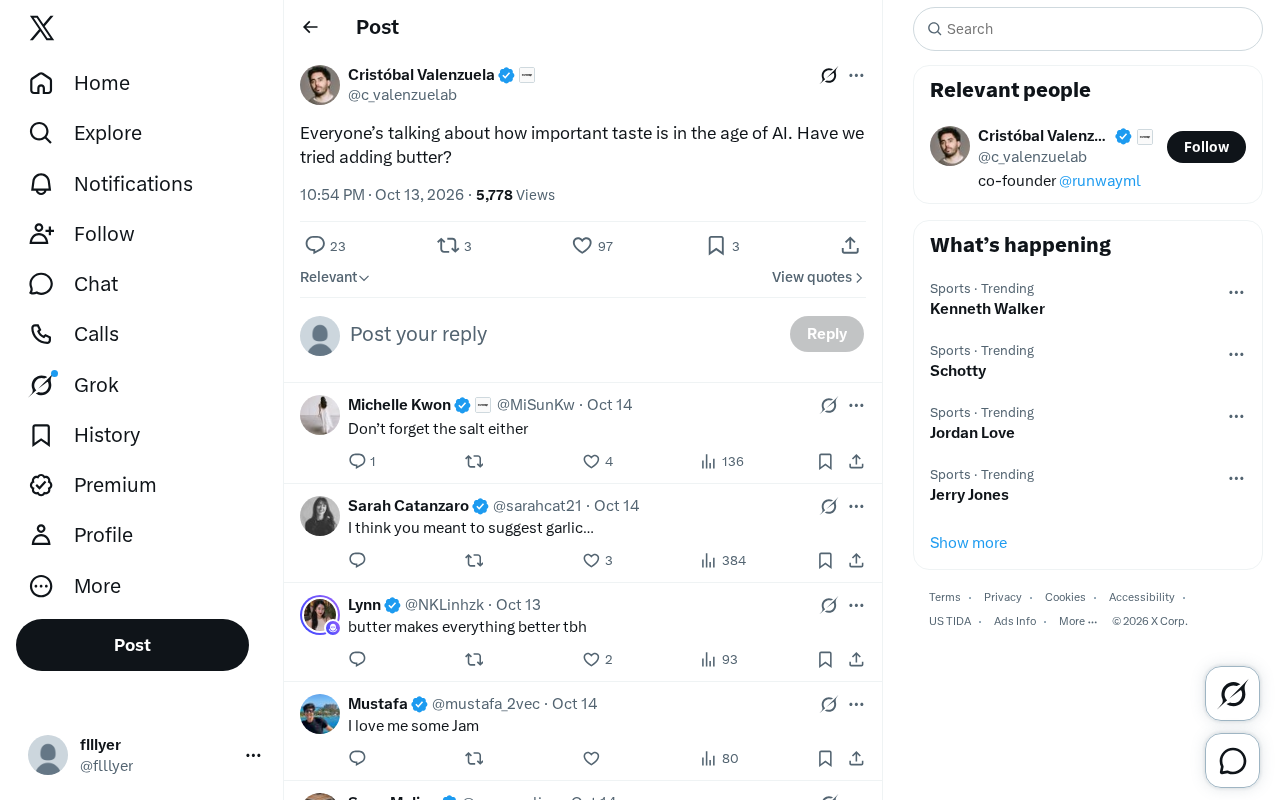
As the AI world hotly debates taste, a tweet uses "add a little butter" to remind us to fix basic experience first.
Starting from a Twitter post, the article discusses the popular "taste" discourse in the AI world. The author notes that as model capabilities converge due to Model-as-a-Service, judgment has indeed become key to product differentiation, but the word taste is becoming abstract and jargon-like, reduced to intellectual performance and social currency. The cooking metaphor "add a little butter" advocates bypassing abstract taste debates to first solve the most concrete basic experience problems: response speed, default output quality, error message friendliness, and onboarding barriers. Drawing on multiple sources, the article points out that basic experience is the foundation of taste, and the two are complementary rather than opposed; effective improvements in AI products often come from butter-adding tweaks rather than deep taste reconstruction. The conclusion: while pursuing taste, be wary of its discourse inflation—quality taste must ultimately land on details you can feel.
In the AI world, one word has been trending lately: taste. From model evaluation to product design, from prompt engineering to agent building, everyone is talking about how important "taste" is. But this Twitter post raises a trickier question: Have we been so busy discussing taste that we forgot to add a little butter?
"Add a little butter" is a brilliant metaphor. It's neither a denial of taste nor a simple supplement—it points to a more instinctive, more sensory, more "unrefined" solution path. While everyone is using rational analysis to deconstruct the components of "good taste," the author reminds us: maybe what makes a dish delicious isn't your deep understanding of ingredients, but that pat of butter casually tossed into the pan.
Why "Taste" Became the Talk of the AI Era
Discussions about AI and taste keep recurring on Twitter, podcasts, and industry conferences. The consensus is fairly clear: when model capabilities converge, what differentiates products is no longer technical parameters but the taste of creators and product managers—knowing what's worth building, what to cut, and what kind of interaction "feels right."
This judgment has merit. Model-as-a-Service has commoditized underlying capabilities, dramatically lowering the barrier to building AI products, making judgment the scarcest resource. But the problem is that when taste is repeatedly discussed and deconstructed into frameworks and methodologies, it can itself become a kind of intellectual performance.
Based on the discussion atmosphere under the tweet and similar expressions in multiple tech communities, a shared sense of fatigue is observable: the word taste is becoming increasingly abstract and jargon-like. Everyone talks about taste, but no one can clearly explain what taste actually is, let alone guarantee that having taste leads to good products.
"Model-as-a-Service" (MaaS) is a key concept for understanding this section's context. It refers to cloud providers offering pre-trained large models via API, allowing developers to call inference capabilities without building their own models, paying by usage. This model rapidly commoditized underlying model capabilities: differences between vendors' models on general tasks keep shrinking, and both technical and financial barriers to building AI products have dropped significantly. The result is that the competitive focus has shifted from "can you build a model" to "what can you build with models," making product judgment, interaction design, and the ability to make trade-offs scarce resources—precisely the structural reason taste is discussed so often.
What "Add a Little Butter" Really Means
The brilliance of this tweet is that it refuses to enter the discourse system of taste. It doesn't argue about what good taste is, doesn't list methods for cultivating taste, but directly throws out an actionable suggestion: add butter.
In cooking, butter's role isn't to provide complex flavor layers but to add the most direct fatty aroma and mouthfeel. It's a cheat code, a baseline, the shortest path from "edible" to "delicious." Applied to AI products, this means: rather than agonizing over abstract taste, first solve the most concrete experience problems—response speed, default output quality, friendliness of error messages, the learning curve for first-time use.
This approach resonates across multiple sources. Many AI product reviewers on Bilibili and YouTube repeatedly mention that users' first impressions are often determined by the most basic interaction details, not some ingenious "design philosophy." This cross-validates the tweet's "butter theory": basic experience is the foundation of taste; taste without a foundation is a castle in the air.
This involves an often-overlooked distinction: hygiene factors vs. delighters. The former refers to elements like response latency, default output usability, error handling, and first-use smoothness—things that "cost points if substandard, but don't earn points if met"; the latter are the tasteful designs that surprise people and build reputation. The product methodology principle of "fix the baseline before pursuing the high line" corresponds exactly to the tweet's butter metaphor—when basic experience is lacking, any ingenious design philosophy will be perceived by users as "hard to use," and filling in basic experience is often the lowest-cost, most directly felt improvement.
Divergence and Consensus Across Multiple Perspectives
It should be noted that views on the relationship between taste and basic experience are not entirely consistent across sources.
At the consensus level: most discussants agree that competition in AI products is shifting from model capability to product experience, and that experience involves both the "high line" of taste and the "baseline" of fundamentals. Neither can be neglected.
At the divergence level: some views hold that taste cannot be taught, emphasizing intuition and aesthetic accumulation, representing an elitist view of creation; others are more pragmatic, believing that with AI assistance, rapid iteration on basic experience has more commercial value than pursuing perfect taste. The tweet's "butter theory" clearly sides with the latter, but it avoids taking sides through humor—it's just asking: Have you tried it?
There's also an observation from a single source worth noting: some practitioners point out that in AI programming and AI application development, the most effective improvements often come from "butter-adding" tweaks—adding a style instruction before output, adding an interesting animation during loading, adding a plain-language explanation when an error occurs. These small moves don't involve deep discussions of taste, yet they genuinely improve the felt experience.
The "adding a style instruction before output" mentioned in the text is a typical practice of system prompt tuning. A system prompt is an instruction injected before each inference call to constrain role, tone, format, and boundaries, significantly changing output style without retraining the model. Similar low-cost techniques include few-shot examples, output format constraints, and temperature parameter adjustment. These tweaks are called "adding butter" because they don't change the model's capabilities themselves but can rapidly improve users' subjective perception of output quality at extremely low engineering cost.
Implications for AI Creators
The tweet's subtext is: taste matters, but don't use taste as an excuse for inaction, and don't use taste as a secret handshake to distinguish insiders from outsiders.
For creators and product people in AI, this means two things. First, maintain the pursuit of taste, but be wary of the inflation of taste discourse—if a concept can't guide concrete action, it may just be social currency. Second, before pursuing the "high line," ensure the "baseline" is met. Adding butter doesn't require Michelin-level judgment; it just requires you to be willing to taste your own dish.
Quality taste must ultimately manifest in details you can feel. Otherwise, no amount of exquisite plating can save a dish that forgot the salt.
FAQ
Q: What specifically does taste mean in AI products? A: It usually refers to creators' judgment about output quality, interaction style, and feature trade-offs—hard to quantify but reflected in every concrete decision.
Q: What scenarios does the butter metaphor apply to? A: Any scenario where basic experience needs improvement—default output style, loading experience, error message copy, and first-use onboarding.
Q: Why is this topic being discussed now? A: As model capabilities become homogenized, product differentiation relies more on experience and judgment, making taste a hot topic.
Q: Is adding butter contradictory to improving taste? A: No. The former is rapid reinforcement of basic experience; the latter is long-term accumulation of judgment. They are complementary.
One-line Summary
As the AI world hotly debates taste, a tweet uses "add a little butter" to remind us to fix basic experience first.
Paragraph Summary
Starting from a Twitter post, the article discusses the popular "taste" discourse in the AI world. The author notes that as model capabilities converge due to Model-as-a-Service, judgment has indeed become key to product differentiation, but the word taste is becoming abstract and jargon-like, reduced to intellectual performance and social currency. The cooking metaphor "add a little butter" advocates bypassing abstract taste debates to first solve the most concrete basic experience problems: response speed, default output quality, error message friendliness, and onboarding barriers. Drawing on multiple sources, the article points out that basic experience is the foundation of taste, and the two are complementary rather than opposed; effective improvements in AI products often come from butter-adding tweaks rather than deep taste reconstruction. The conclusion: while pursuing taste, be wary of its discourse inflation—quality taste must ultimately land on details you can feel.
Related articles

iPhone Duo Hands-On: Is the $2,000 Small-Screen Foldable Worth It?
YouTube's Allison shares her iPhone Duo hands-on: dual-screen multitasking doubles efficiency, great video viewing, nice matte finish—but thick body, small outer screen, and a $2,000 luxury price.

Sentry's Ad Cracks Up Developers: Can On-call Actually Be Fun?
Sentry's ad short film taps into developers' on-call anxiety, using humorous dialogue to showcase its observability platform—errors, logs, traces, metrics, replays, and releases in one place.

LLM App Getting Worse With Every Change? Build an Effective Evaluation System in Three Steps
How do you know if your LLM app is getting better or worse? A Reddit-based guide to test sets, automated regression evaluation, LLM-as-judge scoring, and structured agent tracing.