Exodus Lets AI Coding Assistants Migrate Apps to Cloud Run with One Click

Exodus lets AI coding assistants migrate apps to Cloud Run using 50+ playbooks and cost estimates.
Exodus for Google Cloud Run is a free, open-source tool that solves the pain points of migrating local apps to Cloud Run—what to change, how much it costs, and how to do it. Rather than a new deployment CLI, it combines a migration brain and an execution agent: it inspects the local app, compares current and post-migration costs, and generates a structured task list from 50+ playbooks drawn from real cases, which coding assistants like Claude Code, Codex, and Cursor execute step by step. The assistant-driven model lowers switching costs and keeps migration traceable and interruptible. Still early-stage with just 62 votes and 2 comments on Product Hunt, its core bet is that coding assistants become the developer entry point, embedding migration capabilities as agent-callable playbooks.
Google Cloud Run has long been a flagship managed container platform: no servers to manage, instant scaling when traffic spikes, and no charges when your code isn't running. But migrating a local app to Cloud Run often gets stuck on three questions: what to change, how much it will cost, and how to do it. The open-source tool Exodus for Google Cloud Run, which ranked #20 on Product Hunt, is built to tackle exactly this pain point—it lets coding assistants like Claude Code, Codex, and Cursor take over the migration work directly.
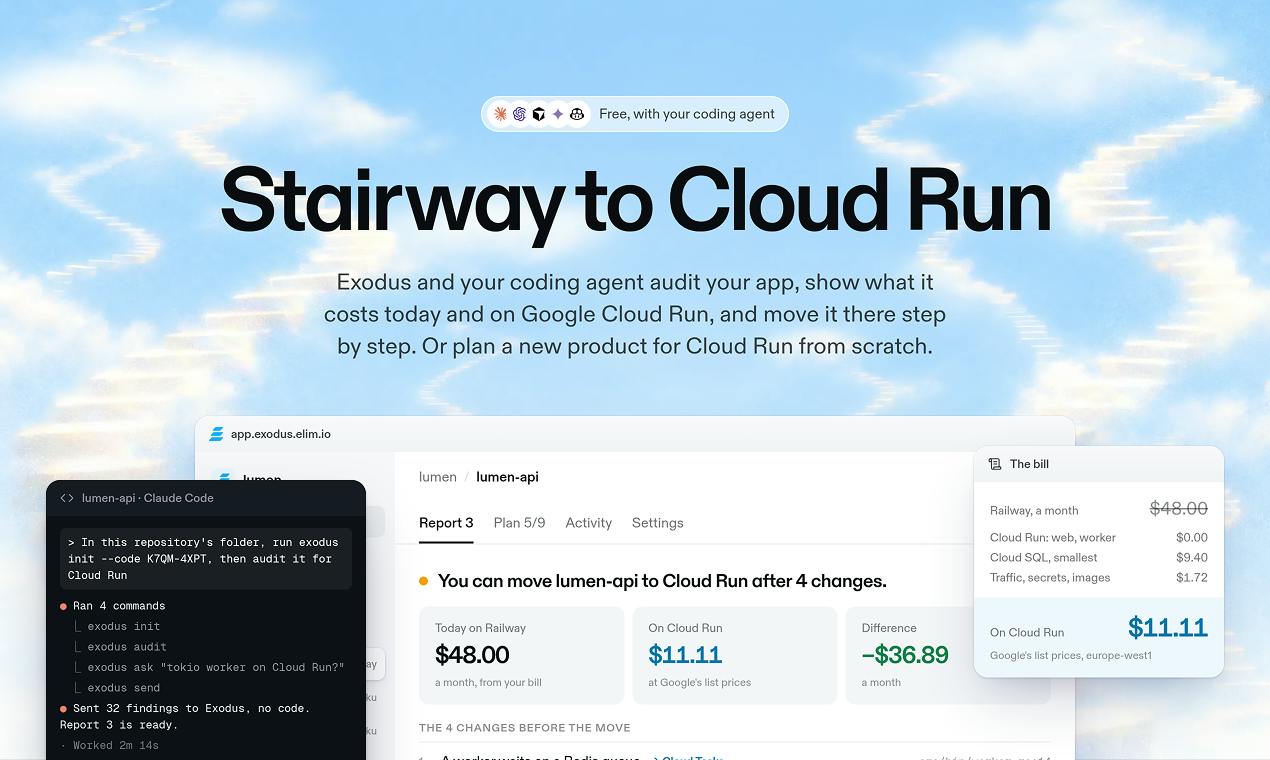
What Exodus Actually Does
Exodus isn't positioned as yet another deployment CLI—it's a combination of a "migration brain" and an "execution agent." It first inspects your application's current state on your local machine, calculates both the current running cost and the estimated bill after migrating to Cloud Run, and then lists the changes that need to be made. These judgments come from over 50 playbooks, which the developers describe as rules distilled from real migration cases.
In other words, Exodus turns a "migration plan" into a structured task list, then hands it to your coding assistant to execute item by item. It also supports the reverse scenario: designing a brand-new application directly for Cloud Run. The entire tool is free and open source, and can currently be tried on any code repository.
This approach sidesteps the core contradiction of traditional migration tools: generic scripts struggle to adapt to wildly varied local environments, while Exodus hands decision-making to the model and constraints to playbooks, letting AI coding assistants work within a bounded space.
Cloud Run is a fully managed serverless container platform offered by Google Cloud, built on Knative. It accepts standard OCI container images, handles autoscaling automatically, and supports scaling down to zero instances, so there's no charge when there are no requests. Unlike PaaS offerings such as App Engine, Cloud Run doesn't restrict language or framework—any app that can be packaged into a container and listen on a specified port works. Its billing is based on request count and actual CPU and memory usage time, which is precisely the premise that makes Exodus's cost estimation feature viable.
Playbook here refers to structured migration knowledge packages, typically describing the steps, check items, and constraints needed for a certain type of application under a specific tech stack. Unlike generic scripts, it doesn't execute commands directly—it provides reasoning context for AI coding assistants, letting the model make judgments within a limited scope. Over 50 playbooks means the tool attempts to cover a wide range of frameworks, dependencies, and deployment patterns.
Coding Assistants Take Over Migration—What Changes
From "Tool-Driven" to "Assistant-Driven"
Past migration tools typically required developers to learn a new set of commands and configuration formats, whereas Exodus reuses the coding assistants developers already have installed. You don't need to leave Cursor or Claude Code—migration tasks are dispatched at a granularity the agent can understand, advancing step by step. This lowers the cost of tool-switching and makes the migration process traceable and interruptible.
Agent-driven means tasks are advanced by AI coding assistants with autonomous planning and tool-calling capabilities, rather than the developer executing CLI commands step by step. In this kind of architecture, the tool provides task lists and constraints, while the assistant is responsible for understanding code context, deciding the order of changes, and executing edits. Its advantage is adaptability to differences in local environments; the cost is that results are limited by model capability and context window, which is why external knowledge like playbooks is needed to constrain behavioral boundaries.
Cost Transparency Is a Prerequisite for Migration
Exodus lays out "how much you're spending today" and "how much you'll spend after moving to Cloud Run" directly, which is a missing piece in many migration decisions. The uncertainty of cloud bills often makes teams hesitant to act, and seeing the numbers before making a move is more controllable than reconciling afterward.
A Two-Way Bet on Open Source and the Agent Ecosystem
According to its Product Hunt page, Exodus was launched by two developers and is categorized under Open Source, Developer Tools, GitHub, and Google Cloud Run. With 62 votes and 2 comments, it's still in an early stage of exposure and hasn't yet formed large-scale community discussion.
Its bet is this: AI coding assistants are becoming the entry point to developers' operating systems. Making migration capabilities into agent-callable playbooks rather than a standalone UI means tying its value to the growth of the assistant ecosystem. This choice carries risk—if the assistant ecosystem fragments, playbook maintenance costs will rise; but if the bet is right, Exodus will become the default middle layer in migration scenarios.
Three Things Worth Watching
Reusability of migration knowledge. If the 50+ playbooks really come from real cases, their value lies not just in automation, but in extracting migration experience from individuals' heads and turning it into model-executable assets.
Accuracy of cost estimation. The product promises to show a comparison between current and post-migration costs, but the precision of such estimates depends on its ability to model the application's actual workload—real-world effectiveness needs hands-on verification.
The boundary with Google's official tools. Cloud Run itself has deployment paths and migration documentation; Exodus's differentiation lies in being agent-driven and cross-assistant compatible. Whether it can stand firm alongside official solutions depends on whether the playbooks cover scenarios in enough detail.
For now, Exodus looks more like an early attempt with a clear direction than a mature migration solution. For teams already using coding assistants, it offers a low-cost entry point for trial and error; for teams accustomed to traditional deployment workflows, its appeal is limited.
One-line Summary
Exodus lets AI coding assistants execute app-to-Cloud Run migration and cost estimation using 50+ playbooks.
Paragraph Summary
Exodus for Google Cloud Run is a free, open-source tool aimed at solving the pain points of migrating local apps to Cloud Run: what to change, how much it costs, and how to do it. It doesn't provide a new deployment CLI—instead, it acts as a combination of migration brain and execution agent: first inspecting the local app, comparing current and post-migration costs, then generating a structured task list based on playbooks distilled from 50+ real cases, which coding assistants like Claude Code, Codex, and Cursor execute item by item. This assistant-driven model lowers tool-switching costs and makes the migration process traceable and interruptible. The tool is still early-stage, with only 62 votes and 2 comments on Product Hunt. Its core bet is that coding assistants will become the developer entry point, embedding migration capabilities into the ecosystem as agent-callable playbooks.
Related articles

Huberman's Rational Supplement Guide: A Five-Layer Health Framework and Scientific Decision-Making
Stanford neurobiology professor Huberman proposes a rational supplement framework: behavior and nutrition are the foundation, basic combination supplements serve as insurance, and sleep/hormonal/cognitive directions should stick to single-ingredient experiments. Omega-3 is the top single-ingredient choice, and melatonin is not recommended.

The Unsung Painter Behind Gilded Age Manhattan Interior Design
HN discussion highlights the painter behind Gilded Age Manhattan interiors: he created murals and decorative paintings but was long overlooked as his work was seen as architectural appendage.

Can AI Agents Be Socially Engineered? Understanding Prompt Injection and Tool Permission Risks
Through Invariant Lab's GitHub Issue injection and Brave's AI browser attack, this article analyzes how Prompt Injection induces AI Agents to perform unauthorized actions, and offers protection advice across three layers: least privilege, tool validation, and operation auditing.