Explainable Singing Voice Emotion Recognition: A New Framework of Acoustic and Vocal Technique Features

Study uses compact vocal descriptors with SHAP and GRAD-CAM to achieve explainable singing voice emotion recognition.
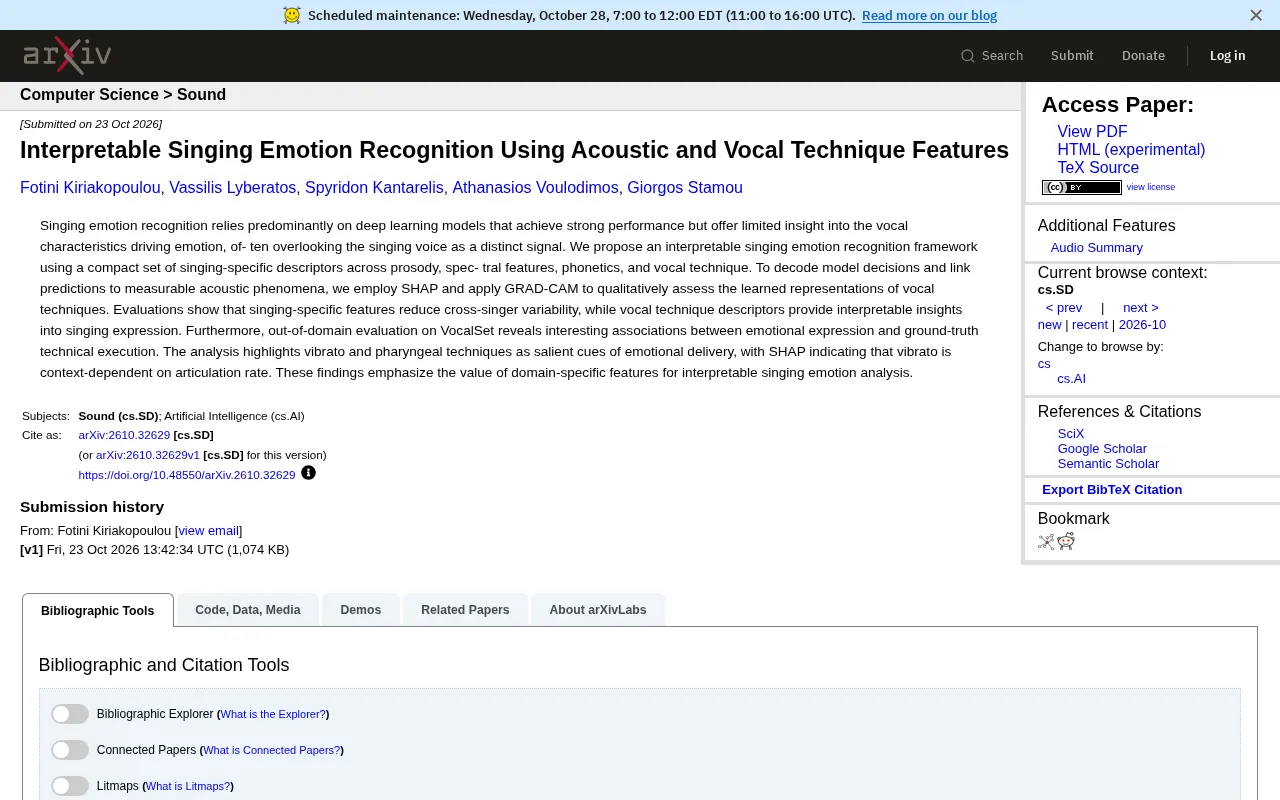
To address the lack of interpretability in deep learning black boxes for singing voice emotion recognition, this study proposes a compact feature framework centered on singing-specific descriptors across prosody, spectral, phonetic, and vocal technique dimensions. It uses SHAP to quantify feature contributions and GRAD-CAM to observe technique representations, building an explanation chain from acoustic phenomena to model decisions. Experiments find vibrato and pharyngeal voice are salient emotional cues, with vibrato's role modulated by articulation rate. Singing-specific features also reduce cross-singer variability, and out-of-domain evaluation on VocalSet reveals an association between emotional expression and technique execution. The authors note limitations such as limited samples and datasets and handcrafted features.
Title
Explainable Singing Voice Emotion Recognition: A New Framework of Acoustic and Vocal Technique Features
Meta Description
A new study proposes an explainable singing voice emotion recognition framework that uses singing-specific features such as prosody, spectral, phonetic, and vocal technique cues, combined with SHAP and GRAD-CAM to decode model decisions. It finds that vibrato and pharyngeal voice are core cues for emotional expression, and the role of vibrato is modulated by articulation rate.
Article Content
Singing voice emotion recognition has long been dominated by deep learning models. These models are powerful but rarely reveal the vocal features that drive emotional expression, often treating singing as ordinary audio signals. A new study proposes an explainable singing voice emotion recognition framework that uses only a small set of singing-specific descriptors—covering prosody, spectral, phonetic, and vocal technique features—to decode model decisions and directly link predictions to measurable acoustic phenomena.
Why Explainable Singing Voice Emotion Recognition Is Needed
Traditional singing voice emotion recognition models focus on classification accuracy while ignoring the uniqueness of singing as a distinct signal. Singing and speech differ fundamentally in vocal mechanism, breath control, and artistic expression: techniques such as vibrato, pharyngeal voice, and breathy voice are themselves part of emotional expression. Deep learning black-box models cannot tell researchers "what the model heard," limiting their application in music education, assisted creation, and clinical music therapy.
The starting point of this study is precisely to fill this gap—rather than pursuing larger and deeper networks, it turns to a compact set of vocal descriptors with clear physical meaning, allowing every prediction to be traced back to specific acoustic features.
Framework Design: Singing-Specific Features and Explainability Tools
The research team constructed a feature set covering four dimensions: prosody (e.g., rhythm, stress), spectral features, phonetic features, and vocal technique descriptors. This design intentionally avoids generic audio features and instead captures vocalization patterns unique to singing.
For explainability, the study uses SHAP (Shapley Additive Explanations) to quantify each feature's contribution to emotion prediction and employs GRAD-CAM for qualitative assessment of learned representations of vocal techniques. SHAP provides feature-level attribution, while GRAD-CAM visualizes technique-related representation patterns from inside the model. The two are complementary, forming a complete explanation chain from input features to model decisions.
A detail worth noting: a direct benefit of using singing-specific features is reduced cross-singer variability. Different singers vary greatly in timbre and range, and generic features can easily lead models to learn singer identity rather than emotional cues, whereas singing-specific descriptors focus more on expression itself.
SHAP (Shapley Additive Explanations) originates from the Shapley value in cooperative game theory. Its core idea is to fairly distribute the output of a model prediction among input features: for each feature, compute its marginal contribution to the prediction when added to or removed from all possible feature subsets, then take a weighted average. This gives each feature a signed contribution value, where positive values push the prediction toward a certain emotion category and negative values pull it away. Compared with simple feature importance ranking, SHAP's advantage is that it provides both direction and local explanation—for a single singing sample, it can say "for this judgment of sadness, how much did vibrato contribute?" The cost is that exact computation grows exponentially with the number of features, so in practice approximate algorithms such as KernelSHAP or TreeSHAP are usually used.
GRAD-CAM (Gradient-weighted Class Activation Mapping) was originally used for visualizing image models. It uses the gradient of the target class with respect to the last convolutional feature map as weights, performs a weighted sum over the feature map and applies ReLU, producing a heatmap corresponding to input spatial or temporal locations that indicates where the model "looked." In audio tasks, if the model retains a convolutional structure over time-frequency dimensions, GRAD-CAM can locate the time segments or frequency bands that contribute most to emotion judgments, enabling qualitative observation of learned representations of vocal techniques. It does not require modifying the model architecture but relies on gradient information, making it a post-hoc attribution method that complements SHAP's feature-level attribution at a different granularity.
Key Findings: Vibrato and Pharyngeal Voice Are Core Cues for Emotional Expression
Experimental analysis revealed two prominent vocal technique cues. Vibrato and pharyngeal voice techniques were identified as salient cues for emotional communication, with vibrato's role being particularly subtle—SHAP analysis showed that vibrato's effect on emotion is context-dependent, specifically depending on articulation rate. This means the same vibrato may convey different emotional colors at different speech rates, and independent interpretation of a single feature is insufficient.
Another noteworthy finding comes from out-of-domain evaluation. The study tested on the VocalSet dataset, revealing an interesting association between emotional expression and actual technique execution. This cross-dataset validation examined the generalization ability of the features on broader singing voice data.
Vibrato is a phenomenon in singing where pitch fluctuates periodically around a center frequency, typically at about 5 to 7 times per second, with amplitude varying with emotional intensity and style; it is produced jointly by periodic tension and relaxation of laryngeal muscles and fluctuations in respiratory air pressure, and is regarded as an important carrier of emotional tension in both Western bel canto and popular singing. Pharyngeal voice refers to a vocalization mode in which resonance is concentrated toward the pharyngeal cavity and the laryngeal position is relatively raised, producing a bright, penetrating timbre often accompanied by higher laryngeal tension, used in pop, rock, and folk singing to express intense or sharp emotions. Both are "advanced" vocal techniques beyond basic parameters such as pitch and loudness, and their acoustic manifestations do not directly correspond to any generic audio feature, thus requiring specialized descriptors. This also explains why generic audio representations easily miss such cues, while singing-specific feature sets can explicitly incorporate them into the model and subject them to SHAP attribution.
Method Positioning from Multiple Perspectives
The study's approach to explainability contrasts with two mainstream routes in current audio affective computing. According to the paper's own analysis, the deep learning route excels in performance but lacks interpretability, while the pure handcrafted feature route is interpretable but often sacrifices accuracy due to limited feature expressiveness. This study's compromise—constraining the feature space with domain knowledge and then decoding with SHAP and GRAD-CAM—represents a pragmatic choice.
It should be noted that this conclusion comes from a single research team's experimental setup, and out-of-domain evaluation is limited to only one dataset, VocalSet. Whether the interaction effect between vibrato and articulation rate holds stably in other singing styles (such as pop, folk, and bel canto) still awaits more independent verification.
VocalSet is a public singing voice dataset recorded by professional singers under multiple vowel, scale, and technique conditions, covering vocal techniques such as vibrato, pharyngeal voice, breathy voice, and straight tone, with annotations for singer identity, technique type, and pitch information. Its value lies in its relatively systematic technique annotations, making it suitable for testing whether vocal descriptors truly capture acoustic differences at the technique level rather than spurious correlations caused by singer or recording conditions. However, the dataset consists mainly of vocal exercise-style singing, with limited coverage of repertoire and emotion labels. Therefore, using it as an out-of-domain evaluation set can demonstrate the features' cross-singer and cross-technique generalization ability, but it is difficult to fully represent the complex emotional expression in real songs. Understanding this helps appropriately interpret the scope of the conclusion that "out-of-domain evaluation reveals an association between emotional expression and technique execution."
Significance for Singing Voice Emotion Analysis
The value of this work goes beyond a recognition framework. It suggests to researchers that for a highly structured artistic signal like singing, domain-specific feature design may reveal emotional mechanisms better than generic representation learning. For music education, explainable feedback can help learners understand "which technique conveys what emotion"; for assisted creation tools, feature-level attribution makes emotion regulation actionable.
Of course, the current framework's feature set is still handcrafted. Whether it can be combined with self-supervised learning in the future to improve performance while maintaining explainability is an open question worth attention in this direction.
One-line Summary
Research uses compact vocal descriptors plus SHAP and GRAD-CAM to achieve explainable singing voice emotion recognition.
Paragraph Summary
Addressing the lack of interpretability in deep learning black boxes for singing voice emotion recognition, this study proposes a compact feature framework centered on singing-specific descriptors, covering prosody, spectral, phonetic, and vocal technique dimensions, and uses SHAP to quantify feature contributions and GRAD-CAM to observe technique representations, establishing an explanation chain from acoustic phenomena to model decisions. Experiments find that vibrato and pharyngeal voice are salient cues for emotional communication, and vibrato's role is contextually modulated by articulation rate. Singing-specific features also effectively reduce cross-singer variability, and out-of-domain evaluation on VocalSet reveals an association between emotional expression and technique execution. The authors also note limitations such as limited samples and datasets and the still-handcrafted nature of the features.
Related articles

Will GitHub Die? Open Source Maintainer Burnout and the Collaboration Crisis in the AI Era
Lex Fridman podcast discussion on open source maintainer burnout and GitHub's predicament: massive pull requests overwhelm core maintainers, and AI worsens code bloat. Using math journal peer review and Poincaré conjecture verification as analogies, the article analyzes why verification in knowledge production must be deliberately slow, and how open source communities can avoid the failure mode of maintainers exiting.

Stop Building Cookie-Cutter AI Websites: 3 Tools That Transform Your Coding Agent
Three tools that boost AI coding agents: FFmpeg skill for local video editing in Claude Code and Cursor, Hallmark's 50 design themes to fix cookie-cutter AI sites, and Jailbreaks' 25+ model prompts.

How America's Gerontocracy Squeezes the Younger Generation
Americans over 55 hold nearly three-quarters of national wealth, alongside an 80-year-old president and elderly congressional leaders. The Atlantic's Idrees Kahloon explains how gerontocracy drives up housing costs, squeezes opportunities for the young, and explores zoning reform and child poverty reduction as practical fixes.