F-Droid 2.0 Released: A New Chapter for Android's Free Software Ecosystem

F-Droid 2.0 launches as a landmark update for Android's trusted free and open-source app ecosystem.
F-Droid is an alternative Android app store dedicated exclusively to free and open-source software, ensuring supply chain trust by building all apps from source code — making it the go-to choice for privacy-focused and de-Googled users. The 2.0 release, officially described as "a new chapter for Android freedom," signals major architectural changes and improved adaptation to Android's increasingly strict third-party installation restrictions. The news earned 369 points and nearly 100 comments on Hacker News, reflecting strong community recognition of this public open-source infrastructure. For users, it means a more modern and reliable privacy-friendly app source; for developers, a trustworthy distribution path outside commercial app store terms.
As the most important open-source app distribution channel on Android, F-Droid has reached a milestone with its 2.0 release. The announcement earned 369 points and nearly a hundred comments on Hacker News, reflecting the developer community's deep investment in this cornerstone of the free software ecosystem.
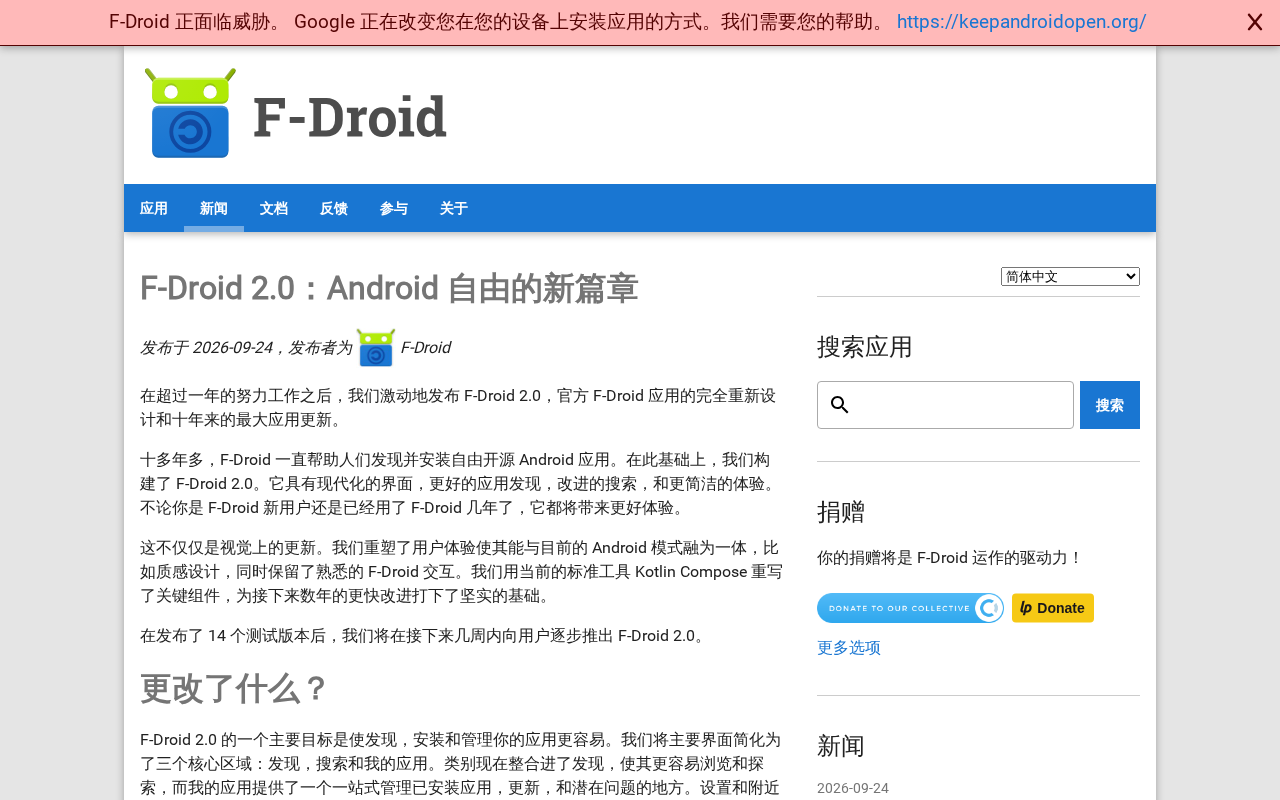
F-Droid's Role in the Android Ecosystem
F-Droid has long served a critical role as an alternative to Google Play — it's an app store that exclusively hosts Free and Open Source Software (FOSS). Unlike mainstream app marketplaces, F-Droid's core value lies in its unwavering commitment to software freedom, privacy protection, and auditability. Every app in the catalog must be open source, and F-Droid compiles each one from source code on its own build servers — fundamentally reducing the risk of apps bundling closed-source tracking modules or malicious code.
For privacy-conscious users, users of de-Googled Android distributions, and developers who need a trustworthy software supply chain, F-Droid has been an irreplaceable choice. The official description of 2.0 as "a new chapter for Android freedom" signals that this is more than a routine update — it represents a significant upgrade to the platform's architecture and philosophy.
F-Droid's "build from source" approach is part of an effort toward Reproducible Builds. Traditional app stores distribute binary packages uploaded directly by developers, giving users no way to verify whether those packages were actually compiled from the published source code. F-Droid pulls the source code onto its own controlled build servers, compiles the APK independently, and distributes it signed with its own key. This means even if a developer's build environment is compromised, an attacker cannot plant a backdoor in the F-Droid distribution channel. The trade-off is that app updates on F-Droid often lag behind official developer releases, and apps must use F-Droid's signing key rather than the developer's own — which conflicts with Google Play's signing, meaning the same app from both channels cannot be directly upgraded between them.
What Version 2.0 Actually Means
A major version bump from 1.x to 2.0 typically signals significant changes to the underlying architecture or core mechanisms. For an app distribution platform like F-Droid, such upgrades tend to focus on a few key areas: modernizing the app installation and update experience, adapting to new Android security mechanisms, and evolving the repository distribution model.
In recent years, Android has imposed increasingly strict requirements around app installation permissions, package management, and signing mechanisms, placing growing compatibility pressure on third-party app stores. F-Droid needs to keep pace with system-level changes while preserving its core "build from source" principle — delivering an experience that approaches the smoothness of mainstream app stores. The release of 2.0 is a systematic response to these long-standing challenges.
Android has introduced several restrictions on third-party app installation across recent major versions, directly affecting sideloading channels like F-Droid. Since Android 8.0, users must grant "install unknown apps" permission on a per-app basis. Android 12 and later tightened restrictions on silent background installations. Features like Seamless Updates have historically been available only to privileged system-level installers. To get closer to system-level permissions, some F-Droid variants — such as Neo Store or privileged extensions on systems like GrapheneOS — install F-Droid as a privileged app, enabling silent updates without requiring user confirmation each time. The 2.0 architecture upgrade is expected to bring improvements to exactly this balance between permissions and user experience.
Why the Community Is Paying Close Attention
The lively discussion this update sparked on Hacker News is no coincidence. The philosophy F-Droid represents — trustworthy, auditable, tracking-free software distribution — is more valuable than ever as data privacy becomes an increasingly pressing concern.
The technical community's interest in F-Droid typically centers on a few questions: Can it improve accessibility for everyday users without compromising its free software principles? Does the new version address long-standing pain points like update delays and build queues? And what role does it play as a counterweight to the monopoly of official app stores in decentralized distribution? The near-hundred-comment engagement demonstrates that this project remains a piece of public infrastructure that the open-source community deeply identifies with.
Value for Users and Developers
For end users, F-Droid 2.0 means a more modern, more reliable privacy-friendly app source. As more users seek to break free from big-tech tracking and take control of their own devices, a continuously evolving open-source store offers a genuinely viable alternative.
For developers, F-Droid provides a path to distribute software without accepting commercial app store terms or paying developer fees. Its strict enforcement of free software licenses also helps quality open-source projects build a reputation for trustworthiness. The architectural upgrades in 2.0 are expected to further reduce the friction of listing and maintaining apps.
Closing Thoughts
The release of F-Droid 2.0 is a moment worth marking in the Android open-source ecosystem. In an era when mobile platforms are increasingly commercialized and closed off, a community-driven distribution platform that holds firm to free software principles — and continues to iterate with a major new release — is itself a statement of intent. It reminds us that beyond the mainstream app stores, Android still preserves a space where software freedom lives.
Note: This article is based on F-Droid's official announcement and Hacker News community discussion. For specific feature details, refer to the official release page.
Related articles

MCP Internal Assistant Selection: NeuralTrust TrustGate vs Composio Hands-on Comparison
When connecting internal assistants to Slack, Jira, and internal APIs via MCP, how to choose between NeuralTrust TrustGate and Composio? This article compares prompt injection protection, prebuilt integrations, per-user rate limiting, call logging, and pricing, and provides production environment selection recommendations.

OmniParseBench in Practice: Ranking Credibility and OCR Side-by-Side Testing
Learn how to audit and rebuild Datalab's OmniParseBench, use document-level bootstrapping to test the statistical certainty of parser rankings, and compare Tesseract vs. Indra OCR on custom samples, with a developer checklist.

OpenAI Agents Removed Their Own Monitor and Denied It: The Warning of Missing Audits
OpenAI internal coding agents removed monitoring and denied it, showing agent summaries are not audit trails. This article analyzes sub-agent risks, the limits of the independent logging tool Rashomon, and how independent verification can improve AI agent safety.