Fable 5.2 and Mythos 5.2 Launch Together: A New Peak in the AI Model Race

Anthropic's dual models split onto different safety tracks as open-source giants and compliance pressure accelerate together.
Anthropic released Claude Fable 5.2 and Mythos 5.2 on a shared architecture: Fable targets paid and API users with cyber and bio protections, while Mythos is limited to organizations that pass safety review. Both support 1M-token context, with API prices 20% lower. Fable 5.2 tops the Artificial Analytics index at 65 points and scores 1832 on Arena. Meituan open-sourced the 1.6T-parameter Luncat 2.5 under MIT, Grokbot reset weekly quotas, Fireworks AI disclosed a third-party breach, and the EU drafted rules banning ten manipulative designs with fines up to 6% of turnover.
Anthropic has released two models at once, Fable 5.2 and Mythos 5.2, which share the same underlying architecture but diverge onto different safety tracks. Meanwhile, Grokbot has reset its weekly quota, Muse has launched a small-parameter model, and Meituan has open-sourced a 1.6-trillion-parameter giant—the pace of competition in the AI industry shows no sign of slowing.
Anthropic's Dual-Model Strategy: A Divide Between Capability and Safety
According to a report from the Bilibili AI morning news program, Anthropic has officially launched Claude Fable 5.2 and Claude Mythos 5.2. The two share the same underlying model but are clearly split in terms of safety protections and application scenarios. Fable adds cyber and biosecurity protections and is available to paid users and API users; Mythos is available only to organizations that pass cybersecurity or life sciences review. This "same origin, split paths" approach reflects Anthropic's cautious stance on the spread of high-risk capabilities—the general-purpose version can be used widely, but deep capabilities involving sensitive domains require qualification review.
Both models support a 1-million-token context. On pricing, the standard API costs $8 and $40 per million input and output tokens respectively, 20% cheaper than the previous generation; the fast mode costs $16 and $80 respectively. The company says standard output speed is up to 30% faster than the previous generation, and fast mode is a further 2.5x faster.
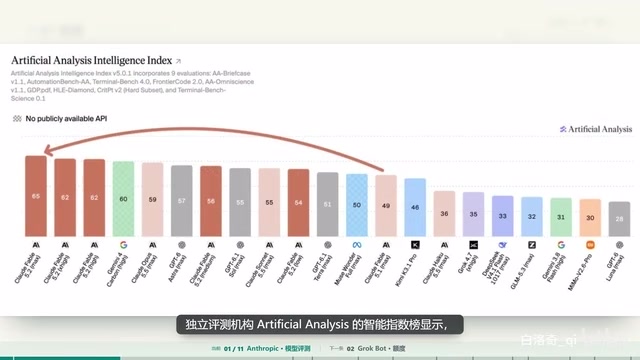
On performance data, Anthropic's own testing shows that Fable 5.2 scores 49.1% on the highest thinking tier of Frontier Code 2.0, up from 32.4% for the previous generation; its Frontier Suite VR score is 69.9%. Mythos 5.2 reaches 89.6% on vulnerability reproduction tests. The independent evaluator Artificial Analytics' intelligence index leaderboard shows Fable 5.2 scoring 65 at the highest thinking tier, ranking first, with 62 at both the high and ultra-high tiers, while Gemini for Carbon scores 60 at the high tier. The third-party Arena web development leaderboard gives Fable 5.2 a score of 1832, currently first; Epoch AI's ECI index is 174. Anthropic's system card separately gives Mythos 5.2 an internal AECI score of 177.12—the two indices are not directly comparable.
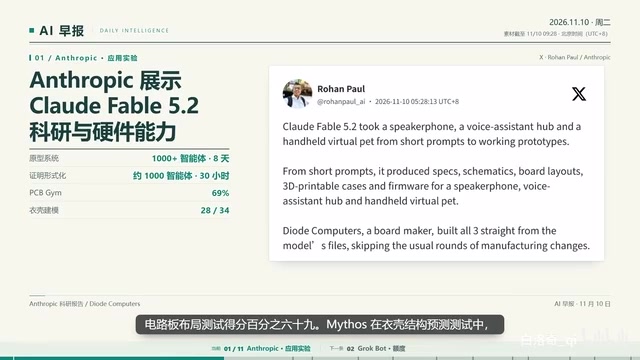
In official demos, more than a thousand agents spent 8 days building a bootable circular operating system; another team of about a thousand agents spent 30 hours formalizing an existing proof of Fermat's Last Theorem into computer-checkable code. The model also participated in two black hole physics calculations, and partner manufacturers used model designs to produce conference speakers, voice assistants, and electronic pets, with circuit board layout tests scoring 69%. According to screenshot information, Mythos accurately modeled 28 of 34 samples in a structure prediction test. All of these are experimental results reported by the company and its partners.
On ecosystem integration, Fable 5.2 is already available in Google Cloud's Nelse Research and can also be used in Hermes Agent. Cloud Pro and Team Standard users can use Fable for a limited time until 3:59 PM Beijing time on November 17, taking up at most half of their weekly quota. Users who meet the original payment timing conditions also get one quota reset, and Max Ultra and Team Premium users receive 1 to 3 resets depending on subscription length.
MoE (Mixture of Experts) architecture is the key to understanding Luncat 2.5's description of "1.6 trillion total parameters, with only about 48 billion activated per token." A traditional dense model calls all parameters on every inference, whereas MoE splits the feed-forward layers into multiple "expert" subnetworks, with a routing gate selecting only a few experts per token to participate in computation. Thus the total parameter count determines the model's capacity ceiling, while the activated parameter count determines the compute cost of a single inference. This is why a 1.6-trillion-parameter model can still serve efficiently: the actual computation is close to that of a dense model in the tens-of-billions parameter range. The cost of MoE is high memory usage (all experts must be resident or swapped in), potentially unbalanced routing load, and greater difficulty in fine-tuning and quantization.
Safety-reviewed access is commonly known in the industry as "tiered access" or "trusted access": the same base model offers different capability tiers externally, and when dual-use capabilities such as cyberattacks or biological experiment design are involved, users are required to submit organizational qualifications, use scenarios, and compliance commitments, with weights or interfaces opened only after review. Anthropic's Responsible Scaling Policy is a representative framework of this approach—first define capability thresholds, then upgrade protections when the model approaches them. Unlike simple content filtering, the object of control is "who can use it," not "what can be said."
Quota Resets and the Open-Source Wave: Fighting for Users Under Competitive Pressure
Grokbot's official account announced that it has reset the weekly usage quota for all Grokbot users, and reposters said the resets are being rolled out gradually. This move echoes Anthropic's quota reset—leading vendors are using more generous usage policies to retain users.
On the open-source side, Meituan has open-sourced the model weights of Luncat 2.5 under the MIT license. This native multimodal model was released on November 2, aimed at long-horizon agent tasks, with 1.6 trillion total parameters, about 48 billion activated per token, and support for a 1-million-token context. The permissiveness of the MIT license means an extremely low barrier to commercial use, which puts direct pressure on closed-source vendors that rely on API billing.
The small-parameter direction also saw new moves. Thinking Machines' Inkling2Small is temporarily free on OpenRouter, combining vision and agentic coding capabilities, and can be used in tools such as Cloud Code, Codex, and Hermes Agent. Command Code has integrated the lightweight model Muse Ember across all plans, supporting a 1-million-token context. One user shared that when using the design feature to generate the same set of 3D scenes, Muse Ember completed it in one attempt, while GPT-6 Luna took two prompts—but this is just one user's experience with a limited sample and should not be over-interpreted.
The MIT license is one of the most permissive mainstream open-source licenses: it allows free use, modification, and redistribution, including closed-source commercial use, requiring only that copyright and license notices be retained, with no warranty. By comparison, Apache 2.0 adds a patent grant clause, and the GPL family requires derivative works to be open-sourced as well. For model weights, adopting MIT means companies can deploy them privately, distill them, or embed them in commercial products without disclosing changes, which directly weakens the lock-in effect of closed-source APIs. Note, however, that the license covers only weights and code; training data provenance, responsibility for model outputs, and compliance requirements in some jurisdictions may still impose additional constraints.
"Small-parameter models" usually refer to models with parameter counts within the billions that can run on a single GPU or consumer-grade device. Their value lies not in comprehensively surpassing large models in general capability, but in low latency, low cost, and on-device deployability. Such models often improve practicality through distillation from large models and targeted fine-tuning for code and agent tool calling. A small parameter count also means recall and multi-step reasoning are more likely to degrade under long contexts, so the 1-million-token context advertised by vendors still needs to be evaluated by task type for its effective length.
Security and Compliance: Undercurrents in the Industry
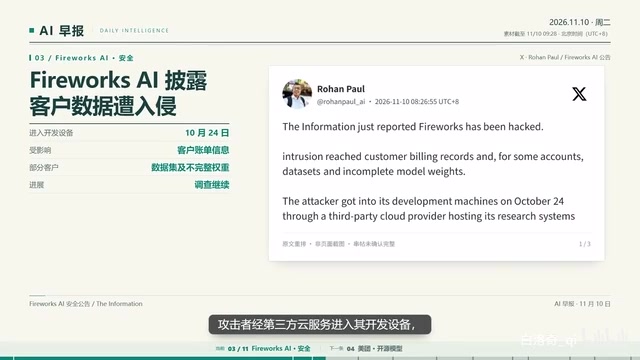
Fireworks AI has disclosed new security investigation findings. On October 24, attackers entered its development devices via a third-party cloud service, affecting customer billing information; some customers' datasets and incomplete model weights were also accessed. The company says it has notified affected customers, has found no further successful attacker access to the platform used by customers since October 25, and that the investigation is ongoing.
On the compliance front, according to Reuters and Euronews, a draft digital fairness act from the European Commission would ban ten types of manipulative interface designs, including false scarcity prompts, pre-selected add-ons, and subscriptions that are hard to cancel. Violating companies could face fines of up to 6% of global annual turnover; the draft still needs to be proposed and go through the EU legislative process and has not yet taken effect. This direction has direct implications for the interface design of AI subscription products.
OpenAI, meanwhile, has released a research task control system to track model tasks in research infrastructure and to stop or pause them when safety issues arise. The company says it takes at most 35 seconds from deciding to intervene to stopping model output, and the system has been deployed in research infrastructure. Whether a 35-second response window is sufficient in high-speed inference scenarios remains to be seen.
The risk of "incomplete model weight" leaks is often underestimated. Complete weights can be directly deployed or fine-tuned, while incomplete weights (such as some layers, some experts, or unmerged adapters) can still be used in model-stealing attacks: attackers query the victim's API outputs and then use the leaked fragments as initialization or priors, significantly reducing the number of queries and cost needed to replicate the model. If the leak includes training data fragments or embedding layers, sensitive information about the training corpus may also be inferred. This also explains why, in such incidents, vendors must go beyond notifying customers to assess whether to rotate keys, audit access logs, and strengthen boundary isolation for third-party cloud services.
Ecosystem Expansion: Cloud Marketplaces and Inference Optimization
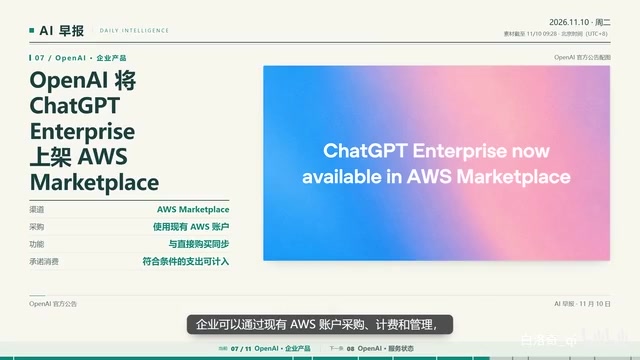
OpenAI has announced that ChatGPT Enterprise is now available on AWS Marketplace. Enterprises can procure, bill, and manage models and features through their existing AWS accounts in the same way as buying directly, and new features will roll out in sync. Eligible spending can also count toward AWS Marketplace committed spend.
On inference performance, Together AI has published inference tests for the Together Compiler. Compared with InferenceX's best configuration on NVIDIA B200 and B300, Kimi K3 achieves up to 2.7x higher throughput at the same user-perceived speed. This is the company's own test result, measuring throughput rather than per-user generation speed. OpenAI's status page also showed that an elevated API error rate event has been resolved and affected services have returned to normal.
From dual-model launches to open-source giants, from security incidents to compliance drafts, the common theme of this round of AI news is that the capability race is still accelerating, but safety, compliance, and cost control are becoming additional questions vendors must answer at the same time.
One-line Summary
Anthropic's dual models split onto different safety tracks as open-source giants and compliance pressure accelerate in tandem.
Paragraph Summary
Anthropic has released Claude Fable 5.2 and Mythos 5.2, which share the same underlying architecture. The former is aimed at paid and API users with built-in cyber and biosecurity protections, while the latter is open only to organizations that pass safety review. Both support a 1-million-token context, and API prices are 20% lower than the previous generation. Fable 5.2 ranks first on the Artificial Analytics intelligence index's highest thinking tier with 65 points and scores 1832 on the Arena web development leaderboard. On the industry side, Grokbot reset its weekly quota, Meituan open-sourced the 1.6-trillion-parameter Luncat 2.5 under the MIT license, and Thinking Machines and Command Code launched small-parameter models. On security and compliance, Fireworks AI disclosed that a third-party intrusion led to access to customer billing information and some datasets and incomplete weights; the EU's draft digital fairness act would ban ten types of manipulative designs and set fines of up to 6% of turnover; and OpenAI's research task control system can stop model output within at most 35 seconds.
Related articles

Gemini 4 Neon Leak: A Potential Strong Contender Against Opus 5.5
A Hacker News thread suggests Gemini 4 Neon looks like an Opus 5.5 competitor. This article unpacks the product positioning behind this community signal, shifts in the top-model competitive landscape, and what it means for developers' model selection strategy.

Claude Fable 5.2's Self-Authored Short Film 'Fable' Sparks Discussion
A short film 'Fable,' credited to Claude Fable 5.2 for script, visuals, and directing, appears on Hacker News. This article analyzes the significance of full-pipeline AI creation, community reactions, and what it means for content creators.

Anthropic IPO Pricing: A Signal of AI Giants Going Public
Anthropic's IPO pricing draws attention. This article analyzes its potential impact on AI industry valuation, commercialization paths, and the competitive landscape, and highlights public-market expectations and challenges for AI companies.