Fable 5 Sparks Debate: Is AI Reasoning Actually Getting Worse?

Fable 5 sparks Hacker News debate on whether AI reasoning quality measurably dropped in August.
A tweet about the "Fable 5" project went viral on Hacker News, centering on an observable decline in large language model reasoning quality in August. The article examines three main causes: providers compressing chain-of-thought or routing to lighter models to cut compute costs; evaluation noise producing non-essential metric swings; and the "alignment tax" from safety fine-tuning. The deeper takeaway is a structural gap — as critical workflows increasingly depend on closed-source models, users have less tolerance for black-box performance swings, yet sustainable third-party monitoring mechanisms are sorely lacking.
A Tweet That Set Off a Community Conversation
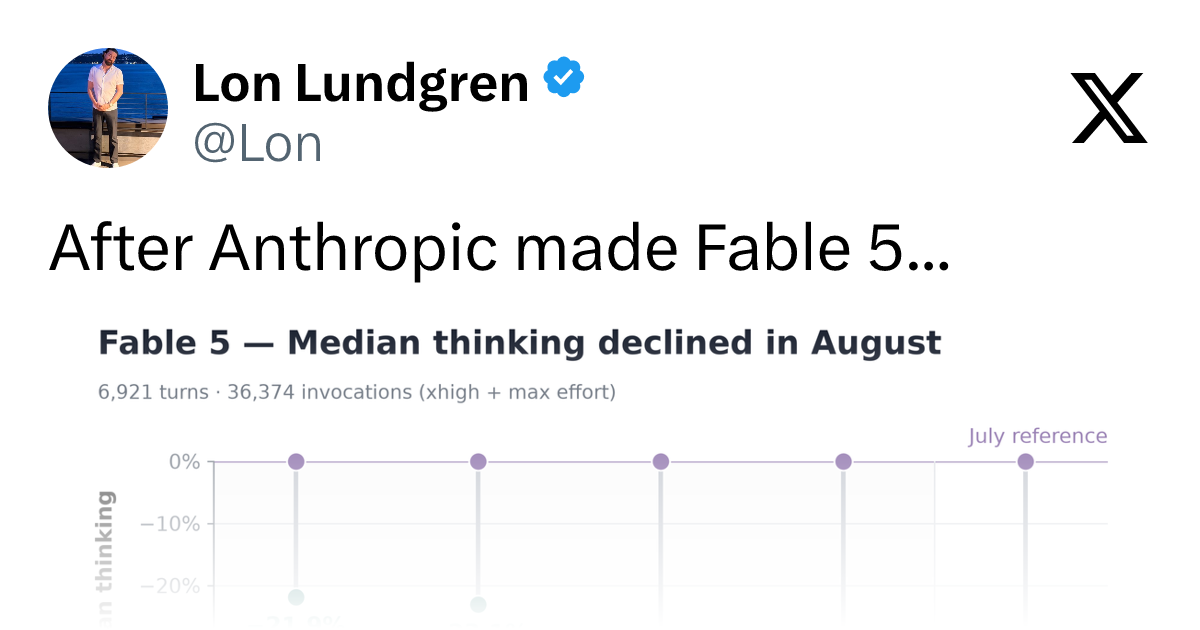
A discussion around "Fable 5" recently went viral on Hacker News, racking up 234 upvotes and over 150 comments. It all started with a tweet making a pointed observation: "Median thinking declined in August" — suggesting that the median quality of AI reasoning had measurably dropped during that month.
The topic resonated widely because it touches on a sensitive and consequential question in the AI world: do large language models actually fluctuate in performance over time, and can they genuinely "regress"?
What Does "Declining Reasoning" Actually Mean?
When people talk about a drop in median thinking, they're typically referring to an observable decline in the average quality with which a model handles complex reasoning tasks — as measured by some evaluation framework or real-world usage scenario. For users who rely on AI for coding, analysis, or Q&A, these fluctuations aren't just academic curiosities; they have a direct impact on productivity.
There's a long-standing gut feeling in the community that popular models sometimes seem to "get dumber" after version updates or behind-the-scenes changes. The Fable 5 discussion attempts to turn these scattered user impressions into a trackable, quantifiable trend.
It's worth noting that based on the available material — just a title and a discussion link — it's unclear whether "Fable 5" refers to a specific benchmark, a product, or a monitoring project. From the name and context, though, it most likely refers to an evaluation framework designed to continuously track model reasoning performance.
Why Do Model Capabilities Fluctuate?
Several explanations are commonly cited in the industry when trying to account for this kind of variation.
Backend Optimization and Cost Trade-offs
When serving large numbers of users, model providers constantly have to balance response speed, compute costs, and output quality. When the chain-of-thought is compressed, sampling parameters are adjusted, or routing strategies favor lighter model variants, performance on complex tasks can quietly decline.
Chain-of-thought (CoT) is a technique — introduced by Google researchers in 2022 — that prompts models to explicitly lay out intermediate reasoning steps before arriving at a final answer. It significantly improves performance on math, logic, and multi-step reasoning tasks. However, full CoT reasoning requires generating a large number of tokens, which is computationally expensive. Under high-concurrency conditions, providers may reduce allowed reasoning steps, raise the temperature parameter, or route requests to smaller "distilled" model variants to cut costs. These adjustments typically go unannounced, and users can only detect them indirectly through changes in output quality. This is why "the model got dumber" complaints tend to cluster around peak usage periods — like after a wave of new users joins.
The Limits of Evaluation Methodology
Another possibility is that the observed "decline" is partly noise in the evaluation itself. Minor variations in sample size, question distribution, or scoring criteria can cause median metrics to shift in ways that don't reflect any real change in underlying model capability. A single month of declining numbers doesn't necessarily mean the model has actually regressed.
Side Effects of Data and Alignment
Ongoing safety alignment, content filtering, and fine-tuning can sometimes come at the cost of reasoning flexibility. This so-called "alignment tax" may manifest as a drop in reasoning quality on certain types of tasks.
The "Alignment Tax" refers to the performance degradation that can occur in certain capability dimensions after a model undergoes alignment training — such as reinforcement learning from human feedback (RLHF) or safety fine-tuning. The goal of alignment training is to make model outputs safer and more aligned with human preferences, but this inherently imposes constraints on the model's existing capability distribution. Research suggests that over-alignment can make models overly conservative on tasks requiring creative reasoning, counterfactual thinking, or edge-case analysis. OpenAI, Anthropic, and others have acknowledged this trade-off in technical reports, though the specific magnitude and scope of these losses are rarely disclosed — which makes external evaluation even harder.
The Value of This Community Discussion
The real significance of this debate may not lie in the specific question of whether things actually declined in August. Rather, it reflects a growing and important demand: AI models need sustainable, reproducible, third-party monitoring.
As more critical workflows come to depend on closed-source models, users are becoming increasingly sensitive to unexplained performance swings from these black boxes. Projects like Fable 5 — whatever their final conclusions — are pushing for a more transparent accountability mechanism, one where changes in model capability are documented and traceable, rather than left as a cacophony of subjective impressions.
The absence of third-party model monitoring is a structural gap in today's AI ecosystem. Unlike traditional software, large language models have fuzzy version boundaries — providers can swap out underlying weights, adjust inference parameters, or change routing strategies without bumping a version number. Some independent evaluation projects are trying to fill this void, including the LMSYS Chatbot Arena (which continuously runs standardized benchmarks), the HumanEval suite (focused on tracking code generation capability), and academic efforts like BIG-Bench. But these projects all face common challenges: high maintenance costs, limited coverage of real-world scenarios, and the risk that model providers deliberately optimize for leaderboard performance. If Fable 5 is indeed a tracking framework of this kind, its value lies in providing continuous longitudinal monitoring — not just a single cross-sectional comparison.
Staying Grounded Amid the "Getting Dumber" Debate
For everyday users, these discussions call for a measured response. A single metric from a single month is not enough to draw firm conclusions, and subjective impressions of model quality are easily distorted by factors like task complexity and prompt quality.
A more practical approach: for critical tasks, build your own small-scale benchmark. Periodically test the models you rely on with a fixed set of questions to check for stability — rather than relying entirely on community rumors or any single leaderboard.
As AI becomes more deeply embedded in production environments, tracking model reliability will be an enduring challenge. The conversation sparked by Fable 5 is a snapshot of exactly that trend.
Related articles

Building Your Own OpenAI-Compatible Gateway to 6 Chinese LLM Providers: Five Pitfalls Beyond the Happy Path
A developer built the He-API gateway to unify DeepSeek, Kimi, Qwen, Doubao, ERNIE, and GLM behind one OpenAI-compatible endpoint. Five real pitfalls: streaming compatibility, token billing precision, hot reload, two-dimensional rate limiting, and base_url config.

In the AI Era, a Developer's Core Value Is No Longer Writing Code
AI coding assistants make code generation easier than ever, but a developer's core value is shifting from writing code to understanding requirements and making the right trade-offs. This article explores how developers can stay irreplaceable in the AI era.

Hands-On with PhotoCraft: An Open-Source Photo Editor You Can Actually Tinker With
Hands-on review of PhotoCraft, an open-source photo editor with 58K GitHub stars: self-hosting, local inference, zero API costs, plus installation steps and use cases.