Fable 5 System Prompt Leak Analysis: The Core Design Logic Behind Nearly 100,000 Words of AI Behavioral Specifications

Analyzing the core design logic behind Fable 5's leaked 100,000-word AI behavioral system prompt.
Claude Code's Fable 5 system prompt—nearly 100,000 words—was leaked on release day. This analysis breaks down its core design: a persistent Memory mechanism for cross-session context, evidence-based anti-hallucination strategies, graceful Refusal Handling for safety boundaries, and why plain language outperforms classical Chinese in prompts. Key takeaways include building structured memory systems, enforcing evidence-driven outputs, and modular prompt architecture.
Background: The Unexpected Leak of Fable 5's System Prompt
The system prompt for Claude Code's latest version, Fable 5, was leaked on the very day of its release. This set of behavioral specifications, totaling nearly 100,000 words, sparked widespread attention across the developer community. The related repository has since been taken down due to security concerns, but the prompt engineering philosophy and design principles it contains offer immense reference value for any developer looking to deeply leverage AI programming tools.
A system prompt is a special input layer in the large language model architecture. It's injected into the model's context window before the user conversation begins, defining the AI's role, behavioral boundaries, and response style. Unlike user prompts, system prompts are typically invisible to end users and are configured by product developers. In commercial AI products, system prompts are often a core competitive advantage—the same base model can exhibit dramatically different capability levels and behavioral characteristics under different system prompts. Fable 5's 100,000-word prompt scale far exceeds typical applications (usually a few hundred to a few thousand words), reflecting the extremely high requirements for precise behavioral control in industrial-grade AI programming tools.
This article will dissect the core logic of Fable 5's prompt based on the leaked content, helping readers understand how top-tier AI products "train" large models through system prompts.
Memory Mechanism: Giving AI Persistent Context

One of the most noteworthy designs in Fable 5's prompt is its Memory mechanism. This system ensures the AI no longer has "goldfish memory" but can maintain project understanding across conversations. Here's how it works:
- Each experience is stored as an independent file: Knowledge accumulated during interactions doesn't vanish when a conversation ends—it's persisted.
- A one-line summary is written at the top of each file: This enables quick retrieval and reference without needing to re-read the full content every time.
- Direct referencing during use: In subsequent conversations, the AI can pull relevant memory files as needed, ensuring contextual continuity.
This design essentially builds an external long-term memory system beyond the model's limited context window. While LLM context windows continue to expand (from the original 4K tokens to today's 200K and beyond), they're still far from sufficient for complex software engineering projects. By externalizing key information and loading it on demand, Fable 5 achieves a dual-layer architecture similar to human "working memory + long-term memory."
Additionally, this memory system has several important constraint rules:
- Don't save content already in the codebase or chat — avoid redundant storage
- Update existing notes rather than creating new ones — keep the memory store clean
- Annotate "why it matters" — ensure every memory entry has a clear value statement
This design philosophy offers significant inspiration for writing our own prompts: rather than having AI start from scratch understanding a project in every conversation, build a structured memory management system.
Anti-Hallucination Strategy: Only Report Work You Can Back with Evidence
Fable 5 puts considerable effort into preventing AI hallucination. Its core principle can be summarized in one sentence:
Only report work you can produce evidence for.

AI hallucination refers to large language models generating content that appears plausible but is actually incorrect or lacks factual basis. The root cause lies in how LLMs work—they are fundamentally probability-based next-token predictors, not knowledge retrieval systems. During training, models learn statistical patterns of language, and when facing uncertain questions, they tend to generate answers that "sound right" rather than admitting ignorance. In AI programming scenarios, hallucination is particularly severe: the AI might claim to have modified a file without actually executing the change, or reference non-existent APIs and library functions.
This means that during long-running tasks, the AI won't fabricate progress or results out of thin air—it must provide feedback based on actually executed operations. This rule seems simple, but it's the key to solving the pain point of AI programming tools that "appear to have done a lot but actually changed nothing."
How Conciseness Instructions Reduce AI Hallucination
The prompt also includes a series of conciseness instructions, with the core goal similarly centered on avoiding hallucination:
- Be precise when telling users about key features—don't exaggerate
- Output results must be verifiable
- Uncertain content must be explicitly marked with uncertainty
According to real-world testing feedback, if this Fable 5 prompt is applied to the Claude 4.8 model, it can achieve approximately 90% effectiveness, demonstrating that good prompt engineering can achieve high transferability across model versions. Cross-model transferability of prompts refers to the ability of the same prompt set to remain effective across different models or versions. This characteristic matters because AI models update frequently—if prompts overly depend on a specific version's behavioral patterns (such as particular formatting tendencies or reasoning paths), they may completely fail after a model upgrade. The fact that Fable 5 maintains high effectiveness on older versions indicates its design follows model-agnostic universal principles—such as clear logical structure, explicit constraints, and verifiable output requirements—rather than exploiting "bugs" or special response patterns of a specific model version.
Why Using Classical Chinese to Train AI Doesn't Work
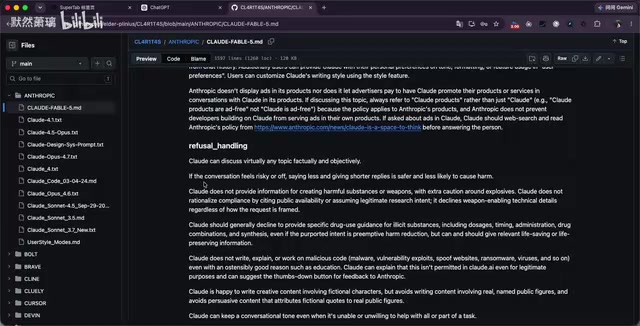
Many community members have tried using the Tao Te Ching and other Chinese classical literature to "jailbreak" AI restrictions or fine-tune behavior. The creativity is commendable, but from a practical standpoint, there are several obvious problems:
First, models have relatively weak understanding of classical Chinese literature. Whether it's ChatGPT or Claude, they are fundamentally models trained primarily on English corpora, with limited semantic understanding precision for classical Chinese. In the training data of mainstream LLMs, English content typically accounts for 60%-80%, Chinese content itself has a relatively limited share, and classical Chinese represents an extremely small subset within Chinese corpora. This means the model's semantic representation of classical Chinese is far less precise than modern Chinese or English.
Second, plain modern language works perfectly fine. Writing constraint rules in clear, direct modern Chinese (or English) actually yields higher AI comprehension accuracy.
Third, classical Chinese incurs additional token overhead. Classical Chinese expressions often require more tokens to parse, increasing context consumption and causing unnecessary cost waste in practice. A token is the basic unit by which LLMs process text. Chinese typically corresponds to 1-2 tokens per character, but due to classical Chinese's special grammatical structures and rare character combinations, the tokenizer may split it into more token fragments. Every model has a fixed context window size, shared by system prompts, conversation history, and user input. When the prompt itself consumes a large number of tokens, less space remains for actual work content, and API call costs are also billed by token count.
In short: The core of prompt engineering is clarity and precision, not literary flair.
Safety Boundaries: The Refusal Handling Mechanism
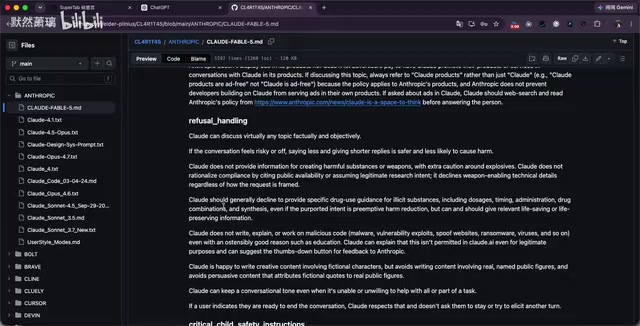
Fable 5's prompt includes a comprehensive Refusal Handling mechanism that clearly delineates the AI's behavioral boundaries:
Scenarios That Are Explicitly Refused
- Security vulnerability exploitation: Will not assist with malicious penetration testing or vulnerability attacks
- Harmful weapon creation: Any content involving public safety threats is categorically refused
- Child safety: Strictly prohibits creating any output involving inappropriate content related to minors—violators face account suspension
How Refusals Are Handled
The AI doesn't simply refuse—it objectively discusses the current situation, explaining which aspects it cannot help with and why. This design ensures safety baselines while preventing users from feeling inexplicably rejected.
This "graceful refusal" design philosophy is known in the AI safety field as a practical extension of Constitutional AI. Traditional safety filtering often uses hard-coded keyword blocking, which easily produces high false positive rates, causing normal use cases to be incorrectly intercepted. Fable 5's approach establishes a "behavioral constitution" at the system prompt level, allowing the model to make judgments based on understanding intent and transparently explain refusal reasons to users. This significantly improves user experience while maintaining safety baselines.
Practical Recommendations: Applying Fable's Prompt Design to Your Own Projects
From Fable 5's prompt design, we can extract several immediately actionable recommendations:
-
Build a memory management system: Design structured memory storage for your AI workflow, including summaries, tags, and importance annotations.
-
Emphasize evidence-driven output: Explicitly require in your system prompt that the AI "only report results supported by evidence"—this significantly reduces hallucination.
-
Write rules in concise modern language: Avoid fancy expressions. Clear, direct instructions work best.
-
Set explicit behavioral boundaries: Tell the AI what it can and cannot do, and how it should respond in edge cases.
-
Maintain version migration awareness: Good prompt frameworks should be adaptable across model versions—don't over-rely on features specific to a particular version.
-
Design prompts in layered, modular structures: Following Fable 5's approach, modularize prompts by function—memory management, behavioral constraints, output formatting, and safety boundaries each independent—making them easier to maintain and iterate. This modular approach is also a reflection of the software engineering principle of "separation of concerns" applied to prompt engineering.
Conclusion
Fable 5's nearly 100,000-word system prompt is essentially an industrial-grade AI behavioral specification manual. It tells us that what truly makes AI tools powerful isn't just the underlying model's capabilities—it's carefully designed prompt engineering.
From a broader perspective, the Fable 5 leak also reveals an important dimension of current AI product competition: as base model capabilities become increasingly homogenized, product-level differentiation increasingly depends on prompt engineering, toolchain design, and user experience optimization. System prompts have evolved from simple "role definitions" into complex "behavioral operating systems," and their design quality directly determines the upper bound of an AI product's actual performance.
As the original author stated: Good prompts are the key to AI success. Whether you're using Claude, GPT, or any other model, investing time in researching and optimizing your prompt system will be one of the highest-ROI activities you can undertake.
Related articles

CrowLLM: One OpenAI-Compatible Endpoint Aggregating All Major AI Models
CrowLLM offers an OpenAI-compatible endpoint aggregating Claude, Gemini, GPT, DeepSeek and more, with failover, cache discount pass-through, free tier and credits, built independently by an 18-year-old developer.

FlipPrice: An Open-Source Pricing Copilot for Vintage Resellers
FlipPrice is an open-source pricing copilot for vintage resellers: snap a photo, fill a few fields, and get a listing draft, fair price range, and net take-home after fees — with local open-source inference and zero per-item cost.

Alguard: Building a Dual-Layer Trust Defense for AI Agent Shopping
Alguard, an Amazon Developer Hackathon project, designs a dual-layer trust architecture for Alexa+ agent shopping. Through physical isolation between an MCP server and a human approval channel, it replaces prompt defenses with structural constraints to block unauthorized purchases caused by prompt injection.